Sarva Pitru Amavasya 2026 is one of the most significant days of Pitru Paksha, a traditional period dedicated to remembering and honouring departed ancestors. Also known as Mahalaya Amavasya, Pitru Amavasya, Pitru Visarjani Amavasya and Ashwin Amavasya, it marks the conclusion of Pitru Paksha.
In 2026, Sarva Pitru Amavasya will be observed on Saturday, October 10, 2026.
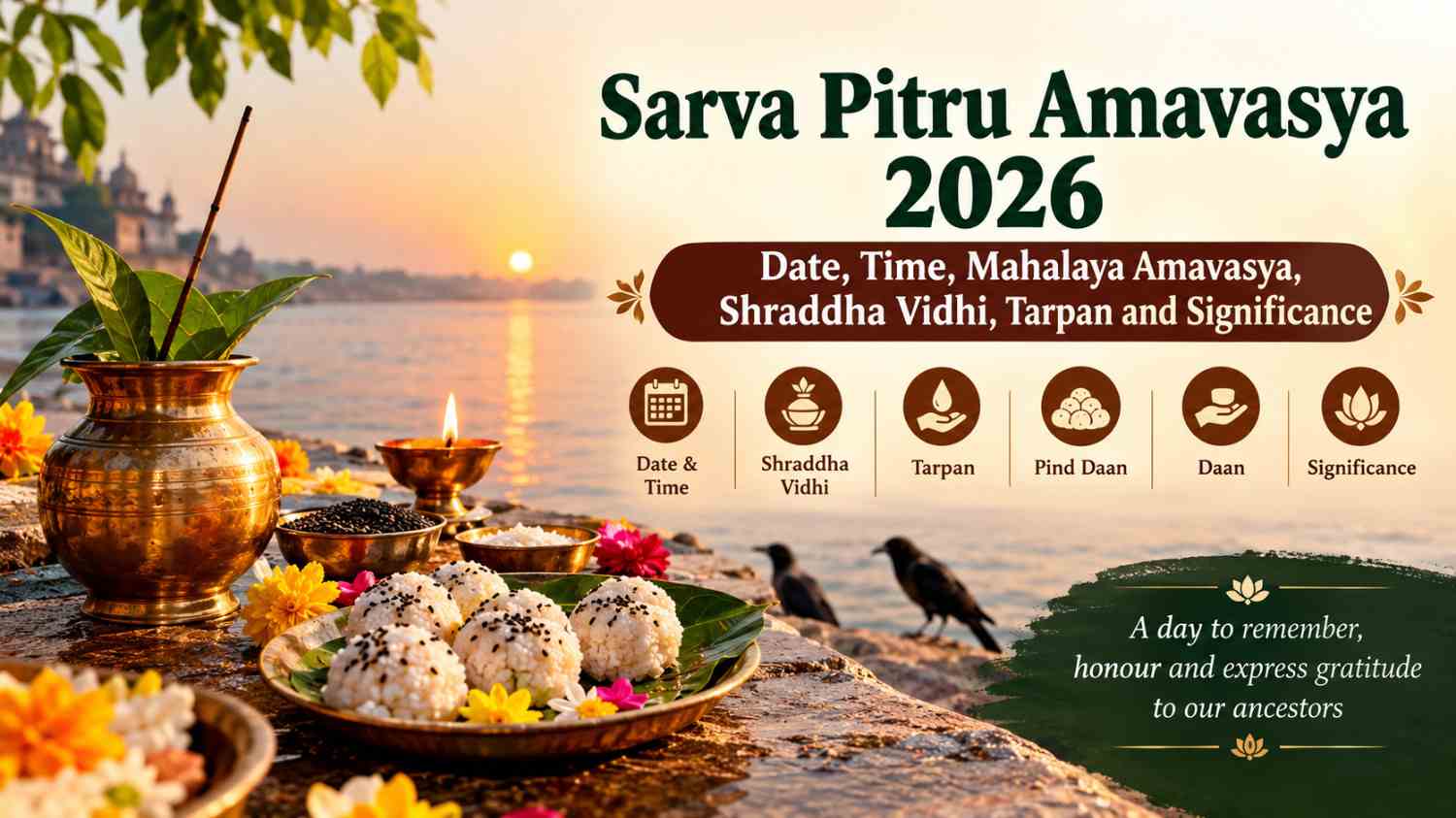
The Amavasya Tithi will begin at approximately 9:35 PM on October 9, 2026, and end at approximately 9:19 PM on October 10, 2026. Since the Tithi is present during the daytime on October 10, the main Sarva Pitru Amavasya observance will be performed on October 10.
This Amavasya is especially important for remembering ancestors whose exact death Tithi is unknown, whose Shraddh could not be performed on the appropriate day, or whose family wishes to offer collective prayers for all departed ancestors.
The day is traditionally observed through Shraddh, Pitru Tarpan, Pind Daan, food offerings, charity and prayers.
Sarva Pitru Amavasya 2026 Date and Time
Here are the important details for Sarva Pitru Amavasya 2026:
| Details | Date / Time |
|---|---|
| Sarva Pitru Amavasya 2026 | Saturday, October 10, 2026 |
| Amavasya Tithi Begins | October 9, 2026, around 9:35 PM |
| Amavasya Tithi Ends | October 10, 2026, around 9:19 PM |
| Pitru Paksha Ends | October 10, 2026 |
| Other Names | Mahalaya Amavasya, Pitru Amavasya, Ashwin Amavasya |
| Main Observances | Shraddh, Tarpan, Pind Daan, Daan and Ancestor Remembrance |
The exact Shraddh Muhurat can differ depending on the local sunrise and Panchang calculation. Therefore, the local Panchang should be followed for minute-level ritual timings.
When Is Sarva Pitru Amavasya in 2026?
Sarva Pitru Amavasya will be observed on Saturday, October 10, 2026.
The Amavasya Tithi begins on the night of October 9 and continues until the night of October 10. Because the Tithi is present on October 10 during the relevant daytime period, that day is observed for Sarva Pitru Amavasya Shraddh and related ancestral rituals.
This is why people may sometimes see October 9 and October 10 mentioned when searching for the date. The distinction comes from the start and end of the lunar Tithi, while the actual observance is determined according to the applicable Hindu calendar rules.
What Is Sarva Pitru Amavasya?
Sarva Pitru Amavasya is the final Amavasya of Pitru Paksha.
The Sanskrit expression Sarva Pitru refers broadly to all ancestors, while Amavasya refers to the new moon Tithi.
During Pitru Paksha, Shraddh is normally performed according to the lunar Tithi associated with the death of an ancestor. However, families may not always know the exact Tithi of every departed family member.
Sarva Pitru Amavasya therefore has a special place in tradition because it provides an occasion to remember ancestors collectively.
It may be observed for:
- Ancestors whose exact death Tithi is unknown
- Ancestors whose Shraddh was missed
- Departed relatives who could not be honoured earlier
- Multiple ancestors from the family lineage
- Ancestors whose names or dates are no longer clearly remembered
For this reason, Sarva Pitru Amavasya is often considered one of the most important days of the entire Pitru Paksha period.
Why Is Mahalaya Amavasya Important?
Mahalaya Amavasya represents the closing point of Pitru Paksha.
According to Hindu tradition, Pitru Paksha is a period for expressing gratitude and respect toward one’s ancestors. Families perform rituals and charitable activities with the belief that remembering one’s lineage is an important spiritual responsibility.
The importance of Mahalaya Amavasya is therefore not limited to a single ritual.
It represents:
- Remembrance of ancestors
- Gratitude toward previous generations
- Family traditions
- Spiritual reflection
- Charity and service
- Respect for departed family members
- Completion of the Pitru Paksha observance
For many families, the day also carries an emotional meaning. It creates an opportunity to remember parents, grandparents and earlier generations and reflect on the family values they passed down.
Sarva Pitru Amavasya 2026 Shraddh Vidhi
The exact Shraddh procedure can differ according to family tradition, region and community. However, a commonly followed structure includes the following steps.
1. Take a Bath and Maintain Cleanliness
Begin the day by taking a bath and wearing clean clothes.
The area where the ancestral ritual will be performed should also be cleaned properly.
The traditional approach emphasizes cleanliness, discipline and a peaceful state of mind.
2. Remember Your Ancestors
Before beginning the ritual, remember the ancestors for whom the Shraddh is being performed.
If their names and family lineage are known, they may be mentioned according to the family tradition.
If the exact identity or Tithi is unknown, a collective prayer for departed ancestors can be made.
3. Perform Pitru Tarpan
Pitru Tarpan is one of the central practices associated with Pitru Paksha.
Water is traditionally offered with appropriate ritual materials such as black sesame while remembering the ancestors.
The exact direction, mantra, hand position and procedure can differ according to tradition, so formal Tarpan should ideally follow the method used by the family.
4. Prepare Shraddh Food
Traditional Shraddh food is generally simple and vegetarian.
Depending on the household tradition, preparations may include:
- Rice
- Dal
- Seasonal vegetables
- Roti
- Puri
- Kheer
- Fruits
- Milk-based preparations
- Traditional sweets
Food should be freshly prepared and handled respectfully.
5. Perform Pind Daan
Where Pind Daan is part of the family tradition, rice-based Pind offerings may be prepared and offered according to the prescribed method.
The ritual should be performed according to the appropriate family or religious tradition rather than combining procedures from unrelated sources.
6. Offer Food
Food prepared for Shraddh may traditionally be offered to Brahmins, guests, people in need, cows, crows or others according to family custom.
Different communities follow different practices, so there is no need to assume that every household must follow an identical sequence.
7. Perform Charity
Charity is another important aspect of Pitru Paksha.
Families may donate:
- Food grains
- Rice and pulses
- Clothes
- Fruits
- Meals
- Useful household items
- Educational materials
- Financial assistance
The spirit of charity is traditionally considered more important than displaying the value of the donation.
Sarva Pitru Amavasya Tarpan Vidhi
Pitru Tarpan is traditionally performed as an offering of water in remembrance of departed ancestors.
A simple framework is:
- Take a bath and wear clean clothes.
- Prepare a clean and peaceful place.
- Keep water and the required ritual materials ready.
- Remember the ancestors with devotion.
- Offer water according to the prescribed family method.
- Mention the names of ancestors when known.
- Pray for the peace and well-being of departed ancestors.
- Complete the ritual respectfully.
If you are performing Tarpan for the first time, it is better to follow a known family tradition or seek guidance from a knowledgeable priest.
Sarva Pitru Amavasya Pind Daan
Pind Daan is a traditional ancestral offering associated with Shraddh rituals.
Pind is generally prepared using cooked rice along with other prescribed ingredients. The exact preparation and offering method can vary.
The ritual is traditionally understood as an expression of remembrance and respect toward departed ancestors.
Pind Daan is not necessarily performed in exactly the same way by every Hindu family. Some families perform elaborate Pind Daan rituals, while others focus on Tarpan, food offerings, prayer and charity.
If you are planning a formal Pind Daan ceremony, follow the established procedure of your family or the guidance of a qualified priest.
Sarva Pitru Amavasya Shraddh Muhurat 2026
For ancestral Shraddh, the Aparahna period is traditionally considered particularly important.
The commonly referenced ritual periods include:
- Kutup Muhurat
- Rohina Muhurat
- Aparahna Kaal
Current 2026 calculations show these periods falling around the late morning and afternoon on October 10. Exact minute-level timings differ between Panchang calculations because they depend on local sunrise and geographical location.
Therefore, rather than publishing one universal time for every reader, it is safer to use the local Panchang timing applicable to the place where the Shraddh is being performed.
This is particularly important when the ritual requires an exact Muhurat.
What Food Is Prepared on Sarva Pitru Amavasya?
Food prepared for Shraddh is traditionally kept simple, fresh and sattvic.
Common preparations include:
- Rice
- Dal
- Seasonal vegetables
- Roti
- Puri
- Kheer
- Fruits
- Milk
- Traditional sweets
Many families avoid:
- Meat
- Fish
- Eggs
- Alcohol
- Intoxicants
- Excessively spicy food
Some families also avoid onion and garlic during Shraddh according to their particular tradition.
There is no single menu that applies to every Hindu household. Food practices differ according to community and family customs.
The central idea is to prepare food with cleanliness, simplicity and respect.
What Should You Donate on Sarva Pitru Amavasya?
Daan, or charity, is traditionally associated with Shraddh observances.
You can consider donating practical necessities such as:
- Rice
- Wheat
- Dal
- Fruits
- Clothes
- Blankets
- Food
- Educational supplies
- Household necessities
- Financial assistance
- Meals for people in need
A useful donation can be more meaningful than an expensive donation made only for display.
The purpose of charity is traditionally connected with compassion and service.
What Should You Not Do on Sarva Pitru Amavasya?
Different families follow different rules, but common traditional guidelines include avoiding:
- Alcohol
- Intoxicating substances
- Non-vegetarian food
- Unnecessary arguments
- Disrespect toward elders
- Wasteful behaviour
- Deliberate harm to animals
- Excessive entertainment
- Dishonest behaviour
- Disrespect toward Shraddh food and rituals
Some traditions also recommend avoiding certain purchases, ceremonies or auspicious activities during Pitru Paksha.
Such restrictions are custom-based, so they should not be treated as universal rules for every Hindu family.
What If You Do Not Know Your Ancestor’s Death Tithi?
This is one of the most important questions related to Sarva Pitru Amavasya.
If the exact death Tithi of an ancestor is unknown, the family may traditionally observe their Shraddh on Sarva Pitru Amavasya.
The same applies in traditional practice when the Shraddh of an ancestor was missed or could not be performed on the appropriate Tithi.
This is one reason why the final Amavasya of Pitru Paksha has such broad significance. It provides an occasion to remember ancestors collectively rather than leaving an ancestor unremembered simply because the exact Tithi is unavailable.
Can Shraddh Be Performed for Multiple Ancestors?
Yes.
Sarva Pitru Amavasya is traditionally associated with the remembrance of multiple or all ancestors.
If a family wants to remember several departed relatives together, the appropriate procedure can be followed according to their family tradition.
Where names, Gotra or other lineage information is known, it can be included according to the prescribed ritual.
If information is incomplete, a collective prayer may be made for the departed ancestors of the family.
Can Women Perform Sarva Pitru Amavasya Rituals?
Practices differ among Hindu communities.
In some traditional families, specific Shraddh responsibilities are assigned to particular members of the family. In other traditions, women participate actively in ancestral remembrance and certain offerings.
Therefore, there is no single rule that can accurately describe every Hindu family.
If there is uncertainty about who should perform a formal ritual, the best approach is to follow the family’s established tradition or seek guidance from a knowledgeable priest.
The important point is that ancestral remembrance should not become a source of unnecessary conflict within the family.
Sarva Pitru Amavasya and Pitru Dosha
Sarva Pitru Amavasya is also associated in astrology with remedies for Pitru Dosha.
Traditional astrology may recommend practices such as:
- Pitru Tarpan
- Shraddh
- Pind Daan
- Charity
- Feeding people
- Offering food to animals
- Prayers for ancestors
However, Pitru Dosha is an astrological and religious concept rather than a scientifically established condition.
Therefore, such practices should be understood within their religious or cultural context rather than presented as guaranteed solutions to financial, health, family or personal problems.
Sarva Pitru Amavasya and Mahalaya Amavasya: Are They the Same?
In many Hindu traditions, Sarva Pitru Amavasya and Mahalaya Amavasya refer to the same Amavasya associated with the conclusion of Pitru Paksha.
You may also find the following names:
- Sarva Pitru Amavasya
- Mahalaya Amavasya
- Mahalaya
- Pitru Amavasya
- Ashwin Amavasya
- Pitru Visarjani Amavasya
Regional terminology can vary, but the central significance remains the remembrance and honouring of departed ancestors.
Why Is Sarva Pitru Amavasya Also Called Pitru Visarjani Amavasya?
The final Amavasya is sometimes referred to as Pitru Visarjani Amavasya because it marks the traditional conclusion of the Pitru Paksha period.
The idea of “Visarjan” here refers to the ceremonial conclusion or farewell associated with the ancestral observance.
After the completion of Pitru Paksha, the religious calendar moves toward the festive period associated with Navratri and Devi worship.
This gives Mahalaya Amavasya a transitional significance in the Hindu calendar.
Simple Sarva Pitru Amavasya Puja at Home
Not every family can perform an elaborate Shraddh ceremony.
A simple observance can still be meaningful.
Step 1: Clean Yourself and the Ritual Area
Take a bath and wear clean clothes. Prepare a clean space for prayer and remembrance.
Step 2: Remember Your Ancestors
Sit peacefully and remember your departed parents, grandparents and other ancestors.
Step 3: Perform Tarpan
If you know the traditional method, perform Tarpan using the prescribed materials.
Step 4: Prepare Simple Food
Prepare fresh vegetarian food according to your family tradition.
Step 5: Offer Food or Donate
Offer food according to your household custom and consider donating a meal or useful items to someone in need.
Step 6: Pray
End the observance with a sincere prayer for the peace of departed ancestors.
The purpose of the day is not to create fear. It is traditionally about gratitude, remembrance, responsibility and respect for one’s lineage.
Sarva Pitru Amavasya Do’s and Don’ts
Do’s
- Observe the correct Amavasya Tithi.
- Follow the appropriate local Shraddh Muhurat.
- Keep the ritual area clean.
- Remember ancestors respectfully.
- Perform Tarpan according to family tradition.
- Prepare simple vegetarian food.
- Give charity according to your ability.
- Feed people in need.
- Respect elders.
- Maintain a peaceful atmosphere.
Don’ts
- Avoid alcohol and intoxicants.
- Avoid non-vegetarian food if your family follows traditional Pitru Paksha restrictions.
- Avoid unnecessary arguments.
- Do not disrespect Shraddh food.
- Do not perform unfamiliar rituals without understanding their procedure.
- Do not turn religious observance into a public display.
- Do not treat astrological remedies as scientifically guaranteed solutions.
Sarva Pitru Amavasya 2026 and Navratri
Sarva Pitru Amavasya has an important place in the Hindu calendar because it marks the conclusion of Pitru Paksha before the beginning of the festive Devi worship period.
After the ancestral fortnight concludes, the calendar moves toward Sharad Navratri and the worship of Goddess Durga.
Thus, Mahalaya Amavasya is traditionally viewed as a transition:
Pitru Paksha → Sarva Pitru Amavasya → Navratri
The exact beginning of Navratri-related observances is determined by the following lunar Tithi and the applicable Panchang.
Sarva Pitru Amavasya Mantra
Families may recite traditional Pitru mantras according to their ritual practice.
One commonly used form of ancestral invocation is:
ॐ पितृभ्यः स्वधायिभ्यः स्वधा नमः।
ॐ पितामहेभ्यः स्वधायिभ्यः स्वधा नमः।
ॐ प्रपितामहेभ्यः स्वधायिभ्यः स्वधा नमः।
The pronunciation, sequence and number of repetitions can vary according to tradition.
If you are unfamiliar with Sanskrit mantras, a sincere prayer remembering your ancestors can also form part of a personal observance.
Frequently Asked Questions
When is Sarva Pitru Amavasya in 2026?
Sarva Pitru Amavasya will be observed on Saturday, October 10, 2026.
When does Sarva Pitru Amavasya Tithi start?
The Amavasya Tithi begins at approximately 9:35 PM on October 9, 2026.
When does Sarva Pitru Amavasya Tithi end?
The Amavasya Tithi ends at approximately 9:19 PM on October 10, 2026.
Is Sarva Pitru Amavasya the last day of Pitru Paksha?
Yes. It is traditionally observed as the final day of Pitru Paksha.
What is another name for Sarva Pitru Amavasya?
It is also known as Mahalaya Amavasya, Mahalaya, Pitru Amavasya, Ashwin Amavasya and Pitru Visarjani Amavasya.
What should I do if I don’t know my ancestor’s death date?
If the exact death Tithi is unknown, Sarva Pitru Amavasya is traditionally considered an appropriate day to remember and perform Shraddh for such ancestors.
Can I perform Shraddh for more than one ancestor?
Yes. The day is traditionally associated with collective remembrance of ancestors, making it suitable for remembering multiple departed family members.
What should we eat on Sarva Pitru Amavasya?
Simple vegetarian food such as rice, dal, vegetables, roti, puri, kheer and fruits is commonly prepared, depending on family tradition.
What should I donate on Mahalaya Amavasya?
You can donate food grains, clothes, fruits, meals, useful household items or financial assistance according to your ability.
Is Pind Daan compulsory?
Not every family follows the same Shraddh procedure. Pind Daan is an important part of some traditions, while others emphasize Tarpan, food offerings, prayers and charity.
Can women perform Pitru rituals?
Practices differ between families and communities. Women may participate in or perform certain ancestral observances according to their family tradition.
Is Mahalaya Amavasya the same as Sarva Pitru Amavasya?
In many traditions, yes. Both names refer to the Amavasya associated with the conclusion of Pitru Paksha and remembrance of ancestors.
What is the best time for Shraddh on Sarva Pitru Amavasya?
Shraddh is traditionally associated with the Kutup, Rohina and Aparahna periods. Exact timings vary according to the local Panchang and sunrise, so the local calculation should be followed.
Conclusion
Sarva Pitru Amavasya 2026 will be observed on Saturday, October 10, 2026. The Amavasya Tithi begins around 9:35 PM on October 9 and ends around 9:19 PM on October 10.
The importance of this day goes beyond a date on the Hindu calendar. It is traditionally a time to pause and remember the people whose lives contributed to the family that exists today.
For those who know their ancestors’ Tithi, the day can be used according to their established Shraddh tradition. For those who do not know the exact Tithi, Sarva Pitru Amavasya provides a traditional occasion for collective remembrance.
Whether a family performs an elaborate Shraddh ceremony, offers Tarpan, gives food in charity or simply sits together and remembers departed loved ones, the underlying message remains the same:
Remember the past with gratitude, perform one’s responsibilities with sincerity, and carry the values of previous generations forward.
For formal rituals, always follow the local Panchang and family tradition, particularly when determining the exact Shraddh Muhurat.