
In Indian culture, Tulsi (often referred to as Holy Basil in the English world) is much more than a medicinal herb. It is an animate god, a godhead grounded in the earth of millions of Hindu households located in the Indian sub-continent and further. Throughout the millennia, Tulsi has been the plant at the crossroads of the spiritual world, the world of healing and the world of daily devotion and worship and no temple ceremony and no pooja ritual and no sacred occasion may be considered complete without its green, fragrant leaves.
And go into the Hindu neighbourhood of Varanasi, of Vrindavan, or even of a small village in Uttar Pradesh, and you will find a Tulsi Chaura – a raised earthen or brick platform – set up prominently in the courtyard, or even near the main door of the home. The shrub, growing on this stand, is not an ornamental one. It is worshipped in the morning and evening, a lit diya is placed over it, water is sprinkled over it and it is spoken to as though a part of the family.
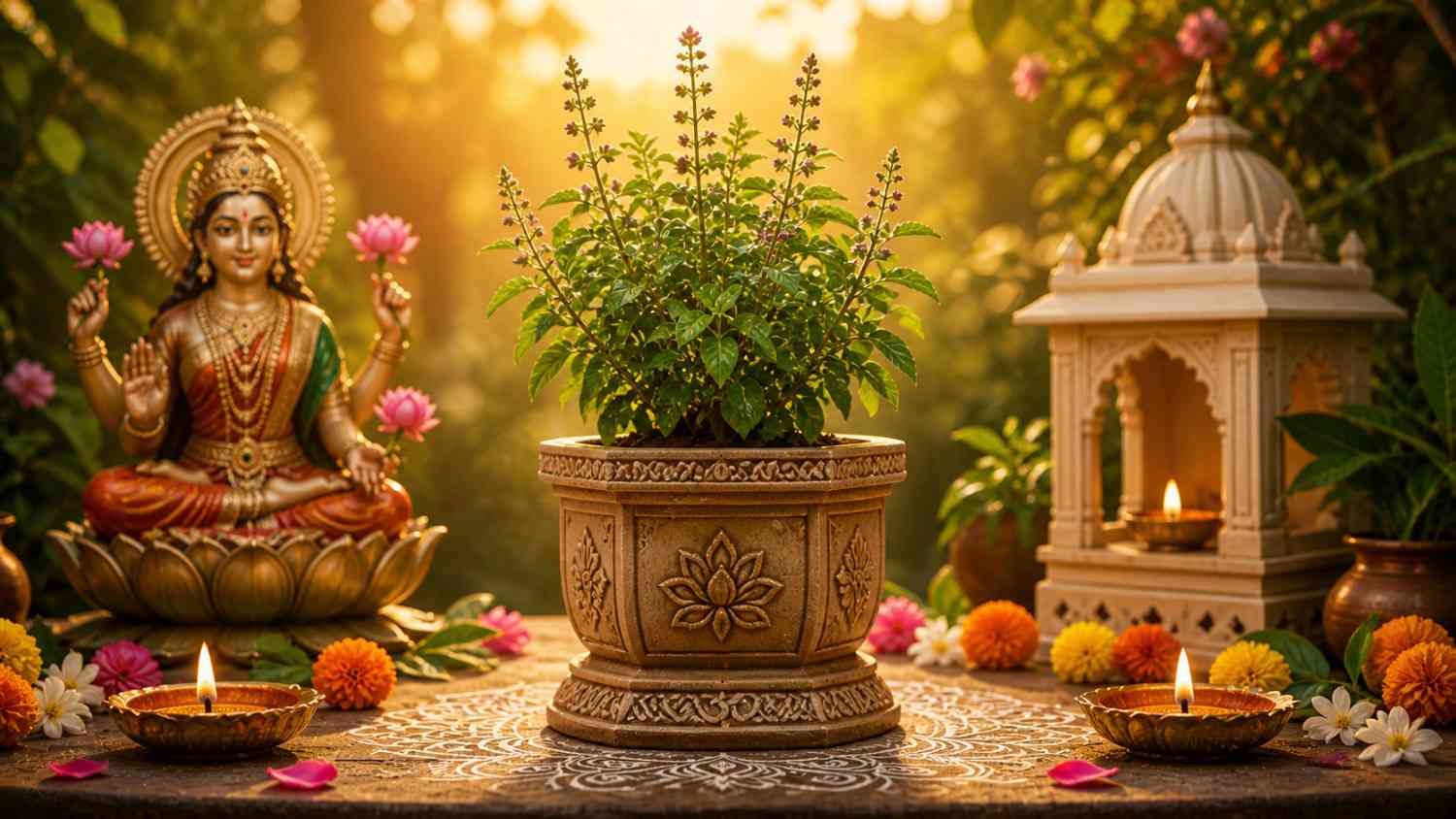
“Where Tulsi grows, there no disease, poverty, or grief can take hold.” — Ancient Sanskrit proverb
The role of Tulsi in Hinduism is multi-dimensional in three aspects. On a spiritual level, it is said to be the manifestation of the goddess Lakshmi and is closely associated with Lord Vishnu. Ayurveda has traditionally recognised Tulsi as The Queen of Herbs, and has used it to treat everything since common colds to chronic stress. Modern science now, as always known in ancient times, confirms the cleansing of the air, the repelling of insects, and the enriching of the air around it, which is the effect that Tulsi has on the atmosphere around it.
Who is Tulsi in Hindu Mythology?
Tulsi is not just a plant, but rather a goddess, a divine soul in a green form, both a reward of piety and a blessing upon the world. To have the knowledge of Tulsi in Hinduism, one has to venture into the sphere of sacred mythology, where Tulsi has a seat of highest honour.
Tulsi as a divine goddess
Tulsi is also worshiped as a goddess in her own right – as Tulsi Devi or Vrindadevi. Her metamorphosis into the Tulsi plant is not viewed as a punishment but as an elevation, a way of her sacred presence to continue to exist on earth and bless those who devote themselves to her. Her divine spirit is believed to reside in all the Tulsi plants which grow and that is why touching the plant with reverence, watering it in the morning and offering prayers to it is seen as a form of direct devotion to Vishnu himself.
Connection with Goddess Lakshmi
In most Puranic traditions, Tulsi is considered as another incarnation of Goddess Lakshmi – the wife of Vishnu and the goddess of wealth, prosperity and auspiciousness. This association is the reason why Tulsi is planted in houses to receive blessings of prosperity and wellbeing. Lord Vishnu is said to love Tulsi more than any other offering and in case a Tulsi leaf is not put on the food offered to him (Prasad), the offering is said to be incomplete.
“Vishnu considers Tulsi leaves more precious than gold and jewels — offering a single Tulsi leaf with devotion equals the offering of an entire world.” — Padma Purana
Symbol of purity, devotion, and protection
Tulsi symbolises the three highest virtues in Vaishnavism: purity (shuddhi), devotion (bhakti), and protection (raksha). It is encircled around the neck of the deceased in form of a garland placed on the lips of the dying to direct their soul harmoniously towards the home of Vishnu, and worn as a necklace (Tulsi mala) by Vaishnavas as a symbol of devotion and spiritual identification.
Tulsi Goddess Story — Mythological Background
One of the most heartfelt and spiritually abundant mythological tales of the Hindu tradition is the mythological story of Tulsi. It is a tale of incredible loyalty, divine action, tragedy and finally, undying grace.
The story of Vrinda and Jalandhar
Many years ago there was a most devoted woman Vrinda who was the wife of the mighty demon king Jalandhar. Vrinda was a woman of very high virtue–so much so, that it formed a divine shield round Jalandhar, making him invulcanised in arms. Not even Lord Shiva could conquer him provided the obedience of Vrinda was not broken.
The gods, who could not defeat Jalandhar in a battle, turned to Lord Vishnu and asked him to help. Knowing that the only means to bring to an end the reign of Jalandhar, was by breaking the pativrata of Vrinda, Vishnu assumed the personage of Jalandhar, and appeared before Vrinda. Vrinda married the disguised Vishnu, unaware about it. Once her devotion shifted (even without their consent) to someone else, the divine shield was shattered, and Shiva was capable of slaying and killing Jalandhar in battle.
Curse and transformation
Vrinda, on learning the deception, was overcome with sorrow and justifiable anger. and she cursed Vishnu that as he had veiled himself in some form as a stone (the form which he has assumed in some versions), so would he become a stone. It is believed to be the origin of the Shaligram stone which was considered sacred and a form of Vishnu up to today.
Vrinda then gave up her life and merged with the earth. Where her body was there grew a sacred plant–the Tulsi plant. In her devotion, and repentant of the deception, Vishnu declared that Vrinda, now Tulsi, would be his most loved offering, that his worship would not be complete without her, nor would she not be revered in all creation as Tulsi Devi.
The union of Tulsi and Shaligram stone in Hindu rituals symbolises the sacred marriage of Vrinda and Vishnu — a divine reconciliation that transcends the original deception.
Spiritual and moral lessons
The tale of Vrinda teaches powerful lessons about devotion and divine will. It highlights the strength and holiness of feminine virtue. It also shows how suffering, when faced with grace, can become an eternal blessing.
Vrinda’s fidelity was so strong that it could restrain the gods. That same spiritual energy is believed to live on through the Tulsi plant. Even today, it is said to influence and connect with the divine.
Significance of the Tulsi Plant in Hinduism
Tulsi has a unique place in Hindu religious life that cannot be compared with any other plant. It is referred to as Vishnupriya (loved by Vishnu), Haripriya (dear to Hari), and just as the Holy Plant, which is referred to as pavitra paudha (holy plant of the god). But why so special, and why has this reverence been preserved, even through three thousand years,?
Presence in Hindu homes and temples
The Tulsi Chaura (Tulsi platform) is considered as sacred as a mini-temple within the home. Traditionally built in the courtyard facing east, this raised platform houses the Tulsi plant and serves as the family’s daily altar. The morning routine in traditional Hindu households begins with watering the Tulsi, lighting a diya, and offering prayers before the day’s activities begin.
In temples across India, Tulsi garlands adorn the idols of Vishnu and Krishna. In Vrindavan — the birthplace of Krishna — Tulsi plants are so revered that devotees consider walking barefoot among them an act of pilgrimage. The temple of Tirumala Tirupati, one of the most visited religious sites on earth, uses Tulsi in virtually every ritual offering.
Role in rituals and offerings
Tulsi leaves are offered to Vishnu and Krishna during abhishek, the sacred bathing ritual. They are placed in charnamrit, the holy water given to devotees. Tulsi is also used to consecrate food offerings. It is even placed on the bodies of the departed.
A home without Tulsi is considered spiritually incomplete. Many Hindu texts say that seeing a Tulsi plant in the morning brings good fortune. It is also believed to purify the mind.
Importance of Tulsi in Hindu Traditions
Daily interaction with the Tulsi plant is one of the sweetest and most consistent devotional practices in Hindu homes. Unlike elaborate temple rituals, it does not require priests or strict timing.
Tulsi worship is simple, personal, and accessible. It is often performed by the women of the household. The practice is passed down through generations—from grandmother to mother to daughter. This tradition has continued for countless years.
Morning rituals
Tulsi is watered every morning, usually at sunrise a ritual known as Tulsi Jal. This should be clean water, which must be offered with both hands together, with either a small prayer or the repetition of the name of Vishnu or Ram. It is then surrounded (pradakshina) once three or seven times clockwise and the recitation of Tulsi stotras (hymns of praise). It is believed that pradakshina this morning is as beneficial as performing a full pilgrimage to holy places.
Evening rituals
A small earthen or brass diya is lit and put close to the Tulsi at dusk. This evening light is considered to keep away bad energies, bring blessings of affluence to the diaya and guard the house at night. The soft glow of the diya and the scent of the Tulsi combine to provide the atmosphere of peaceful presence and sanctity that has been described by poets, saints, and worshipers throughout the centuries.
Tulsi worship is never merely mechanical — it is considered a direct conversation with the divine, a daily renewal of the relationship between the householder and the sacred.
Tulsi in pooja ceremonies
No Vishnu puja, Satyanarayana katha, Ekadashi fast, or Diwali pooja is complete without Tulsi. She is the first offering placed before the deity and the last item removed from the altar. Her presence consecrates the entire space of worship.
Benefits of Worshipping the Tulsi Plant
Inner Peace
Regular Tulsi worship calms the mind, reduces anxiety, and cultivates
a state of inner stillness through
devotional focus.
Purity of Space
The plant releases oxygen and absorbs negative ions, creating a spiritually and physically purer environment in the home.
Protection
Tradition holds that Tulsi wards off evil spirits, negative energies, and ill fortune from the household and its members.
Divine Blessings
Worshipping Tulsi is considered equivalent to Vishnu worship — bringing his blessings of health, longevity, and prosperity.
Mental and emotional well-being
Caring for a living plant can be a mindful practice. Watering Tulsi, praying to it, and observing its growth bring attention to the present moment. This simple routine helps the worshipper feel calm and grounded.
Modern Psychology also recognises the mental health benefits of plant care. Regular spiritual routines can reduce stress and improve focus. This supports what Hindu tradition has long understood. The Tulsi ritual is not only an act of devotion. It is also a meaningful form of self-care.
The fragrance of Tulsi leaves is known to have a calming effect on the nervous system. Sitting near a Tulsi plant in the early morning, breathing in its aroma while chanting softly, is a practice that cultivates equanimity, gratitude, and spiritual focus that carries through the entire day.
Tulsi Medicinal Uses — Ayurvedic Importance
Long before modern pharmacology, Ayurveda had mapped the extraordinary healing properties of Tulsi with remarkable precision. Called The Queen of Herbs in Ayurvedic tradition, Tulsi (Ocimum tenuiflorum) is classified as a Rasayana — a herb that promotes longevity, vitality, and overall well-being.
Core Ayurvedic properties
In Ayurveda, Tulsi is categorised as Katu (pungent) and Tikta (bitter) in taste, with a Ushna virya (hot potency). This makes it particularly effective in balancing Vata and Kapha doshas, which govern immunity, respiratory function, and emotional stability. It is prescribed as an adaptogen — a substance that helps the body adapt to stress and maintain homeostasis.
Immunity booster
Rich in antioxidants, Vitamin C, zinc, and eugenol — Tulsi strengthens the immune response against infections.
Respiratory relief
Highly effective for cough, cold, bronchitis, and asthma — Tulsi decoctions open airways and reduce inflammation.
Anti-bacterial
Eugenol and caryophyllene in Tulsi leaves inhibit bacterial and fungal growth both internally and topically.
Stress & anxiety
As an adaptogen, Tulsi lowers cortisol levels and supports adrenal function, reducing chronic stress.
Tulsi tea and home remedies
A simple decoction of 8–10 fresh Tulsi leaves boiled in water with ginger, black pepper, and honey is one of Ayurveda’s most celebrated remedies for colds and fevers. Applied as a paste, Tulsi leaves treat skin infections, acne, and minor wounds. Tulsi oil is used for headaches and scalp health. Modern Tulsi tea products have taken this ancient wisdom global, with Holy Basil herbal teas now sold in health stores across Europe, North America, and East Asia.
Types of Tulsi Plants
Tulsi is not a single plant but a family of varieties, each with its own characteristics, uses, and spiritual associations. Here are the five most significant types found across India.
Rama Tulsi (Green Tulsi)
The most common variety found in Indian homes, Rama Tulsi has bright green leaves with a mild, pleasant fragrance. It is the primary variety used in daily worship and pooja. Its mild flavour makes it ideal for Tulsi tea and culinary uses. Associated with Lord Rama, it is believed to bring calm, peace, and domestic harmony.
Krishna Tulsi (Shyam Tulsi)
Distinguished by its deep purple-black leaves, Krishna Tulsi has a stronger, clove-like aroma and more potent medicinal properties. Associated with Lord Krishna, it is considered especially powerful in healing and in spiritual protection. It is the preferred variety for treating respiratory ailments and is used extensively in Ayurvedic preparations.
Vana Tulsi (Wild Tulsi)
Found growing wild in forests and uncultivated lands, Vana Tulsi is a more robust plant with slightly larger leaves. Ayurveda prizes it for its strong immune-boosting and fever-reducing properties. Though less commonly kept in homes, it is widely used in herbal medicine and forest-dwelling communities.
Kapoor Tulsi
Kapoor Tulsi is a fast-growing and highly fragrant variety. It is known for its strong air-purifying qualities. It also helps repel mosquitoes and other insects.
Its aroma is sharp and camphor-like. This makes it a good choice for both spiritual and practical use. It is also commonly used in Aromatherapy.
Amrita Tulsi
Perhaps the rarest and most medicinally potent variety, Amrita Tulsi — whose name means nectar of immortality — is valued for its exceptional concentration of therapeutic compounds. Traditional healers associate it with longevity, deep healing, and the restoration of vital energy.
Scientific and Environmental Benefits of Tulsi
Modern science has spent the last several decades catching up to what Ayurveda and Hindu tradition have known for millennia. The findings are compelling: Tulsi is not merely a culturally significant plant — it is a scientifically verified botanical powerhouse with measurable environmental and physiological benefits.
Air purification
Studies have shown that Tulsi produces significant amounts of oxygen — reportedly up to 20 hours a day — while also absorbing harmful pollutants including carbon dioxide, carbon monoxide, and sulphur dioxide from the surrounding atmosphere. This makes it one of the most effective air-purifying plants known, and its traditional placement in the courtyard of homes now appears to be an act of environmental intelligence as much as devotion.
Natural insect repellent
The essential oils in Tulsi — particularly eugenol, camphene, and cineole — are natural insect and mosquito repellents. Planting Tulsi near windows, doors, and living spaces creates a natural barrier against mosquitoes, reducing the risk of mosquito-borne illnesses like dengue and malaria. In villages where Tulsi is traditionally grown, this ancient practice serves as practical public health wisdom.
Research published in the Journal of Vector Ecology confirmed that Tulsi essential oil demonstrates significant mosquito-repellent activity, comparable to synthetic repellents at certain concentrations.
Antimicrobial environment
Tulsi releases phytochemicals into the air that have demonstrated antimicrobial properties in controlled studies. Homes with actively growing Tulsi plants show measurably lower concentrations of certain airborne bacteria and fungi, providing a natural, chemical-free approach to maintaining a healthier indoor environment.
Tulsi in Vastu Shastra and Home Placement
Vastu Shastra — the ancient Indian science of spatial arrangement and architecture — has precise and nuanced guidance on the placement of Tulsi within and around the home. These recommendations are not arbitrary but are based on a sophisticated understanding of how directional energies, sunlight, airflow, and spiritual intentions interact within a living space.
Ideal direction: North or North-East
Vastu Shastra recommends placing the Tulsi plant in the North-East direction of the home. This area is known as the Ishaan corner. It is associated with divine blessings, positive energy, and the element of water.
The East and North directions are also considered auspicious. These directions allow the plant to receive morning sunlight. Sunlight supports healthy growth. It also symbolically represents the energy of a new beginning.
Placement tips
Tulsi should not be placed in the South direction of the home. In Vastu Shastra, this direction is linked to Yama and negative energies.
It should also not be kept in the bedroom or bathroom. These spaces are associated with personal or impure activities. They are considered unsuitable for a sacred plant like Tulsi.
The Tulsi Chaura should always be kept clean and clutter-free. It is traditionally lit with a diya every evening.
Many Vastu experts recommend an odd number of Tulsi plants (1, 3, 5) as this is considered more auspicious and energetically balanced than even numbers.
Rituals and Rules for Tulsi Worship
Tulsi worship, while deeply personal and accessible, is also governed by a set of traditional guidelines that have been passed down through generations. These rules are not merely superstitious — many have practical, scientific, and spiritual rationale behind them.
Best time to worship
The ideal time for Tulsi worship is at sunrise (Brahma Muhurta) and sunset (Sandhyakaal). These transitional moments of the day, when light and darkness meet, are considered spiritually potent in Hindu tradition — times when the boundary between the human and divine is thinnest and prayers carry the greatest power.
Why Tulsi is not plucked at night
One of the most widespread Tulsi rules is that leaves should never be plucked after sunset or before sunrise. Spiritually, this is explained by the belief that Tulsi Devi rests during the night and plucking leaves disturbs her divine sleep. Scientifically, this rule makes excellent sense: plants absorb carbon dioxide and release toxins at night, making their leaves less suitable for consumption. The rule also protects the plant from unnecessary disturbance during its growth hours.
Do’s and Don’ts
- Do water Tulsi daily with clean water in the morning
- Do light a diya near Tulsi every evening
- Do circumambulate the plant with reverence
- Never pluck Tulsi on Sundays, Ekadashi, or during solar/lunar eclipses
- Never allow the Tulsi plant to dry out or become neglected
- Never place Tulsi near impure substances or in the bathroom
Tulsi Vivah — Sacred Ritual and Celebration
Tulsi Vivah — the ceremonial marriage of the Tulsi plant to Lord Vishnu (represented by the Shaligram stone or the image of Krishna) — is one of the most unique and beloved festivals in the Hindu calendar. It marks the official beginning of the Hindu wedding season and is celebrated on the eleventh or twelfth day of the bright half of the month of Kartik (typically October or November).
Meaning and significance
Tulsi Vivah celebrates the divine union of Vrinda (Tulsi) with Vishnu. It represents reconciliation and honour beyond the tragic story of Vrinda’s deception.
By performing this marriage ritual, Hindu households symbolically invite Vishnu and Lakshmi into their homes. They seek blessings for family members who wish to marry. The ritual also marks the transition from the monsoon season to the auspicious winter period.
The ritual process
The Tulsi plant is beautifully decorated with a small canopy (mandap), adorned with marigold flowers, and dressed with a small piece of red cloth to represent the bride. The Shaligram stone representing Vishnu is placed beside her. A priest or the woman of the household then conducts the full marriage ceremony — including the recitation of Vedic mantras, exchange of garlands, and the sacred fire ritual. The assembled family observes and blesses the union.
It is widely believed that a family that performs Tulsi Vivah with devotion will be blessed with auspicious marriages for their children and grandchildren.
Tulsi in Scriptures and Ancient Texts
The reverence for Tulsi is not a folk tradition that evolved outside the formal religious canon — it is deeply embedded in the most authoritative texts of Hindu scripture, from the Vedas to the Puranas to the devotional literature of the medieval saints.
Puranas
The Padma Purana contains the most extensive account of Tulsi’s divine origin, her story as Vrinda, and the detailed merits of worshipping her. The Skanda Purana declares that a home with Tulsi is like a place of pilgrimage, and that Yama (the lord of death) and his messengers cannot enter such a home. The Devi Bhagavata describes Tulsi as an aspect of Maha Lakshmi herself.
Vedas and Bhagavad context
The Vedas do not explicitly mention Tulsi. The Sanskrit name Tulasi appears mainly in later texts. However, the idea of sacred plants is deeply rooted in Vedic thought.
The Atharva Veda contains many hymns about plants. These plants are described as having healing and protective powers. Scholars of Ayurveda often connect these qualities to Tulsi.
Devotional literature
The great Vaishnava saints — Tulsidas, Mirabai, and the poet-saints of the Bhakti movement — wove Tulsi into their devotional poetry as a constant symbol of pure love and surrender. Tulsidas himself, the author of the Ramcharitmanas, took his name from Tulsi as a mark of his devotion, and his masterwork was composed under a Tulsi tree in Varanasi — the very city where this tradition remains most vibrantly alive.
Modern Relevance of Tulsi
In the 21st century, Tulsi has made a remarkable journey from the courtyards of Indian homes to global wellness culture, pharmacological research labs, and urban balcony gardens worldwide. Its relevance has not diminished — if anything, the modern world is discovering Tulsi anew through the lens of science, wellness, and sustainability.
Global herbal market
Holy Basil supplements, Tulsi teas, and Tulsi essential oil products are now staples of the global herbal medicine market. Brands in Europe, North America, and Australia market Tulsi as an adaptogen and stress-relief supplement. The global Holy Basil market was valued at hundreds of millions of dollars and continues to grow as consumers seek natural, plant-based health solutions.
Urban Tulsi gardening
In modern cities, traditional courtyards are often replaced by apartments and balconies. Yet, millions of urban Hindus continue to grow Tulsi. They plant it in pots, window boxes, and terrace gardens.
The spiritual practice adapts easily. The core rituals remain the same. People water the plant, light a diya, and offer morning prayers. These can be performed in a Mumbai flat just as meaningfully as in a Varanasi haveli.
During the COVID-19 pandemic, searches for “how to grow Tulsi at home” and “Tulsi immunity benefits” surged dramatically across India and among the Indian diaspora worldwide — a powerful demonstration of how ancient wisdom resurfaces in times of collective need.
Common Myths and Facts About Tulsi
Myth: Tulsi cures all diseases instantly
Fact: Tulsi supports immunity and has genuine medicinal properties, but it is a complementary herb, not a magic cure. It works best as part of a broader Ayurvedic approach to health.
Myth: Women cannot touch Tulsi during menstruation
Fact: This is a patriarchal social restriction without scriptural authority. Many scholars argue that all devotees, regardless of gender or cycle, can approach Tulsi with reverence.
Myth: Tulsi at home causes marital problems
Fact: This is a baseless misconception. Tulsi is consistently described in scriptures as a bringer of harmony, prosperity, and Vishnu’s blessings into the household
Myth: Dead Tulsi plants bring bad luck
Fact: A Tulsi plant that dies is not an omen — plants die due to environmental conditions. The proper response is to respectfully immerse the dried plant in flowing water and plant a new one.
The intersection of religion and botany around Tulsi is remarkably harmonious — science consistently validates what tradition has long affirmed. The air-purification, antimicrobial, adaptogenic, and anti-inflammatory properties of Tulsi are all well-documented, lending scientific credibility to devotional practices that may have seemed superstitious to the uninitiated.
Conclusion
Tulsi is one of the most remarkable gifts of Hinduism to the world. It is not just a plant. It is seen as a goddess, a healer, and a protector of the environment. It also teaches devotion in everyday life.
For thousands of years, Tulsi has remained unchanged. It has witnessed the rise and fall of empires. It has endured shifts in science, culture, and daily life. Yet, it still stands rooted in the courtyards of Hindu homes.
Fragrant and green, Tulsi brings a sense of peace. Each evening, it is worshipped with a small, steady flame. It continues to guide devotion across generations.
It is a tale of love, loss, devotion and divine transformation. We hear the tale of Vrinda, that true devotion, even when put to the test, even when they seem betrayed, finally turns to something beautiful and everlasting. That transformation realized, the reminder of every Indian house, that love and devotion survive all odds.
“In the leaf of Tulsi, the whole of creation is contained — the divine mother, the healing earth, the breath of life, and the promise of liberation.” — Vaishnava teaching
Medically, Ayurveda was right about Tulsi long before the laboratories confirmed it. As an adaptogen, an antimicrobial, an immune booster, and an environmental purifier, Tulsi delivers measurable, scientifically validated benefits that make the case for keeping her in every home on purely pragmatic grounds — even before her spiritual dimensions are considered.
And spiritually — for those who grow up with the sight of a Tulsi Chaura, the smell of Tulsi leaves on a monsoon morning, the quiet flame of an evening diya — she is not a plant at all. She is family, she is memory, she is the fragrant thread that connects each generation to the one before, and each home to something vast and sacred that has no beginning and no end.
Plant Tulsi in your home. Water her with care. Light a lamp beside her each evening. In doing so, you join an unbroken chain of devotion that stretches back to the earliest days of Indian civilisation — and forward, with hope, into the future.