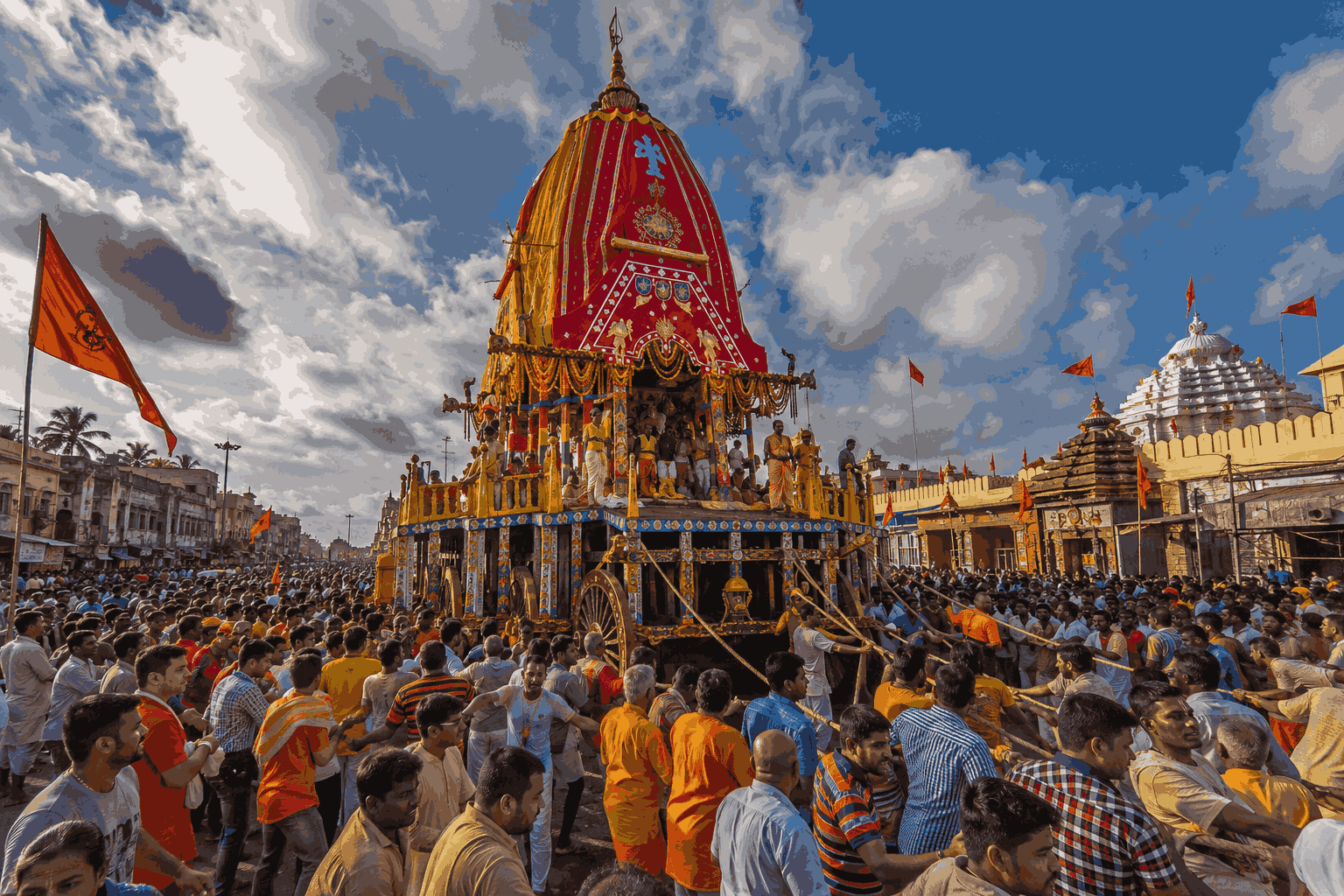
Every year, as the Ashadha month rolls in with the first monsoon showers, millions of devotees across India turn their eyes toward one of Hinduism’s most joyous festivals — the Jagannath Rathayatra. It is the one day when the Lord leaves the sanctum of the temple and comes out onto the open street, so that every devotee, regardless of caste, creed, or background, can have His darshan.
Rathayatra is not simply a religious event; it is a living, breathing celebration of devotion, humility, and community. Streets turn into rivers of people, chants of “Jai Jagannath” fill the air, and for a few days every year, an entire city organises itself around the joy of pulling a rope tied to God’s own chariot.
In this guide, we cover the exact Jagannath Rathayatra 2026 date, the shubh muhurat, the deep meaning and mythology behind the festival, the complete ritual calendar, and a special, detailed focus on the Rathyatra Mela in Varanasi — its history, route, and a practical guide on how you can be part of it this year.
When is Jagannath Rathayatra 2026?
Jagannath Rathayatra 2026 falls on Thursday, 16 July 2026.
The festival is celebrated on Ashadha Shukla Dwitiya — the second day of the bright fortnight (Shukla Paksha) of the Ashadha month, as per the Hindu lunar calendar. Because Rathayatra is a tithi-based festival rather than a fixed calendar date, the exact day shifts slightly every year depending on the position of the moon.
Key Dates at a Glance
| Ritual | Date 2026 | Day |
|---|---|---|
| Snana Purnima (ceremonial bath, start of Anavasara) | Early July 2026 | — |
| Nabajaubana Darshan (first darshan after recovery) | 15 July 2026 | Wednesday |
| Jagannath Rathayatra (main chariot procession) | 16 July 2026 | Thursday |
| Hera Panchami (Goddess Lakshmi visits Gundicha Temple) | 20 July 2026 | Monday |
| Bahuda Yatra (return journey begins) | 24 July 2026 | Friday |
| Suna Besha (deities adorned in gold ornaments) | 25 July 2026 | Saturday |
| Niladri Bije (Lord returns to the sanctum) | 27-28 July 2026 | — |
Shubh Muhurat for Jagannath Rathayatra 2026
The most auspicious window for puja and darshan on the main day is approximately 5:33 AM to 12:00 PM (timings calculated for North India; they may shift slightly by a few minutes depending on your city, so it’s best to confirm local timings closer to the date). The Dwitiya tithi itself begins around midday on 15 July and continues until the morning of 16 July, which is why the yatra is observed on the 16th rather than the 15th.
If you are performing a Jagannath puja or vrat at home, the morning hours before noon are considered the most spiritually charged time to offer prayers, light a diya, and recite the Jagannath Ashtakam.
The Story Behind Jagannath Rathayatra
The legend goes back to King Indradyumna, a devout worshipper of Lord Vishnu who longed for darshan of a mysterious deity known as Nila Madhava, said to manifest deep in the forests of Odisha. Eager to find this deity, the king sent his priest Vidyapati in search of the Savara tribe, who were known to secretly worship Nila Madhava in the forest.
This quest eventually led to the consecration of Lord Jagannath, along with his siblings Balabhadra and Subhadra, in the sacred Jagannath Temple of Puri — one of the four Char Dham pilgrimage sites of India, built in the 12th century by King Anantavarman Chodaganga Deva of the Eastern Ganga dynasty.
A fascinating detail about the idols themselves: unlike most Hindu deities carved in stone or metal, Jagannath, Balabhadra, and Subhadra are made of sacred neem wood and are ceremonially replaced every twelve to nineteen years in a secretive ritual called Nabakalebara — a tradition unlike almost anything else in Hindu worship.
Rathayatra itself commemorates a simple, moving idea: once a year, Lord Jagannath sets out from his temple to visit the Gundicha Temple, believed to be his aunt’s home, about three kilometres away. It is here that the Lord “returns” to the place where he first appeared to King Indradyumna, before coming back to his main abode a week later in the Bahuda Yatra.
Popular belief also links this journey to Lord Krishna’s own visit to Vrindavan to meet the friends and cowherds of his childhood — which is why the festival carries such deep emotional resonance for devotees across India, especially those who follow the Vaishnava tradition.
Why Jagannath Rathayatra Matters
- Darshan without barriers: Unlike temple sanctums, the street procession is open to everyone — there are no restrictions of caste, religion, or nationality when it comes to viewing the chariots. This is one of the very few Hindu festivals where the deity actively steps outside the confines of a temple to reach every devotee.
- Seva through participation: Pulling the ropes of the chariot is considered one of the most meritorious acts a devotee can perform — a direct, physical form of service to the Lord. There is an old belief that even the merit of many lifetimes of temple visits can be earned through a single act of pulling the rath.
- Humility over hierarchy: During the Chhera Pahara ritual, the Gajapati King of Puri himself descends from his royal seat and sweeps the chariot platforms with a golden broom, a powerful reminder that before God, no one — not even a king — is above service.
- The Lord comes to you: At its heart, Rathayatra reflects the idea that divinity does not wait behind closed doors — it steps out to meet its people, on their streets, in their crowds, in their ordinary lives.
- A festival of unity: Rathayatra transcends class and geography. The same chants, the same chariots, and the same spirit of devotion are echoed not just in Puri, but in Ahmedabad, Delhi, Varanasi, and in ISKCON temples across London, New York, Toronto, Sydney, and Dubai.
The Three Chariots of Rathayatra
| Chariot | Deity | Height | Wheels | Colour |
|---|---|---|---|---|
| Nandighosa | Lord Jagannath | ~45 ft | 16 | Red and yellow |
| Taladhwaja | Lord Balabhadra | ~45.6 ft | 14 | Red and green |
| Darpadalana (Devadalana) | Goddess Subhadra | ~44.6 ft | 12 | Red and black |
The chariots are freshly built every single year from sacred wood, following a construction process that begins months in advance on Akshaya Tritiya. Not a single nail or piece of metal is used in the entire structure — everything is bound together using wooden pegs and rope, exactly as it has been done for centuries. Once built, they are pulled by hundreds of thousands of devotees along the Bada Danda (Grand Road) of Puri, from the Jagannath Temple to the Gundicha Temple.
Major Rituals of Rathayatra
- Pahandi Bije — The ceremonial procession in which the deities are carried out of the temple sanctum to their respective chariots, accompanied by rhythmic swaying movements and loud chants.
- Chhera Pahara — The symbolic sweeping of the chariot platforms by the Gajapati King using a golden-handled broom, followed by the sprinkling of sandalwood water and fragrant flowers.
- Rath Tanaa (Chariot Pulling) — The main event, where devotees pull thick ropes tied to each chariot, moving them slowly along the Grand Road amid deafening chants, drums, and conch shells.
- Hera Panchami — Four days after Rathayatra, Goddess Lakshmi, upset at being left behind, visits the Gundicha Temple to “find” her husband — a ritual full of playful divine drama.
- Bahuda Yatra — The return journey of the three chariots back to the main temple, a week after the outward journey.
- Suna Besha — The deities are adorned in gold ornaments weighing several kilograms, offering devotees a glimpse of their most opulent form.
- Niladri Bije — The final ritual where Lord Jagannath re-enters the sanctum sanctorum, offering rasgullas to Goddess Lakshmi to seek her forgiveness for the delay.
Rathyatra Mela in Varanasi 2026: Kashi’s Own Puri
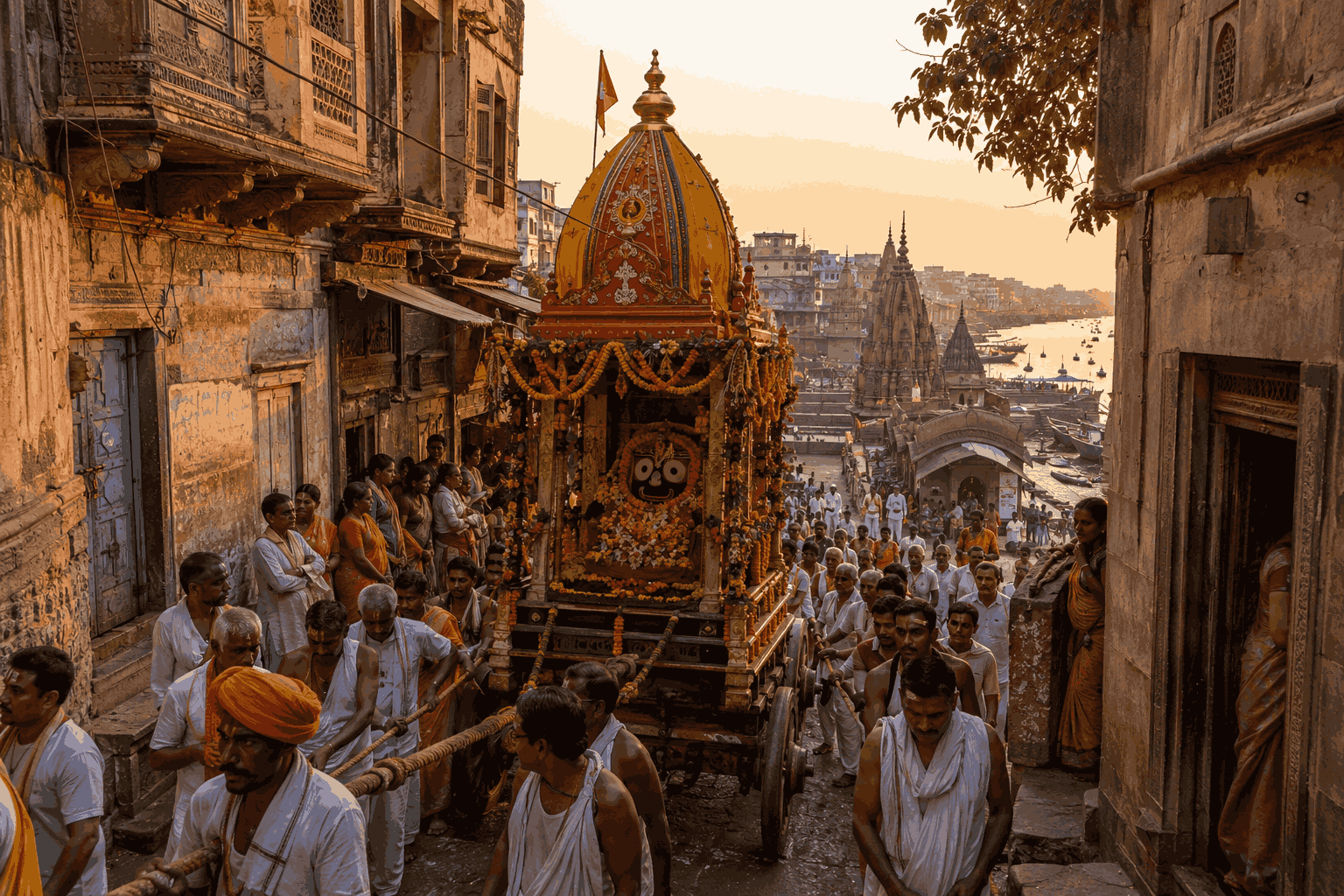
While Puri hosts the grandest celebration in the country, few people know that Varanasi has been holding its own Rathayatra tradition for over two centuries, centred around the historic Jagannath Temple near Assi Ghat. This local celebration is popularly known as the Kashi Lakkha Mela, and it draws lakhs of devotees to the ghats and lanes of the holy city every year, earning its name because it is attended by “lakhs” (hundreds of thousands) of people.
The History of Jagannath Temple, Varanasi
The Jagannath Temple in Varanasi sits quietly beside Assi Ghat, close to a well-known local landmark, and is easy to walk past without realising its significance. According to temple history, the Rathayatra tradition here was initiated around 1806 by two devout patrons who built this temple in the same spirit as the original at Puri, so that pilgrims who could not make the long journey to Odisha could still experience a version of the same darshan and devotion closer to home.
The temple complex is divided into three connected sections and follows a rectangular layout, with a spire rising to nearly sixteen metres. The idols of Jagannath, Balabhadra, and Subhadra are worshipped here in their childhood forms, carved from wood in the same tradition as Puri, along with a striking four-metre image of Prachand Narasimha and his young devotee Prahlada. Four corners of the temple also house figures of other Vaishnavite deities, including Krishna and Lakshmi-Narayana.
Though considerably smaller in scale than the temple complex at Puri, the Varanasi Jagannath Temple has, over two hundred years, become one of Kashi’s most cherished local institutions — a genuine “mini Puri” in the heart of the holy city.
Why is Rathayatra Celebrated in Varanasi?
Varanasi, or Kashi, is considered the spiritual capital of India — a city where almost every major deity and tradition of Hindu worship finds a home, from the twelve Jyotirlingas to the sacred Panchakoshi circuit. It is only fitting, then, that the Jagannath tradition of Puri also found devoted followers here, who built a temple and began their own Rathayatra so that the spirit of Puri’s festival could reach devotees who might never make the long pilgrimage east.
Over time, this grew into one of Kashi’s most beloved local festivals, blending the original Puri rituals with Varanasi’s own distinct spiritual character — the same devotion, expressed through the lens of a city that has hosted pilgrims, sadhus, and seekers for thousands of years.
There’s also a charming local belief tied to the timing of Kashi’s Rathayatra. According to the temple’s chief priests, after the ceremonial bath on Jyeshtha Purnima, Lord Jagannath is believed to fall unwell and remain in seclusion (Anavasara) for around two weeks. During this period, devotees ceremonially offer him a herbal decoction — first a general one, and later a special parwal-based remedy — until he recovers. Once he is well again, he sets out on his city tour to bless his devotees, much like a child returning to play after recovering from a fever.
Because this cycle is based on the local temple calendar rather than the same tithi followed in Puri, the exact date of the Varanasi Rathayatra procession can vary slightly from the main Puri Rathayatra, and has in past years fallen even before the Puri festival itself. It’s a good idea to confirm the local schedule with the Jagannath Temple, Assi Ghat, or the city’s local event calendar as Ashadha month approaches.
The Route of Varanasi’s Rathayatra
The Varanasi Rathayatra procession begins at the Jagannath Temple, Assi Ghat, and moves through the neighbouring lanes of the city, passing through areas that carry the festival’s memory even in their names — most notably Rathyatra Chauraha, a locality named after the historic path the chariots have taken for generations. The chariots move at a gentle, deliberate pace through the narrow lanes of Kashi, accompanied by kirtan, devotional music, saffron flags, and processions of devotees carrying offerings, before the deities eventually make their way back to the temple over the following days.
Because Assi Ghat and the surrounding lanes are narrow and can get extremely crowded, the procession moves considerably slower than the wide Grand Road of Puri — which is part of what gives the Kashi Rathayatra its intimate, close-up character. Devotees often find themselves within touching distance of the chariot ropes, something that’s far harder to manage amid the sheer scale of the Puri crowds.
What Happens During the Mela
- Chariot procession: Idols of Jagannath, Balabhadra, and Subhadra are taken out on decorated chariots, echoing, on a smaller and more intimate scale, the grandeur of Puri.
- Kashi’s first Lakkha Mela of the year: This is considered one of the earliest and most significant “Lakkha Melas” (fairs attended by lakhs of people) on Varanasi’s spiritual calendar, drawing devotees from across Uttar Pradesh and neighbouring states.
- Community fair: A large fair springs up around the procession route, with stalls selling handicrafts, toys, sweets, and devotional items, alongside street food vendors serving festival specials.
- Cultural programs: Traditional music, folk dance, and devotional plays add to the festive energy along the ghats.
- Prasad and offerings: Devotees offer tulsi (holy basil) leaves and local sweets — nankhatai, a crumbly shortbread-like biscuit, is a particularly popular offering during this festival in Kashi.
- Aartis along the route: As the chariots pass, devotees perform aarti with lamps and flowers, and many join in singing bhajans as the procession moves through their lane.
How to Participate in the Varanasi Rathyatra
- Reach Assi Ghat early. The area around the Jagannath Temple gets crowded quickly on festival day, so arriving a couple of hours before the procession begins gives you a good vantage point and time to soak in the atmosphere.
- Join the chariot pulling. Devotees are warmly welcomed to help pull the ropes of the chariot — considered a direct and deeply meritorious act of seva to the Lord.
- Dress modestly and comfortably. Light cotton clothing works best given the humidity of the Ashadha month; footwear that’s easy to walk and stand in for hours is a must, since most of the mela is experienced on foot.
- Explore the mela stalls. Take time to browse the handicrafts, pick up devotional items, and try local festival snacks around the fair — it’s as much a cultural experience as a religious one.
- Respect local customs. Photography is usually welcome, but avoid crowding the immediate path of the chariot, and follow instructions from temple volunteers and local police managing the crowd.
- Keep a family meeting point fixed. Given the crowd density, especially in the narrow lanes near Assi Ghat, it helps to decide a clear meeting spot in advance in case your group gets separated.
- Carry water and stay hydrated. July in Varanasi is hot and humid, and festival crowds mean long hours on your feet — a small bottle of water and a light snack go a long way.
- Combine it with a wider Kashi darshan. Since you’re already in Varanasi, plan a visit to the Kashi Vishwanath Temple and the evening Ganga Aarti at Dashashwamedh Ghat — both are a short ride away and pair beautifully with the Rathayatra experience, letting you experience two of Kashi’s most iconic spiritual moments in a single trip.
Puri vs Varanasi Rathayatra: A Quick Comparison
| Aspect | Puri | Varanasi |
|---|---|---|
| Scale | Millions of devotees, national event | Lakhs of devotees, regional/local event |
| Route length | ~3 km, Bada Danda (Grand Road) | Shorter route through narrow Kashi lanes from Assi Ghat |
| Chariots | Full-scale, freshly built every year | Smaller-scale chariots reflecting the temple’s size |
| Timing basis | Ashadha Shukla Dwitiya (fixed tithi) | Local temple calendar tied to Anavasara recovery period; may vary |
| Character | Grand, crowded, high-energy national festival | Intimate, community-driven, deeply woven into Kashi’s own spiritual rhythm |
Tips for Anyone Attending a Rathayatra Celebration in 2026
Whether you plan to attend in Puri, Varanasi, or your local ISKCON temple’s Rathayatra procession, a few things will make the experience smoother:
- Book travel and stay well in advance, especially for Puri, where accommodation and transport get claimed weeks ahead of the festival.
- Arrive early on the day of the procession — the best viewing spots and comfortable positions near the ropes fill up fast.
- Keep your phone charged and carry a power bank, since crowds can make it hard to reach charging points later in the day.
- Wear comfortable, weather-appropriate clothing given the July heat and humidity across most parts of India.
- Be mindful of elderly family members and children — plan safe exit routes in case the crowd becomes too dense.
- Sample the prasad and festival food, from Puri’s famous Mahaprasad to Varanasi’s nankhatai, jalebis, and pakodas — the food is as much a part of the celebration as the ritual itself.
Frequently Asked Questions
Jagannath Rathayatra 2026 falls on Thursday, 16 July 2026, as per the Ashadha Shukla Dwitiya tithi.
The auspicious window is approximately 5:33 AM to 12:00 PM, though exact timings can vary slightly by location.
Not always. Puri’s Rathayatra follows the Ashadha Shukla Dwitiya tithi, while Varanasi’s local celebration at the Jagannath Temple, Assi Ghat, follows its own temple calendar tied to the Lord’s Anavasara (recovery) period, and can fall a little earlier or on a different day. Check with the local temple closer to the date for the confirmed schedule.
Yes. The chariot procession on the open street is open to everyone. Entry inside the main sanctum of the Jagannath Temple, however, is reserved for Hindus.
Pulling the chariot ropes is considered a highly meritorious act of seva (service) to the Lord, and devotees travel from far and wide specifically to take part in this ritual.
The Jagannath Temple sits right beside Assi Ghat, one of Varanasi’s most prominent ghats, making it easy to combine a Rathayatra visit with a wider tour of the riverfront.
Yes — the Bahuda Yatra, or return journey, is considered equally significant, marking the Lord’s homecoming after a week at the Gundicha Temple, and is followed by rituals like Suna Besha and Niladri Bije.
In Puri, the Mahaprasad from the Jagannath Temple kitchen is highly revered. In Varanasi, tulsi leaves and nankhatai are traditional offerings, alongside popular festival snacks like jalebi and pakodas.
Want the Lord’s blessings delivered to your doorstep this Rathayatra season? Explore verified puja booking services for Jagannath Puja and other Vedic rituals at The Vedic Puja.