Nag Panchami is one of the most widely observed festivals of the Shravan month, dedicated to the worship of Nag Devta, the serpent deities revered across Hindu tradition. Devotees mark the day with prayers, offerings, and rituals performed at home or at local temples, seeking the blessings and protection associated with these deities. Because the festival is rooted in respect for nature and the balance between humans and the natural world, it holds a special place among Shravan observances.
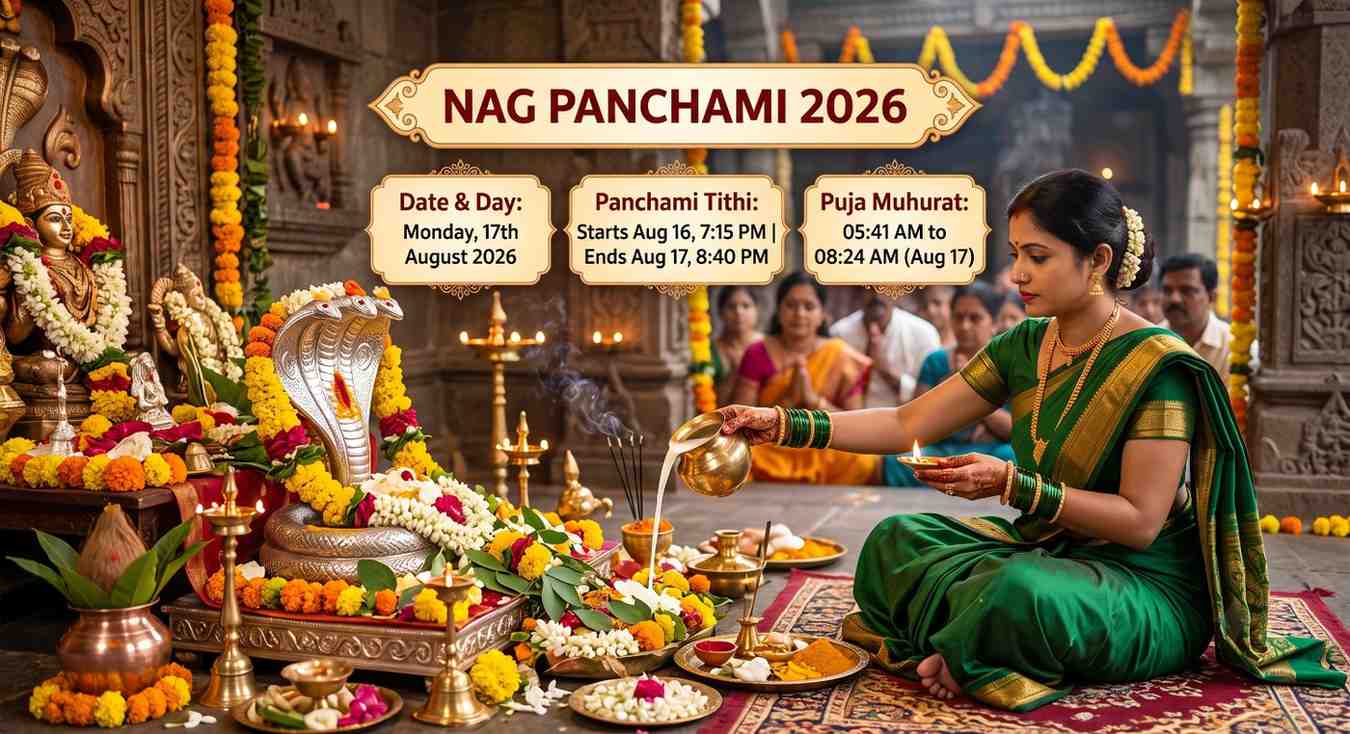
In 2026, Nag Panchami will be observed on Monday, August 17, 2026. This date is calculated according to the Panchami Tithi of Shukla Paksha in the Hindu lunar calendar, and it is the day on which most devotees across India will perform their Puja. For those planning their rituals in advance, knowing the exact Puja Muhurat is just as important as knowing the date itself, since many families prefer to complete their worship within the auspicious window.
The Puja Muhurat for Nag Panchami 2026 is 6:00 AM to 8:10 AM, giving devotees a window of 2 hours and 10 minutes to complete their rituals. Along with the Muhurat, understanding when the Panchami Tithi begins and ends helps devotees plan the day with clarity. This article covers the date, Muhurat, Tithi timings, step-by-step Puja Vidhi, Samagri list, mantra, and important dos and don’ts for Nag Panchami 2026.
Nag Panchami 2026 Date
Nag Panchami 2026 will be observed on Monday, August 17, 2026. The date falls during the Shravan month, a period considered especially significant in the Hindu calendar. Since Hindu festivals follow the lunar Panchang rather than the fixed Gregorian calendar, the date of Nag Panchami shifts slightly every year depending on the movement of the Tithi.
For 2026, the Panchami Tithi of Shukla Paksha aligns with August 17, making this the date on which most devotees across India will perform their Puja. Families who follow regional or community-specific calendars are encouraged to also confirm the date with their local priest or family tradition, as observances can occasionally vary in a few regions.
Nag Panchami 2026 Puja Muhurat
The Puja Muhurat for Nag Panchami 2026 is 6:00 AM to 8:10 AM, offering a window of 2 hours 10 minutes for devotees to perform their rituals. This morning period is generally considered favourable for worship, as many households prefer to begin the day with a fresh start — bathing, wearing clean clothes, and completing the Puja before the day’s other responsibilities begin.
Performing the Puja within this specified time is a matter of tradition and personal or family preference rather than a strict requirement. Some households, depending on their convenience or regional customs, may extend their rituals slightly beyond this window. What matters most, according to widely followed practice, is the sincerity and devotion behind the worship rather than adhering to the minute-by-minute timing.
Panchami Tithi 2026
According to the Hindu Panchang, the Panchami Tithi begins on August 16, 2026 at 4:55 PM and ends on August 17, 2026 at 5:00 PM.
A Tithi is a lunar day in the Hindu calendar, calculated based on the angular relationship between the Sun and the Moon. Unlike a solar day, which always lasts 24 hours, a Tithi can vary in length and does not always align neatly with sunrise and sunset. This is why a Tithi may begin on one day in the afternoon or evening and extend into the next day.
Because the Panchami Tithi this year spans from the afternoon of August 16 to the evening of August 17, the festival is observed on August 17, since that is the day when the Tithi is prevalent during the customary daytime worship hours. Devotees who wish to understand the precise astronomical basis of the Tithi calculation may consult a local Panchang or priest for further detail specific to their region.
Why Is Nag Panchami Celebrated?
Nag Panchami is rooted in the worship of Nag Devta, the serpent deities who occupy an important place in Hindu mythology and cultural memory. In Hindu tradition, the serpent is regarded not merely as a creature but as a divine force, worshipped for protection and wellbeing.
Several beliefs and traditions come together on this day. According to popular belief, worshipping Nag Devta helps bring peace and harmony to the family and offers protection from negative influences. Serpents are also associated with Lord Shiva, who is often depicted wearing a snake around his neck, and with various stories from the Puranas that highlight the coexistence of humans and the natural world.
In religious tradition, Nag Panchami is also seen as an occasion to express respect and gratitude toward nature. Snakes, as part of the ecosystem, are honoured on this day as a reminder of the balance between humanity and nature — a theme that runs through many Shravan month observances. These are matters of faith and tradition, passed down through generations, rather than scientifically verified claims.
Significance of Nag Panchami
Nag Panchami holds cultural and spiritual meaning for millions of devotees. For many families, the day is an opportunity to seek protection from fears associated with snakes, a creature that has historically inspired both reverence and caution across Indian communities.
The festival also reflects a deeper cultural value: coexistence with nature. Since snakes play an important ecological role, controlling rodent populations and maintaining balance in agricultural regions, their symbolic worship on Nag Panchami can be seen as an expression of gratitude toward the natural world. Beyond the ritual aspect, the day is also a time for families to come together, observe fasts, prepare traditional food, and pass on stories and customs to younger generations. These practices vary from household to household and region to region, and no single interpretation applies universally across India.
Nag Panchami Puja Vidhi
While customs can vary by family and region, a commonly followed Puja Vidhi for Nag Panchami includes the following steps:
- Clean the Puja place – Begin by tidying the area where the Puja will be performed, ensuring it is neat and peaceful.
- Bathe and wear clean clothes – Devotees typically take a bath early in the morning and wear freshly washed clothes before starting the ritual.
- Prepare the Puja Samagri – Gather all the necessary items in advance so the Puja can proceed smoothly.
- Place the Nag Devta image or idol – Set up an image, painting, or idol of Nag Devta at the Puja spot; many households also use a symbolic drawing made with turmeric or sandalwood paste.
- Offer water – Begin the ritual by offering water as a mark of purification and respect.
- Offer flowers and traditional items – Flowers, along with other customary offerings, are presented to the deity.
- Apply Roli/Kumkum and Akshat – A tilak of Roli or Kumkum is applied, followed by an offering of Akshat (unbroken rice grains).
- Recite mantras or prayers – Devotees recite prayers or the Nag Devta mantra as part of the worship.
- Perform Aarti – The ritual concludes with an Aarti, using a diya and incense.
- Distribute Prasad – Finally, Prasad prepared for the occasion is offered to the deity and later shared among family members.
Since Puja customs differ across communities and even within families, readers are encouraged to follow the specific sequence and additions practiced in their own household or as guided by their family priest.
Nag Panchami Puja Samagri
A basic list of items commonly used for Nag Panchami Puja includes:
- Nag Devta image or idol
- Fresh flowers
- Roli/Kumkum
- Akshat (rice grains)
- Haldi (turmeric)
- Water (for offering and purification)
- Diya (oil lamp)
- Incense sticks
- Fruits
- Sweets
- Naivedya (food offering)
- Clean cloth for the Puja altar
The exact Puja Samagri may vary according to regional and family traditions, and some households may include additional items such as milk, sandalwood paste, or specific sweets prepared only for this occasion.
How to Perform Nag Panchami Puja at Home
Nag Panchami Puja can be comfortably performed at home without needing to visit a temple. Many families search for guidance on how to do Nag Panchami Puja at home, and the process is fairly straightforward if the basic steps are followed with care.
Start by setting aside a clean, quiet corner of the home for worship. Place an image, painting, or idol of Nag Devta at this spot — many households simply draw a symbolic serpent figure using turmeric or sandalwood paste on a wooden plank or wall near the Puja area. Arrange the Samagri items nearby so they are easily accessible during the ritual.
Begin the Puja within the specified Muhurat if possible, following the steps outlined in the Puja Vidhi section above: offering water, flowers, Roli, Akshat, reciting prayers, performing Aarti, and finally distributing Prasad.
Important: Worship on Nag Panchami should always be directed toward an image, idol, painting, or symbolic representation of Nag Devta. Live snakes must never be captured, touched, handled, fed, or approached in the name of religious observance — doing so is unsafe for both people and the animals involved, and is not necessary to observe the festival meaningfully.
Nag Devta Mantra
Devotees often recite a mantra during the Puja as an expression of devotion. A commonly recited traditional mantra for Nag Devta is:
Om Nagdevataya Namah
This simple mantra is chanted while offering flowers, Akshat, or during the Aarti, as a way of directing one’s prayer and attention toward Nag Devta. Some families also recite specific Puranic shlokas associated with serpent deities, depending on their regional and family customs.
Reciting this mantra is considered a way of expressing devotion and seeking blessings; it should not be understood as a guarantee of any particular outcome regarding health, wealth, or personal circumstances. The mantra is best incorporated into the Puja with sincerity, alongside the other rituals described above.
What to Do on Nag Panchami
Here are some practical points devotees commonly follow on the day:
- Clean the Puja area thoroughly before beginning
- Take a bath and wear clean clothes
- Try to perform the Puja within the specified Muhurat (6:00 AM to 8:10 AM)
- Offer traditional Puja items such as flowers, Roli, and Akshat
- Recite prayers or the Nag Devta mantra
- Perform Aarti with a diya and incense
- Offer Prasad after the Puja is complete
- Follow the specific customs and sequence practiced in your own family
What to Avoid on Nag Panchami
Along with the practices observed on this day, there are certain customs that many families choose to follow out of respect for tradition:
- Some households avoid certain types of food, such as fried or overly salty items, particularly if observing a fast
- Certain regional customs discourage specific household activities on this day, such as digging or ploughing land, out of respect for the serpent deities
- Breaking a particular custom is not something that can be said to definitely cause misfortune — these are matters of personal or family belief, and practices vary widely
Most importantly: Live snakes should never be captured, touched, disturbed, fed, or handled in the name of Nag Panchami worship. This applies regardless of local custom, as it poses a genuine safety risk to both people and the animals involved. Worship should always be directed toward an image, idol, or symbolic representation instead.
Nag Panchami Traditions and Beliefs
Nag Panchami traditions differ widely across India, shaped by regional customs and family practices passed down over generations. It is believed that worshipping Nag Devta on this day helps reduce the effect of negative energy on the family.
According to tradition, some families draw an image of a serpent at the main entrance of the home using turmeric or sandalwood paste, which is considered a symbol of protection. In many regions, women observe a fast on this day and pray for the family’s happiness and prosperity.
According to the religious faith of devotees, this day is an occasion to express gratitude toward nature and the serpent deities. These beliefs and customs are rooted in faith and cultural heritage; they are not presented here as verified historical or scientific facts, and readers are encouraged to follow the interpretation and practices specific to their own family or community.
Conclusion
Nag Panchami 2026 falls on Monday, August 17, 2026, with the Puja Muhurat set between 6:00 AM and 8:10 AM. The Panchami Tithi begins on August 16, 2026 at 4:55 PM and continues until August 17, 2026 at 5:00 PM, forming the astrological basis for the festival’s observance this year.
Whether performed at home or with the guidance of a family priest, the Puja on this day is ultimately an expression of devotion, gratitude, and respect for the Nag Devta and the natural world they represent. From preparing the Puja Samagri to reciting the mantra and performing Aarti, each step offers an opportunity to connect with tradition in a meaningful way.
As with any religious observance, practices can vary significantly across families, communities, and regions. Readers are encouraged to observe Nag Panchami 2026 according to the customs followed in their own household, and to consult a family priest or elder for guidance specific to their tradition.
Frequently Asked Questions
1. When is Nag Panchami in 2026?
Nag Panchami 2026 will be observed on Monday, August 17, 2026.
2. What is the Nag Panchami Puja Muhurat in 2026?
The Puja Muhurat for Nag Panchami 2026 is 6:00 AM to 8:10 AM.
3. What is the duration of the Nag Panchami Puja Muhurat?
The Puja Muhurat duration is 2 hours 10 minutes.
4. When does Panchami Tithi begin in 2026?
The Panchami Tithi begins on August 16, 2026 at 4:55 PM.
5. When does Panchami Tithi end in 2026?
The Panchami Tithi ends on August 17, 2026 at 5:00 PM.
6. Can Nag Panchami Puja be performed at home?
Yes, Nag Panchami Puja can be performed at home using an image, painting, or idol of Nag Devta, following the traditional Puja Vidhi.
7. What Samagri is needed for Nag Panchami Puja?
Common Samagri items include a Nag Devta image or idol, flowers, Roli/Kumkum, Akshat, haldi, water, diya, incense, fruits, sweets, Naivedya, and a clean cloth. Exact requirements may vary by family and region.
8. Which mantra is recited on Nag Panchami?
A commonly recited mantra is “Om Nagdevataya Namah”, chanted during the Puja as an expression of devotion.
9. Can live snakes be worshipped or handled?
No. Live snakes should never be captured, touched, fed, or handled for religious purposes. Worship should be directed toward an image, idol, or symbolic representation of Nag Devta instead.
10. What is the significance of Nag Panchami?
Nag Panchami honours Nag Devta and reflects themes of protection, devotion, and respect for nature, particularly serpents, which hold an important place in Hindu belief and tradition.