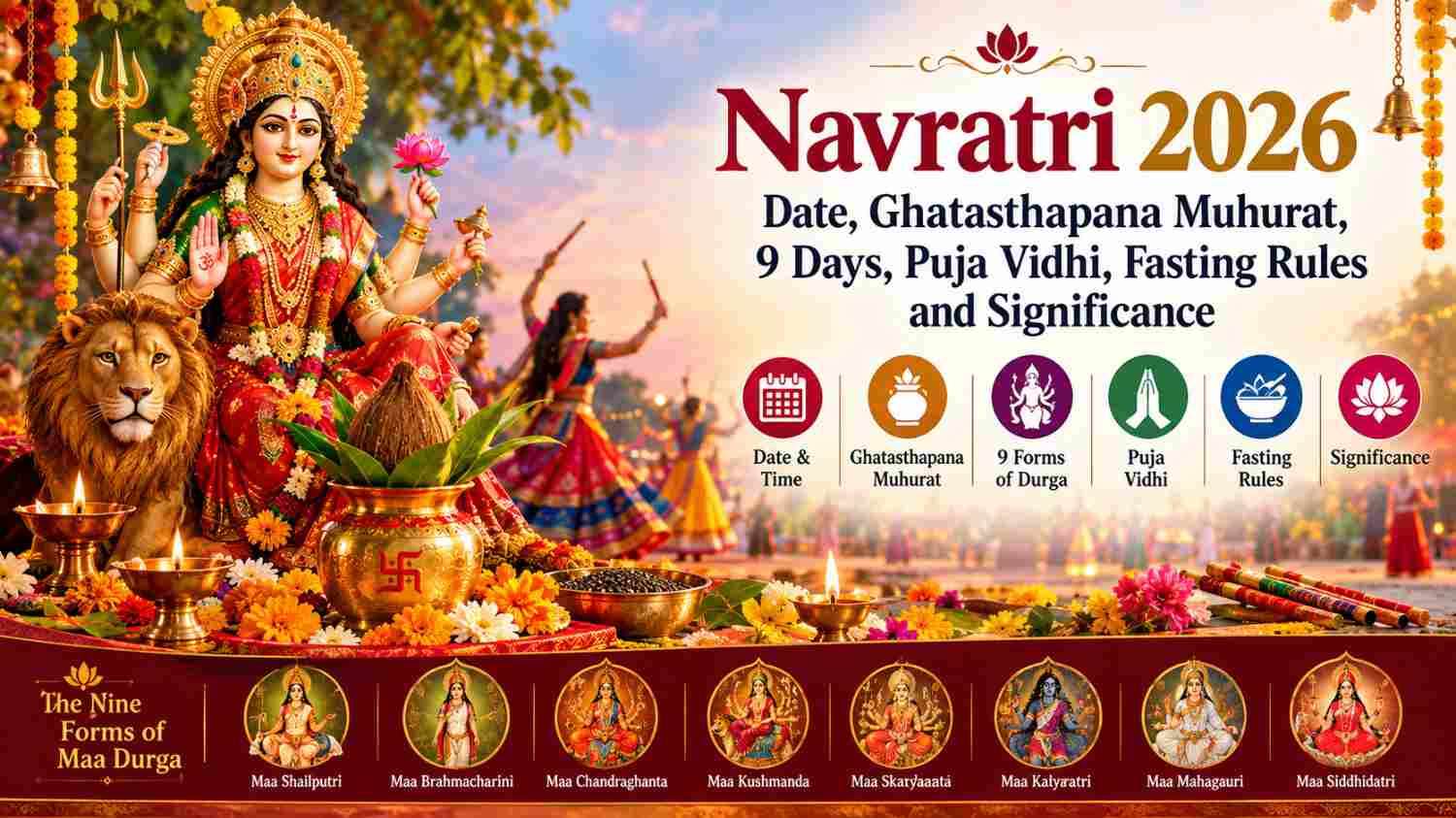
Navratri 2026 is one of the most important Hindu festivals dedicated to Goddess Durga and her nine divine forms. The festival is celebrated with devotion, fasting, prayers, meditation, Durga Puja, Garba, Dandiya and various traditional rituals.
Among the four Navratris observed during the Hindu lunar year, Sharad Navratri is one of the most widely celebrated. It begins during the Shukla Paksha of Ashwin month and leads into the festival of Vijayadashami, also known as Dussehra.
In 2026, Sharad Navratri will begin on Sunday, October 11, 2026, with Ghatasthapana or Kalash Sthapana performed on the first day. The Navratri observance will lead to Vijayadashami on Tuesday, October 20, 2026.
The Pratipada Tithi begins at approximately 9:19 PM on October 10 and continues until approximately 9:30 PM on October 11. Because the first day is determined according to the applicable lunar Tithi, Navratri begins on October 11.
The 2026 Navratri calendar also has an important Tithi overlap around Ashtami and Navami. Current calculations place Mahashtami and Mahanavami observances on October 19, followed by Vijayadashami on October 20.
This guide explains the Navratri 2026 date, Ghatasthapana Muhurat, nine forms of Goddess Durga, Navratri Puja Vidhi, fasting rules, Navratri colours, Kanya Puja, Ashtami, Navami, Dussehra and the spiritual significance of the festival.
Navratri 2026 Date and Time
The most important dates for Sharad Navratri 2026 are:
| Event | Date |
|---|---|
| Navratri Begins | Sunday, October 11, 2026 |
| Ghatasthapana | October 11, 2026 |
| Pratipada Tithi Begins | October 10, around 9:19 PM |
| Pratipada Tithi Ends | October 11, around 9:30 PM |
| Mahashtami | October 19, 2026 |
| Mahanavami | October 19, 2026 |
| Vijayadashami / Dussehra | Tuesday, October 20, 2026 |
The exact ritual timing can vary because Hindu Panchang calculations depend on sunrise and local astronomical conditions. Therefore, the date is broadly fixed, while minute-level Muhurat should be checked according to the Panchang applicable to the place where the Puja is being performed.
When Is Navratri in 2026?
Sharad Navratri 2026 begins on Sunday, October 11.
The festival begins with the Pratipada Tithi of the Shukla Paksha of Ashwin month. The first day is traditionally associated with Maa Shailputri, the first form among the Navadurga.
The first day is also important because devotees perform Ghatasthapana, also called Kalash Sthapana, to formally begin the Navratri worship.
The festival continues through the worship of the nine forms of Goddess Durga and concludes with Vijayadashami.
Navratri 2026 Ghatasthapana Muhurat
Ghatasthapana is one of the most important rituals performed on the first day of Sharad Navratri.
Current 2026 Panchang calculations give the main Ghatasthapana Muhurat approximately between:
6:19 AM and 10:12 AM on October 11, 2026.
An alternative Abhijit Muhurat is also available around midday in current calculations.
Because Ghatasthapana is a Tithi- and sunrise-dependent ritual, the exact minute-by-minute Muhurat can differ according to location. Therefore, readers should use the local Panchang for the final timing rather than treating one published time as universal.
Traditionally, Ghatasthapana is not performed casually at any time of the day. It is connected with the beginning of the Navratri worship period and should be performed during an appropriate Muhurat.
What Is Ghatasthapana?
Ghatasthapana is the ritual of establishing a sacred Kalash at the beginning of Navratri.
The Kalash symbolically represents divine presence, abundance and auspicious energy.
A traditional setup may include:
- Kalash
- Clean water
- Mango leaves or suitable leaves according to tradition
- Coconut
- Red cloth
- Sacred thread
- Rice
- Flowers
- Sand or clean soil
- Barley seeds
- Diya
- Kumkum
- Turmeric
- Betel nut
- Coins
- Fruits
Barley seeds are often planted in a container of soil during Ghatasthapana. The growing Jaware or barley shoots are traditionally associated with prosperity, growth and auspiciousness.
How to Perform Ghatasthapana at Home
A simple traditional procedure can be followed as long as it matches the family’s customary practice.
Step 1: Clean the Puja Area
Clean the place where the Navratri Kalash will be established.
Step 2: Prepare the Base
Place clean soil or earth in a suitable vessel and sow barley seeds.
Step 3: Prepare the Kalash
Fill a clean Kalash with water and add the prescribed auspicious items according to family tradition.
Step 4: Add Leaves
Place mango leaves or the leaves traditionally used by your family around the mouth of the Kalash.
Step 5: Place the Coconut
Wrap a coconut in a clean red or auspicious cloth and place it over the Kalash.
Step 6: Invoke Goddess Durga
Light a diya and offer flowers, kumkum, rice and other Puja materials.
Step 7: Take a Sankalp
Take a personal or family Sankalp to observe Navratri with devotion and discipline.
Step 8: Begin Daily Worship
After Ghatasthapana, perform daily prayers and worship according to your family tradition.
Navratri 2026: Nine Forms of Goddess Durga
During Sharad Navratri, devotees traditionally worship the Navadurga, or nine forms of Goddess Durga.
The nine forms are:
- Maa Shailputri
- Maa Brahmacharini
- Maa Chandraghanta
- Maa Kushmanda
- Maa Skandamata
- Maa Katyayani
- Maa Kalaratri
- Maa Mahagauri
- Maa Siddhidatri
Each form represents a different aspect of Shakti.
The sequence begins with Shailputri and concludes with Siddhidatri.
Navratri 2026 Day-Wise Calendar
The festival follows the lunar Tithi rather than simply assigning one goddess to each ordinary calendar date.
The main sequence is:
| Date | Tithi / Observance | Goddess |
|---|---|---|
| October 11 | Pratipada | Maa Shailputri |
| October 12 | Dwitiya | Maa Brahmacharini |
| October 13 | Tritiya | Maa Chandraghanta |
| October 14 | Chaturthi | Maa Kushmanda |
| October 15 | Panchami | Maa Skandamata |
| October 16 | Shashthi | Maa Katyayani |
| October 17–18 | Saptami Tithi overlap | Maa Kalaratri |
| October 19 | Mahashtami | Maa Mahagauri |
| October 19 | Mahanavami | Maa Siddhidatri |
A special feature of Navratri 2026 is the Tithi arrangement around Saptami, Ashtami and Navami. Because of this, the calendar does not behave like a simple one-date-per-goddess sequence. Current calculations show the Ashtami and Navami observances falling on October 19.
For this reason, readers should not be confused if different calendars display slightly different descriptions of the individual Navratri days.
Why Are Ashtami and Navami Both Important in 2026?
In 2026, the lunar Tithi arrangement creates an overlap that makes October 19 particularly significant.
Current calculations show:
- Ashtami begins on October 18
- Ashtami continues into October 19
- Navami begins on October 19
- Navami continues into October 20
Therefore, Mahashtami and Mahanavami observances are concentrated around October 19 in many current Panchang calculations.
This also makes Kanya Puja, Sandhi Puja, Navami Havan and other concluding rituals especially important during this period.
Because ritual practices differ, families should follow their customary observance when deciding the exact time for Kanya Puja or Havan.
Navratri Sandhi Puja 2026
Sandhi Puja is traditionally performed at the transition between Ashtami and Navami.
The word Sandhi refers to a junction or transition.
Traditionally, the Sandhi period consists of:
- The final 24 minutes of Ashtami
- The first 24 minutes of Navami
Together, this creates a 48-minute ritual period.
For 2026, current calculations place the Sandhi Puja on October 19. One current calculation gives a window of approximately 10:27 AM to 11:15 AM, although the exact timing can vary by location and Panchang.
Devotees may light lamps, offer flowers and perform special prayers during this period according to their tradition.
Navratri Puja Vidhi
Daily Navratri worship can be simple or elaborate depending on family tradition.
A general Puja sequence includes:
1. Morning Bath
Take a bath and wear clean clothes before beginning the Puja.
2. Clean the Puja Space
Keep the Durga idol, Kalash and surrounding area clean.
3. Light a Diya
Light a diya before beginning the worship.
4. Invoke Goddess Durga
Begin with a prayer seeking the blessings of Maa Durga.
5. Offer Flowers
Offer fresh flowers according to the day’s form of Goddess Durga.
6. Offer Kumkum and Rice
Apply kumkum and offer Akshat according to family tradition.
7. Offer Naivedya
Offer fruits, sweets or suitable Prasad.
8. Recite Mantras
Devotees may recite Durga mantras, Durga Chalisa, Devi Kavach or other traditional prayers.
9. Perform Aarti
Complete the worship with Maa Durga Aarti.
Navratri Puja Samagri List
If you are preparing for Navratri Puja at home, the following items can be useful:
- Maa Durga idol or picture
- Kalash
- Coconut
- Mango leaves
- Red cloth
- Mauli
- Rice
- Kumkum
- Turmeric
- Sandalwood
- Flowers
- Garland
- Incense sticks
- Diya
- Ghee or oil
- Cotton wicks
- Camphor
- Fruits
- Sweets
- Panchamrit ingredients
- Barley seeds
- Clean soil
- Betel nut
- Coins
- Sacred water
Not every family requires every item. The Puja Samagri should be adapted to the tradition being followed.
Navratri Fasting Rules
Many devotees observe fasting during all nine days, while others fast on selected days such as Ashtami or Navami.
Common fasting foods include:
- Fruits
- Milk
- Curd
- Sabudana
- Samak rice
- Kuttu flour
- Singhara flour
- Potatoes
- Sweet potatoes
- Peanuts
- Rock salt
- Coconut
Regular grains are commonly avoided by people observing a traditional Navratri fast.
However, fasting rules differ significantly between families and communities.
People with medical conditions, pregnancy, diabetes or other dietary requirements should not follow restrictive fasting rules without appropriate medical advice.
Navratri is a religious observance, not a requirement to compromise health.
What Should You Avoid During Navratri Fasting?
Those following traditional fasting rules commonly avoid:
- Regular wheat
- Regular rice
- Pulses
- Meat
- Fish
- Eggs
- Alcohol
- Tobacco
- Certain spices
- Onion and garlic, depending on tradition
Rock salt is commonly used instead of ordinary table salt during fasting.
Again, fasting practices are not identical across every Hindu community.
Navratri Vrat Food Ideas
A Navratri fasting menu can still be varied.
Some popular options include:
Breakfast
- Fruit
- Milk
- Sabudana preparation
- Dry fruits
Lunch
- Samak rice
- Potato curry
- Curd
- Salad
- Peanut-based dishes
Evening
- Fruit
- Coconut water
- Milk
- Makhana
Dinner
- Kuttu roti
- Singhara flour dishes
- Vegetable preparation
- Curd
The goal is to keep the food simple while following the fasting rules of your household.
Significance of the Nine Forms of Durga
The nine forms of Goddess Durga are traditionally understood as different manifestations of Shakti.
Maa Shailputri
Shailputri is worshipped on the first day. She represents strength, stability and the divine beginning of the Navratri journey.
Maa Brahmacharini
The second form is associated with devotion, discipline and spiritual determination.
Maa Chandraghanta
Chandraghanta is associated with courage, protection and inner strength.
Maa Kushmanda
Kushmanda represents creative energy and the cosmic power of creation.
Maa Skandamata
Skandamata is associated with motherhood, compassion and protection.
Maa Katyayani
Katyayani represents courage and the power to overcome negativity.
Maa Kalaratri
Kalaratri is traditionally associated with the destruction of darkness, fear and evil forces.
Maa Mahagauri
Mahagauri represents purity, peace and spiritual clarity.
Maa Siddhidatri
Siddhidatri is worshipped on Navami and is traditionally associated with spiritual perfection and divine blessings.
Navratri and the Victory of Good Over Evil
One of the best-known traditions associated with Navratri is the story of Goddess Durga’s battle with Mahishasura.
According to Hindu mythology, Mahishasura became extremely powerful and caused suffering among the gods and other beings.
The divine powers united to manifest Goddess Durga.
She fought Mahishasura and ultimately defeated him.
The story symbolizes the triumph of Dharma over Adharma, righteousness over arrogance and divine strength over destructive forces.
Navratri therefore has both a devotional and symbolic meaning.
It encourages devotees to recognize and overcome negative tendencies such as:
- Anger
- Ego
- Greed
- Fear
- Hatred
- Jealousy
- Dishonesty
Why Do People Celebrate Navratri for Nine Nights?
The word Navratri comes from two Sanskrit-derived terms:
- Nava – nine
- Ratri – nights
The festival is traditionally celebrated through nine nights and ten days of devotion.
Each day is associated with a particular form of Goddess Durga.
The number nine also has a strong symbolic presence in Hindu traditions, particularly in connection with Shakti and the Navadurga.
Navratri and Garba
Navratri is not limited to temple worship and fasting.
In many parts of India, the festival is celebrated through Garba and Dandiya Raas.
Garba is traditionally performed around a central lamp or symbolic representation of divine energy.
The circular movement represents the cycle of life and the continuing presence of Shakti.
Modern Navratri celebrations often combine traditional devotional elements with community gatherings, music and dance.
Navratri and Kanya Puja
Kanya Puja, also known as Kanjak or Kumari Puja in different traditions, is commonly performed during Ashtami or Navami.
Young girls are traditionally worshipped as manifestations of the divine feminine.
Families may:
- Invite young girls to the home.
- Wash or respectfully cleanse their feet according to tradition.
- Offer food.
- Apply tilak.
- Give gifts or Prasad.
- Seek their blessings.
The exact number of girls and ritual procedure varies among communities.
Some families also include a young boy, traditionally viewed as Bhairava, alongside the girls.
Navratri Havan
Many devotees perform Havan toward the end of Navratri.
A Havan involves offerings into a sacred fire while mantras are recited.
Common offerings may include:
- Ghee
- Havan Samagri
- Herbs
- Grains
- Coconut
- Dry fruits
- Sesame
- Other prescribed materials
The exact Havan procedure should follow the family’s tradition.
Havan is traditionally understood as a prayerful act of purification and devotion.
What Should You Do During Navratri?
Devotees commonly focus on:
- Daily Durga Puja
- Meditation
- Mantra chanting
- Reading Durga-related scriptures
- Fasting
- Charity
- Helping people in need
- Maintaining cleanliness
- Controlling anger and negative thoughts
- Visiting temples
- Participating in devotional activities
Navratri can be viewed not only as an external festival but also as a period of personal discipline.
What Should You Avoid During Navratri?
Traditional practices commonly encourage devotees to avoid:
- Alcohol
- Intoxicants
- Non-vegetarian food
- Deliberate harm
- Excessive anger
- Dishonesty
- Disrespect toward others
- Wasteful behaviour
- Negative speech
Some households follow additional restrictions regarding haircuts, shaving, purchases or other activities.
These customs vary and should be understood as family or community traditions rather than universal rules.
Navratri 2026: Is It Nine Days or Ten Days?
This is an important question for 2026.
Navratri is traditionally described as a nine-night festival, but the calendar can span more than nine ordinary dates because of lunar Tithi arrangements.
In 2026, the Tithi sequence creates an extended calendar arrangement around Saptami, Ashtami and Navami.
Current calculations show Navratri beginning on October 11 and Vijayadashami falling on October 20.
Therefore, the festival can appear as a longer calendar period even though the religious tradition is still known as Navratri, the nine-night festival.
Navratri 2026 and Vijayadashami
Vijayadashami, or Dussehra, will be observed on Tuesday, October 20, 2026.
It marks the conclusion of the Navratri period and is associated with the victory of good over evil.
Different regions celebrate Vijayadashami in different ways.
Traditions may include:
- Durga Visarjan
- Shami Puja
- Ayudha Puja
- Aparajita Puja
- Ramlila
- Burning of Ravana effigies
- Exchange of Shami leaves
- Beginning new activities
The exact customs depend on regional and family traditions.
Navratri 2026: Maa Durga’s Arrival
A traditional belief connects the weekday on which Navratri begins with the symbolic vehicle associated with Maa Durga’s arrival.
Because Navratri begins on Sunday in 2026, traditional interpretations associate the Goddess’s arrival with an elephant.
In religious tradition, this is interpreted symbolically in connection with prosperity, stability and rainfall.
These vehicle interpretations belong to traditional religious beliefs and should not be treated as scientific predictions.
Navratri 2026: What Is the Significance of the Elephant?
The elephant is traditionally regarded as a symbol of:
- Strength
- Stability
- Prosperity
- Wisdom
- Rainfall
- Abundance
The association of Maa Durga’s arrival with an elephant is therefore viewed positively in traditional festival interpretations.
However, these are cultural and religious beliefs rather than guaranteed predictions about future events.
Frequently Asked Questions About Navratri 2026
When does Navratri start in 2026?
Sharad Navratri begins on Sunday, October 11, 2026.
When is Ghatasthapana in 2026?
Ghatasthapana will be performed on October 11, 2026.
What is the Ghatasthapana Muhurat in 2026?
The main published window is approximately 6:19 AM to 10:12 AM, with an alternative Abhijit Muhurat around midday. Exact timing varies according to location and Panchang.
When is Mahashtami in 2026?
Mahashtami will be observed on October 19, 2026, according to current Tithi calculations.
When is Mahanavami in 2026?
Mahanavami will also be observed on October 19, 2026 in the current calendar calculation because of the Tithi overlap.
When is Dussehra in 2026?
Vijayadashami or Dussehra will be celebrated on Tuesday, October 20, 2026.
Which Goddess is worshipped on the first day of Navratri?
The first day is dedicated to Maa Shailputri, the first form of Navadurga.
What is Ghatasthapana?
Ghatasthapana is the traditional establishment of a sacred Kalash at the beginning of Navratri. It symbolically marks the beginning of the Devi worship period.
Can we eat rice during Navratri fasting?
People following traditional Navratri fasting generally avoid regular rice. Samak rice is commonly used as a fasting alternative.
Can we eat onion and garlic during Navratri?
Many families avoid onion and garlic during Navratri fasting, although practices vary according to tradition.
Can children observe Navratri fasting?
Children should not be placed on restrictive fasts without considering their nutritional needs. A devotional routine involving prayer, simple food and participation in Puja can be a better approach.
Can pregnant women fast during Navratri?
Pregnant women should prioritize adequate nutrition and hydration. Any restrictive fasting should be discussed with a qualified healthcare professional.
Why is Navratri celebrated?
Navratri celebrates the divine feminine power of Shakti and is traditionally associated with the victory of good over evil, particularly Goddess Durga’s victory over Mahishasura.
What is the significance of Kanya Puja?
Kanya Puja is a traditional worship of young girls as manifestations of the divine feminine. It is commonly performed around Ashtami or Navami.
Conclusion
Sharad Navratri 2026 begins on Sunday, October 11, and Vijayadashami will be observed on Tuesday, October 20. Ghatasthapana will also take place on October 11, with the main published Muhurat falling approximately between 6:19 AM and 10:12 AM, while an alternative Abhijit window is available around midday.
The most important thing to remember about Navratri is that it is much more than nine days of fasting.
It is a period of devotion, discipline, self-reflection and respect for Shakti.
Through the nine forms of Goddess Durga, the festival presents different qualities of divine feminine energy—from strength and determination to compassion, courage, purity and spiritual wisdom.
The 2026 calendar is particularly interesting because of the Tithi arrangement around Ashtami and Navami, with both major observances falling on October 19 in current calculations, followed by Vijayadashami on October 20.
Whether you celebrate Navratri through fasting, daily Puja, Durga Saptashati recitation, Garba, Kanya Puja, Havan or simply by spending more time in prayer, the central message remains powerful:
Remove negativity, strengthen faith, cultivate discipline and allow the inner light to overcome darkness.
For exact ritual Muhurat, especially Ghatasthapana, Sandhi Puja, Kanya Puja and Havan, always follow the local Panchang and your family tradition, because minute-level timings can change according to location.