🕉 The Sacred Science of Mantras
Vedic & Devika Traditions — Origin, Meaning, and Spiritual Power
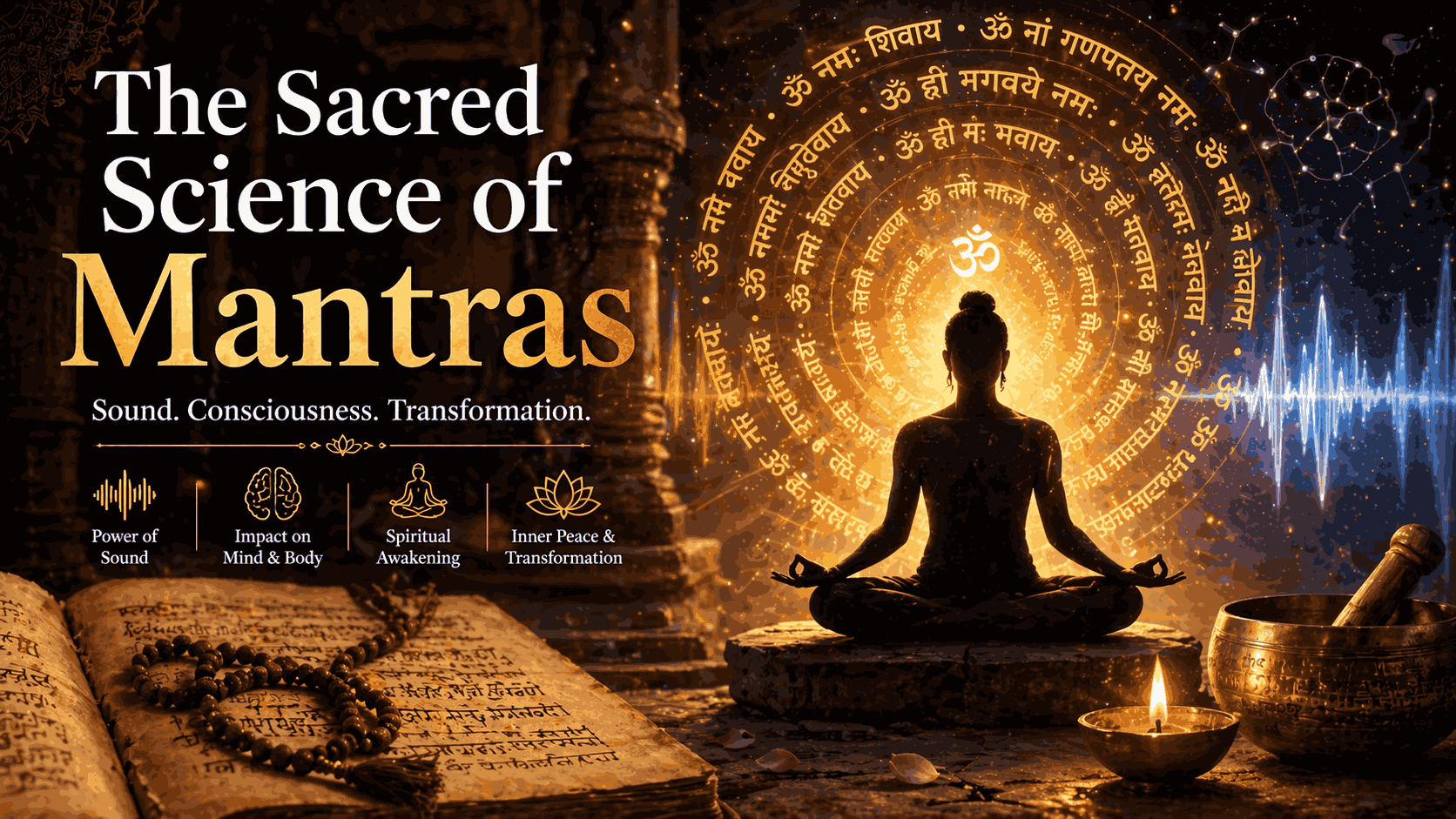
🕉 The eternal science of sacred sound — from the Vedic Rishis to the Tantric Shakti tradition
“Mantra is not merely a word or a sentence. It is a living sound — a cosmic vibration that was heard by the Rishis in the depths of their silence.”
In the vast and timeless ocean of Hindu spiritual tradition, few concepts hold as much power, mystery, and transformative potential as the Mantra. The word ‘Mantra’ itself is derived from two Sanskrit roots — Man (mind) and Tra (to protect or liberate). Literally, a mantra is that which liberates the mind. But this simple definition barely scratches the surface of a tradition refined over thousands of years by sages, mystics, and devotees across the Indian subcontinent.
Mantras are not mere prayers or affirmations. They are precise sonic formulas — vibrations that, when chanted with correct pronunciation, rhythm, intention, and devotion, align the practitioner’s consciousness with specific cosmic energies. The ancient Rishis did not compose these sounds; they received them in states of deep meditative absorption. This is why Vedic mantras are called Apaurusheya — not of human origin.
In the Hindu tradition, mantras are broadly classified into two great streams: the Vedic Mantras (Vaidika), which flow from the four Vedas, and the Devika or Tantric Mantras, which emerge from the Agamas, Tantras, and Puranas. Each tradition carries its own philosophy, purpose, methodology, and spiritual heritage. Together, they form a complete science of sacred sound — spanning from cosmic hymns of the Rig Veda to the potent seed syllables of Tantric Shakti worship.
In this comprehensive guide, we journey through the two great rivers of mantra tradition — exploring their origins, philosophies, types, practices, and the extraordinary spiritual dimensions they open for the sincere seeker.
Part I: Vedic Mantras (Vaidika) — The Voice of the Cosmos
Origin and Philosophy
The Vedic mantras are the oldest and most revered sacred compositions in the world. They originate from the four Vedas — the Rig Veda, Yajur Veda, Sama Veda, and Atharva Veda — a body of knowledge so ancient that scholars date its earliest layers to over 3,500 years ago, though the oral tradition extends far deeper into prehistory.
According to Hindu philosophy, the Vedas are Shruti — ‘that which is heard.’ They were not written or invented by human intellect but were directly cognized by the great Rishis in states of profound Samadhi. In this sense, Vedic mantras are considered eternal cosmic truths that exist independently of the human mind — they are Apaurusheya, non-human in origin.
The Vedic worldview understands existence as a cosmic symphony — a unified field of consciousness vibrating at different frequencies. The Vedic mantras are the precise sonic keys that attune the human nervous system to these cosmic frequencies. When chanted with the correct Svara (pitch), Matra (duration), and Bala (force), they create measurable effects in the mind, body, and environment of the practitioner.
The Four Vedas and Their Mantra Traditions
1. Rig Veda — The Hymns of Praise (Ruk)
The Rig Veda is the oldest of the four Vedas, consisting of 1,028 Suktas (hymns) organized into 10 Mandalas (books). The word ‘Ruk’ means ‘a verse that shines’ — each verse is a luminous praise offered to a specific cosmic deity. The mantras invoke Agni (fire), Indra (cosmic power), Varuna (cosmic law), Surya (the sun), Soma (the divine essence), and many other Devatas.
These are not merely poetic compositions. The Riks carry specific Chhandas (meters) such as Gayatri, Trishtubh, and Jagati — each resonating at a particular frequency and serving a specific spiritual function. The Purusha Suktam and the Nasadiya Suktam (Hymn of Creation) are among the most profound philosophical compositions in the Vedic corpus.
“Aham Vrishabhah” — ‘I am the cosmic bull of power’ (Rig Veda) — an affirmation of the divine energy within every being.
2. Yajur Veda — The Formulas of Sacred Action (Yajus)
The Yajur Veda is the practical manual of Vedic ritual. Its mantras — called Yajus — are formulaic statements used during Yajna (sacrificial rites). Unlike the lyrical hymns of the Rig Veda, the Yajus mantras are prosaic, precise, and action-oriented, directing the priest in the correct performance of sacred rituals and ensuring that every offering and invocation aligns with cosmic order (Rta).
The Yajur Veda exists in two forms: the Shukla (White) Yajur Veda and the Krishna (Black) Yajur Veda. Among its most celebrated mantras is the Mahamrityunjaya Mantra — the Great Death-Conquering mantra of Lord Shiva — and the Shiva Sankalpa Sukta, which directs the mind toward divine intention.
3. Sama Veda — The Melody of the Divine (Saman)
The Sama Veda is the Veda of music. Its mantras are almost entirely drawn from the Rig Veda but are set to specific melodic patterns (Samans) that transform them into powerful musical invocations. In the Bhagavad Gita, Lord Krishna declares: “Vedanam Samavedosmi” — ‘Among the Vedas, I am the Sama Veda.’
The Udgatri priest, specially trained in Saman music, would chant these melodic mantras during the Soma Yajna. The tradition holds that the precise musical intervals of the Saman create specific resonances in the subtle body that open channels for divine grace. Classical Indian music traces its very roots to this sacred musical tradition.
4. Atharva Veda — The Veda of Daily Life
The Atharva Veda stands somewhat apart from the other three Vedas. While the first three are primarily concerned with cosmic order and ritual, the Atharva Veda is deeply connected to the practical concerns of human life — healing, protection, prosperity, love, and overcoming obstacles. Its mantras address everything from medicinal herbs and their healing properties to protective charms against negative energies.
The Atharva Veda preserves ancient knowledge of Ayurveda (medicine), Vastu (sacred architecture), and Jyotisha (astrology). Many scholars believe it represents the oldest stratum of Indian folk and tribal spiritual wisdom that was eventually incorporated into the broader Vedic framework.
Key Features of Vedic Mantras
- Apaurusheya (Non-human Origin): Received by Rishis in meditative cognition, not composed by human intellect.
- Istapurti (Universal Welfare): Oriented toward collective good, cosmic harmony, and dharmic order rather than individual desires.
- Semantic Richness: Each word carries precise, layered meanings — phonetic, philosophical, and symbolic simultaneously.
- Structural Precision: Governed by strict rules of Chandas (meter), Svara (pitch), and Matra (syllable duration).
- Accessibility: Generally open to sincere seekers after proper initiation or Upanayana.
The Great Vedic Mantras
The Gayatri Mantra
Om Bhur Bhuva Swaha, Tat Savitur Varenyam,
Bhargo Devasya Dhimahi, Dhiyo Yo Nah Prachodayat
Considered the mother of all Vedic mantras, the Gayatri is addressed to Savitar — the solar principle of divine intelligence. It is a prayer for the illumination of the intellect so that it may be guided along the path of truth. Chanted at the three Sandhyas (dawn, noon, and dusk), the Gayatri aligns the practitioner’s biorhythm with the solar cycle.
The Mahamrityunjaya Mantra
Om Tryambakam Yajamahe Sugandhim Pushtivardhanam,
Urvarukamiva Bandhanan Mrityor Mukshiya Maamritat
The Great Death-Conquering mantra from the Yajur Veda is addressed to the three-eyed Shiva. It is invoked for healing, protection, and liberation from the cycle of rebirth. The metaphor of the gourd fruit (Urvaruka) separating naturally from the vine when ripe is one of the most beautiful images in Vedic literature — the soul liberated from death as effortlessly as fruit released from its vine.
Part II: Devika / Tantric Mantras — The Power of the Divine Feminine
Origin and Philosophical Foundations
While Vedic mantras celebrate the cosmic order and the masculine principle of cosmic intelligence, the Devika (Tantric) mantras draw from a parallel and equally ancient stream — the Shakta-Tantric tradition. These mantras originate from the Agamas (sacred dialogues between Shiva and Shakti), the Tantras, and the Puranas — a vast body of literature that emphasizes the primacy of Shakti (divine feminine energy) as the dynamic, creative force underlying all existence.
The philosophical foundation of Tantric mantra science rests on the recognition that Sound itself is the primordial creative force of the universe. In Tantric cosmology, before creation there existed only Parashiva (pure consciousness). When Shakti — the dynamic power inherent in consciousness — began to vibrate, the first sound emerged: the Nada (cosmic sound). From this primordial vibration, all manifest reality arose.
This is the crucial difference between the Vedic and Tantric approaches. Vedic mantras primarily carry semantic (meaning-based) power — they describe, invoke, and praise the divine. Tantric mantras operate primarily through phonetic resonance — they ARE the deity. The Mantra, the Devata (deity), and the Yantra (sacred geometric form) are three expressions of the same living spiritual reality.
The Shadanga — Six Limbs of Every Devika Mantra
Every properly constituted Devika mantra has a specific structure known as the Shadanga (six limbs):
| Limb | Meaning |
|---|---|
| Rishi | The sage to whom the mantra was revealed — establishing lineage connection |
| Chandas | The meter that governs the mantra’s rhythm |
| Devata | The deity that the mantra embodies and invokes |
| Bija | The seed syllable — the core energy nucleus of the mantra |
| Shakti | The specific divine energy activated by the mantra |
| Kilaka | The ‘pin’ that unlocks the mantra’s full power through practice |
Types of Devika Mantras
1. Beej (Bija) Mantras — Seed Syllables of Power
Bija mantras are single or short syllable sounds that are the compressed essence of entire deities and cosmic forces. ‘Bija’ means ‘seed’ — just as a massive tree is contained within a tiny seed, the entire divine energy of a deity is compressed into its Bija. These are the most potent and concentrated forms of mantra.
| Bija | Deity | Energy Invoked |
|---|---|---|
| ह्रीं (Hreem) | Bhuvaneshwari | Cosmic illusion (Maya), divine sovereignty |
| श्रीं (Shreem) | Lakshmi | Abundance, beauty, grace, prosperity |
| क्रीं (Kreem) | Kali | Transformation, ego-dissolution, time |
| ऐं (Aim) | Saraswati | Knowledge, creativity, speech |
| दुं (Dum) | Durga | Protection, empowerment, courage |
| क्लीं (Kleem) | Kamadeva / Krishna | Divine attraction, love, fulfillment |
2. Saguna Mantras — Devotional Forms of the Divine
Saguna mantras invoke specific forms (Saguna = ‘with qualities’) of deities. These mantras combine Bija syllables with descriptive names and salutations, creating a complete sonic portrait of the deity’s attributes, powers, and relationships. They are accessible, devotionally rich, and deeply beloved by practitioners at all levels.
Om Aim Hreem Kleem Chamundayai Vichche
This powerful Chamunda (Durga) mantra contains three Bija syllables — Aim (Saraswati/wisdom), Hreem (Bhuvaneshwari/sovereignty), and Kleem (Kali/transformation) — representing the three aspects of the Divine Mother. Together, they invoke the complete power of the Divine Mother in her fierce, protective form.
3. Mala Mantras — The Garland of Sound
Mala mantras are long, elaborate compositions that weave together Bija syllables, divine names, and protective invocations into an extended garland (Mala) of sound. The Shodashi Mala Mantra of the Sri Vidya tradition and various Kavacha (armour) mantras belong to this category. These are typically chanted for protection, comprehensive blessing, and as part of extended ritual worship (Puja).
The Great Devika Mantras and Their Powers
Sri Vidya and the Panchadashi Mantra
The Sri Vidya tradition represents the pinnacle of Tantric mantra science. Its central mantra — the Panchadashi (fifteen-syllable mantra) — is considered the most complete of all Tantric mantras. Divided into three Kutas (sections) representing Creation, Preservation, and Dissolution, this mantra is traditionally passed only through direct lineage initiation (Diksha).
Kali Mantra — The Liberation of Time
Om Kreem Kalikayai Namah
Kali is perhaps the most misunderstood deity in the Hindu pantheon. Far from being a symbol of mere destruction, she represents the liberating power of time and transformation. Her mantra, centered on the Bija ‘Kreem,’ activates Kundalini energy and accelerates spiritual transformation. Devotees of Kali — particularly in the Bengali Shakta tradition — regard her as the most direct path to liberation precisely because she strips away all illusions without compromise.
Lakshmi Mantra — The Grace of Abundance
Om Shreem Mahalakshmyai Namah
Lakshmi, goddess of abundance and auspiciousness, is invoked through mantras centered on the Shreem Bija. The tradition distinguishes between eight forms of Lakshmi — the Ashtalakshmi — representing wealth, grain, courage, victory, knowledge, progeny, elephants, and spiritual grace. The Sri Sukta (from the Rig Veda) and the Kanakadharastotram remain the most celebrated Lakshmi hymns in the tradition.
Part III: Mantras by Functional Goal
Kamya Mantras — For the Fulfillment of Desires
Kamya mantras are chanted to fulfill specific earthly desires — wealth, health, love, success, and the removal of obstacles. They are particularly associated with the Atharva Veda and Tantric traditions. The tradition recognizes that the legitimate fulfillment of human desires (Purusharthas — Dharma, Artha, Kama) is itself part of the spiritual journey. Examples include mantras for business success, healing specific ailments, and harmonious relationships.
Astra Mantras — The Mantras of Protection
Astra mantras are associated with divine weapons wielded by cosmic beings. In the Vedic and Epic traditions (Ramayana, Mahabharata), great warriors like Rama and Arjuna received Astras — divine weapons that were actually mantra-activated energies. The Agneyastra (fire weapon), Varunaastra (water weapon), and Brahmaastra are classic examples. In contemporary practice, Astra mantras are used for protection, removal of negative energies, and spiritual shielding.
Para Mantras — The Mantras of Liberation
Para mantras represent the highest tier of mantra practice — those directed not toward any earthly goal but toward the ultimate liberation of consciousness from the cycle of birth and death (Samsara). ‘Para’ means ‘beyond’ — these mantras take the practitioner beyond all relative states of existence. The Pranava (Om), the Mahavakyas (great sayings like Aham Brahmasmi — ‘I am Brahman’), and certain Upanishadic mantras belong to this supreme category.
The Mandukya Upanishad dedicates its entire text to the single syllable Om — the Para mantra par excellence. The three phases of Om (A, U, M) and the fourth state of silence that follows represent the four states of consciousness: waking, dreaming, deep sleep, and Turiya (transcendence).
Vedic vs. Devika Mantras — A Comparative Overview
| Feature | Vedic Mantras | Devika / Tantric Mantras |
|---|---|---|
| Origin | Vedas (Samhita / Aranyaka) | Agamas, Tantras, Puranas |
| Focus | Rituals, Harmony, Knowledge, Universal Welfare | Power, Quick Grace, Energy Activation |
| Sound Basis | Semantic (Meaning-centric) | Phonetic (Bija / Sound-centric) |
| Initiation | Generally open / Upanayana | Often requires Guru Diksha |
| Structure | Longer Suktas / Verses | Short to Medium Vidyas with Bijas |
| Deity Focus | Nature deities, Cosmic principles | Shakti, Devi, Specific Goddesses |
| Speed of Results | Gradual, through sustained practice | Faster, more targeted results |
A sincere Vedic practitioner chanting the Purusha Suktam is invoking the cosmic person through the poetry of Vedic vision — like sacred astronomy, mapping the heavens of consciousness. A Tantric practitioner chanting Hreem is not describing Bhuvaneshwari — they are generating her sonic form in their own being, like sacred alchemy transforming lead into gold through vibrational force. Both approaches are valid; both lead to the same summit by different paths.
The Living Science of Sacred Sound
The tradition of mantras in Hinduism is not a relic of the ancient past. It is a living, breathing science of consciousness — as relevant in the 21st century as it was when the Rishis first heard these sounds in the Himalayan forests thousands of years ago. Modern neuroscience is beginning to validate what the ancient sages knew intuitively: that specific sound patterns create measurable changes in brain wave activity, hormonal balance, and neurological function.
But the deepest dimension of mantra practice cannot be captured in any laboratory. It belongs to the interior journey — the silent, sacred space where the practitioner and the mantra merge, where the boundary between the one who chants and the chant itself dissolves, and where the cosmic silence from which all sound arises is directly experienced.
Whether you are drawn to the universal cosmic hymns of the Rig Veda, the healing formulas of the Atharva Veda, the melodic chants of the Sama Veda, or the transformative power of Tantric Bija mantras — the invitation is the same: to turn inward, to listen deeply, and to discover that the mantra you seek is already vibrating at the core of your own consciousness.
“The universe began with sound. The Vedas are that sound in human language. The Tantras are that sound as living energy. And within you, both are One.”
🕉 Om Tat Sat 🕉
🙏 Frequently Asked Questions — Mantras
Answers to the most common questions seekers ask about Vedic and Devika mantra traditions.
1. What is the difference between a Vedic mantra and a Tantric (Devika) mantra?
The core difference lies in origin, purpose, and mechanism. Vedic mantras come from the four Vedas and work primarily through meaning and cosmic invocation — they praise and align the practitioner with universal forces like Surya, Agni, and Varuna. Tantric/Devika mantras come from the Agamas and Tantras and work primarily through phonetic resonance — particularly through Bija (seed) syllables that are considered the sonic body of a deity. Simply put: Vedic mantras describe the divine; Tantric mantras are the divine in sound form.
2. Do I need a Guru or initiation (Diksha) to chant mantras?
It depends on the mantra. Vedic mantras like the Gayatri, Mahamrityunjaya, and Shanti mantras are generally considered open to all sincere seekers — though proper pronunciation guidance is strongly recommended. Tantric/Devika mantras — especially advanced Vidyas like the Panchadashi (Sri Vidya) or the Shodashi — traditionally require initiation from a qualified Guru. The initiation (Diksha) transfers the Guru’s realized understanding of the mantra’s energy, making it significantly more potent. That said, simple Saguna mantras like Om Namah Shivaya or Om Shreem Mahalakshmyai Namah are widely chanted without formal initiation and carry great benefit through sincere devotion.
3. What does the word “Om” (OM / AUM) actually mean?
Om (written as AUM in Sanskrit) is the Pranava — the primordial sound from which all creation emerges. The Mandukya Upanishad devotes its entire text to this single syllable. The three phonemes carry deep meaning:
- A (अ): Represents the waking state (Jagrat) and the gross world of physical experience.
- U (उ): Represents the dream state (Svapna) and the subtle inner world.
- M (म): Represents deep sleep (Sushupti) and the causal body.
- The silence after AUM: Represents Turiya — the fourth state of pure witnessing consciousness, beyond all three.
Om is therefore not merely a sound but a map of all states of consciousness. It is placed at the beginning of almost every mantra because it tunes the practitioner to the universal frequency before the specific invocation begins.
4. How many times should a mantra be chanted? What is the significance of 108?
The traditional unit of mantra repetition is the Mala — a rosary of 108 beads. Chanting a mantra 108 times completes one Mala. The number 108 is profoundly significant across multiple dimensions:
- Astronomical: The distance between the Earth and the Sun is approximately 108 times the Sun’s diameter. The same ratio applies to the Earth-Moon distance.
- Yogic: There are 108 Upanishads, 108 Marma points (vital energy points) in the body, and 108 names each for major deities.
- Mathematical: 108 = 1¹ × 2² × 3³ — the product of the first three integers raised to their own powers.
- Breath: A human being takes approximately 21,600 breaths per day — exactly 108 × 200.
For intensive practice, mantras may be chanted for 1,008 or 100,000 repetitions (a Laksha Japa) over a defined period called an Anushthana.
5. Can women chant Vedic mantras?
This has been a topic of evolving interpretation within Hindu tradition. Historically, certain Vedic texts and some orthodox schools restricted access to specific Vedic mantras based on gender and caste. However, many ancient sources — including the Rig Veda itself — contain hymns composed by women Rishikas (female seers) such as Lopamudra, Gargi, and Maitreyi, demonstrating that women have always been among the tradition’s great sages. The Tantric tradition explicitly welcomes women, as Shakti (the Divine Feminine) is the supreme principle. Today, most contemporary spiritual teachers and many traditional scholars affirm that sincere devotion and spiritual eligibility (adhikara) are not limited by gender. Mantras like the Gayatri are now widely taught to women across all traditions.
6. What is the best time of day to chant mantras?
The tradition identifies four especially powerful times — called Sandhyas (junctions of time) — for mantra practice:
- Brahma Muhurta (4:00–6:00 AM): The most auspicious time. The mind is fresh, the atmosphere is charged with Sattva (purity), and cosmic energy is at its peak. Highly recommended for Vedic and Para mantras.
- Sunrise (Pratah Sandhya): The transition from night to day — ideal for Surya (sun) mantras and the Gayatri.
- Noon (Madhyahna): Secondary Sandhya, suitable for continued Japa practice.
- Sunset (Sayam Sandhya): The transition from day to night — ideal for Devi mantras, Shiva mantras, and evening Puja.
The most important principle, however, is consistency. A mantra chanted daily at the same time creates a powerful rhythm that deepens the practice over time, regardless of which Sandhya you choose.
7. What is the difference between Japa, Kirtan, and Yajna?
These are three distinct modes of mantra practice, each serving different purposes:
- Japa: Silent or whispered repetition of a mantra, typically with a mala (rosary). This is the most common and accessible form of mantra practice — deeply personal, meditative, and internalized. The Bhagavad Gita calls Japa Yajna the highest form of sacrifice.
- Kirtan: Communal, melodic chanting — often call-and-response — typically of devotional names and mantras (Nama Kirtan). It is outward, joyful, and community-oriented. The Bhakti tradition (especially in Vaishnavism) considers Kirtan the most powerful spiritual practice for the current age (Kali Yuga).
- Yajna / Homa: Fire ritual in which mantras are chanted while offerings (ghee, herbs, grains) are made into a consecrated fire. The fire acts as the mouth of the deity — offerings made into it reach the cosmic forces directly. Yajnas are elaborate, collective, and generate powerful purification of the environment.
8. What are Bija mantras and why are they so powerful?
Bija means ‘seed’ in Sanskrit. A Bija mantra is a single-syllable sound that contains the concentrated sonic essence of a deity or cosmic force — just as a mighty tree is fully contained within a tiny seed. What makes Bija mantras exceptionally powerful is that they operate beyond the level of ordinary meaning. You cannot translate “Hreem” or “Kreem” into a concept — they are pure vibrational signatures. When chanted with sustained focus and proper pronunciation, they:
- Directly activate specific energy centres (Chakras) in the subtle body.
- Establish a vibrational resonance with the corresponding deity’s energy field.
- Bypass the analytical mind, working directly on the deeper layers of consciousness (Koshas).
- Serve as the nucleus around which longer Saguna mantras are built.
Because of their concentrated power, Bija mantras — especially advanced ones — are traditionally received from a qualified teacher who has themselves realized the mantra’s energy through sustained practice.
9. Can mantras be chanted mentally (silently), or must they be spoken aloud?
The tradition recognizes three modes of chanting, each with different effects:
- Vaikhari (Audible / Spoken): Chanting aloud. Purifies the physical environment, is excellent for Kirtan and group practice, and benefits others present. Recommended for beginners as it keeps the mind anchored.
- Upamsu (Whispered / Murmured): Chanting in a low voice or whisper, lips moving but barely audible. Considered ten times more powerful than Vaikhari. Creates a deeply internalized vibration.
- Manasika (Mental / Silent): Chanting entirely within the mind, with no physical movement. Considered the most powerful — one hundred times more effective than audible chanting according to many texts. Requires strong concentration but yields the deepest meditative absorption.
For most practitioners, beginning with audible chanting and gradually moving toward mental Japa as concentration deepens is the recommended progression.
10. Does the meaning of a mantra matter, or is the sound alone sufficient?
This is one of the most fascinating philosophical debates within the mantra tradition itself. The two traditions offer complementary answers:
- Vedic View (Mimamsa school): The meaning of the mantra is central. Understanding the semantic content — who is being invoked, what is being requested, and why — deepens the practitioner’s intention and opens the intellect to the cosmic reality being described. Meaning + sound = complete invocation.
- Tantric View: The sound itself is the primary vehicle of power. A Bija like Hreem carries its transformative energy regardless of whether the practitioner intellectually understands it. The vibration acts directly on the subtle body. Meaning enhances but is not strictly necessary.
In practice, the most complete approach combines both: understand the meaning deeply, then release the meaning during chanting and surrender to the sound. This is what masters of both traditions consistently recommend — intellectual understanding provides the container; the sound fills it with living energy.
11. Which mantra is best for a complete beginner?
There is no single ‘best’ mantra — the right mantra depends on your spiritual inclination (Ishta Devata — chosen deity), purpose, and temperament. However, the following are universally recommended as entry points:
- Om (AUM): The simplest and most universal. Begin every session with Om. It is the root of all mantras.
- Om Namah Shivaya: The Panchakshara (five-syllable) mantra of Shiva. Deeply purifying, protective, and liberating. Widely recommended across all traditions.
- Om Namo Narayanaya: The Ashtakshara (eight-syllable) mantra of Vishnu. Cultivates surrender, devotion, and inner peace.
- Gayatri Mantra: The supreme Vedic mantra for illumination of the intellect. Best chanted at sunrise.
- Om Shreem Mahalakshmyai Namah: For those drawn to the Divine Mother and seeking abundance and grace in life.
Begin with one mantra, practice it consistently for at least 40 days (a traditional Sadhana cycle), and observe the subtle shifts in your mind and energy. Depth in one mantra far exceeds breadth across many.
12. Is there a scientific basis for the power of mantras?
Modern science is increasingly validating what the ancient tradition knew experientially. Research across neuroscience, acoustics, and psychophysiology has found:
- Brainwave Entrainment: Repetitive rhythmic chanting shifts brain activity from Beta (active thinking) to Alpha and Theta states — associated with deep relaxation, creativity, and meditative absorption.
- Vagal Tone: Slow, rhythmic chanting activates the parasympathetic nervous system through the vagus nerve, reducing cortisol (stress hormone) levels and improving heart rate variability.
- Cymatics: The science of visible sound demonstrates that specific frequencies create precise geometric patterns in matter — supporting the Tantric claim that mantras generate specific energy forms.
- Sanskrit Phonetics: Research on Sanskrit pronunciation shows that the palatal articulation points activated during Sanskrit chanting stimulate specific meridian points on the roof of the mouth connected to the brain’s limbic system.
However, as any genuine practitioner will tell you: the most profound effects of mantra practice operate at dimensions of consciousness that no current scientific instrument can measure. Science offers a fascinating outer confirmation — but the inner experience is the real proof.
Tags: Vedic Mantras, Tantric Mantras, Gayatri Mantra, Mahamrityunjaya Mantra, Bija Mantra, Shakti, Devi, Hindu Spirituality, Mantra Yoga, Sacred Sound, Agamas, Rig Veda, Yajur Veda, Sama Veda, Atharva Veda, Kali Mantra, Lakshmi Mantra, Sri Vidya