By understanding the nine celestial lords, you understand the map of your own destiny.
Introduction: When the Sky Speaks to Your Soul
You work hard. Yet sometimes, life feels like an invisible wall has appeared between you and everything you deserve — your health suffers, your career stalls, your relationships break, your peace of mind simply vanishes.
Hindu philosophy has a profound answer, one that has been given to seekers for thousands of years: the planets are watching. And they are influencing you.
This is not blind superstition. It is the conclusion of India’s ancient Vedic sages — astronomer-priests who spent lifetimes studying the cosmos and its relationship to human life. The system they built is called Jyotish Shastra — the science of light — and at its very core stand the nine celestial powers known as the Navagrahas.
The Navagraha Puja is one of the most ancient, most respected, and most universally practised rituals in all of Hinduism. It is performed before weddings, before moving into a new home, before beginning a business, before surgery, before examinations — because in Hindu thought, before you begin anything important in this world, you first seek permission and balance from the cosmos.
What Are the Navagrahas? The Nine Lords of Destiny
The word Navagraha comes from two Sanskrit roots: Nava meaning nine, and Graha meaning “that which seizes or holds.” The Graha is not merely a planet in the astronomical sense — it is a divine force that grasps — that takes hold of a person’s life energy and directs it according to the cosmic law of karma.
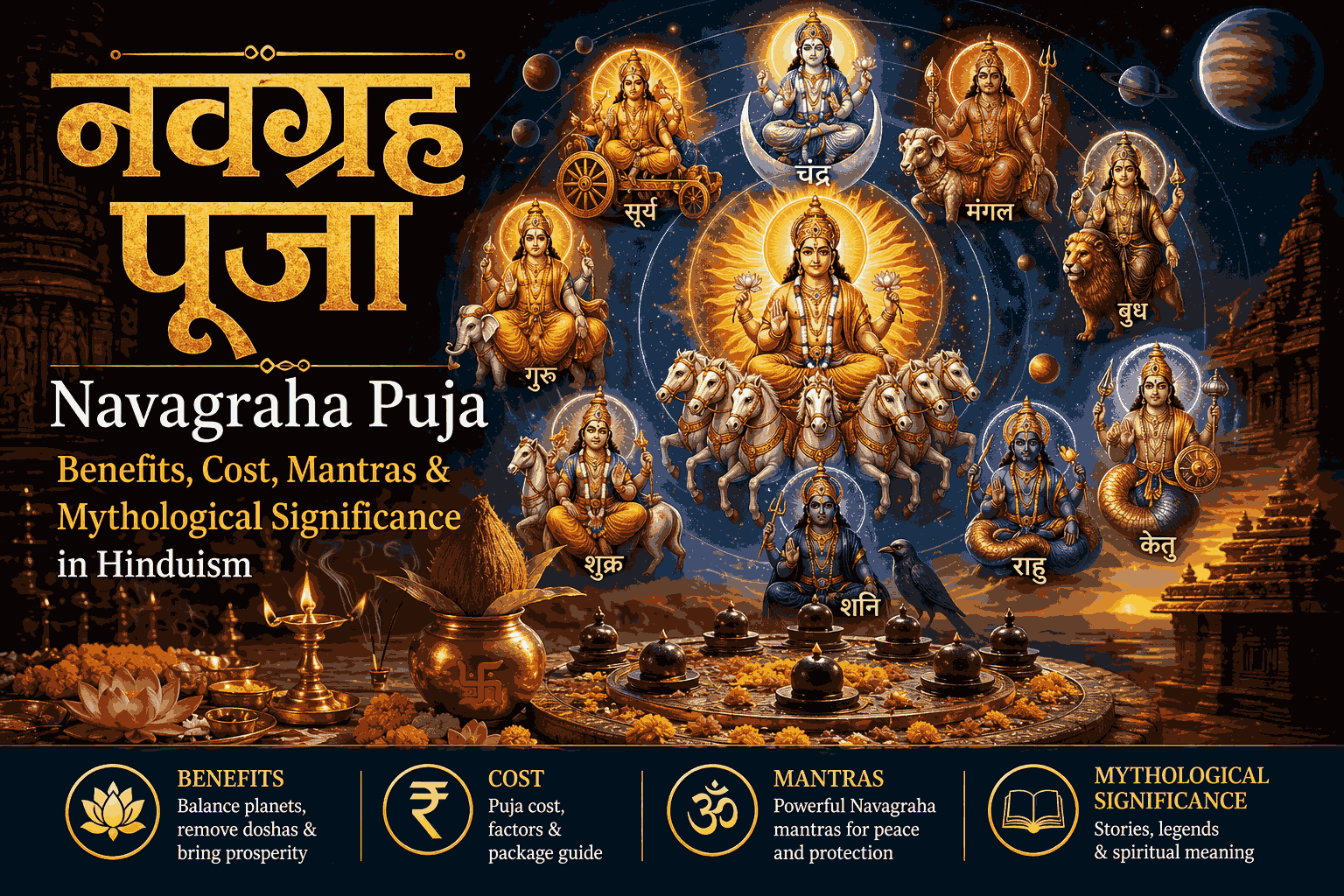
The nine Grahas are:
1. Surya — The Sun Surya is the king of all Grahas, the life-giver, the soul of the solar system. He sits on a chariot pulled by seven horses — a poetic symbol for the seven colours of light. Surya governs health, authority, self-confidence, father, government, and leadership. His day is Sunday (Ravivar). A strong Sun gives vitality and fame; a weak Sun brings ego problems and poor health.
2. Chandra — The Moon Chandra is the lord of the mind and emotions. Since Hinduism follows a lunar calendar, Chandra holds immense daily relevance. He governs mother, mental health, water, fertility, and intuition. His day is Monday (Somvar). A strong Moon brings emotional stability; an afflicted Moon creates anxiety and depression.
3. Mangal — Mars Mangal is the warrior planet. He rules over courage, energy, land, siblings, and physical strength. He is depicted in red, armed with weapons, riding a ram. His day is Tuesday (Mangalvar). He is the source of the dreaded Mangal Dosha. A strong Mars gives drive and determination; an afflicted Mars causes aggression and accidents.
4. Budha — Mercury Budha is the prince of intellect. He governs communication, business, education, logic, and the skin. His day is Wednesday (Budhvar). A strong Mercury brings sharp intellect and business success; a weak Mercury causes confusion and miscommunication.
5. Guru (Brihaspati) — Jupiter Guru is the teacher of the gods and the greatest benefic planet in Vedic astrology. He governs wisdom, children, wealth, spirituality, and higher education. His day is Thursday (Guruvar). A strong Jupiter blesses with abundance and spiritual growth; an afflicted Jupiter creates obstacles in education and children.
6. Shukra — Venus Shukra is the guru of the demons and the lord of all earthly pleasures — beauty, love, luxury, art, and marital happiness. His day is Friday (Shukravar). A strong Venus brings romantic fulfillment and material comfort; a weak Venus causes relationship problems and lack of joy.
7. Shani — Saturn Shani is the most feared yet most respected of all Grahas. He is the lord of karma, time, discipline, and justice. He moves slowly and teaches through suffering and delay — but his lessons are permanent. His day is Saturday (Shanivar). A strong or well-placed Shani rewards sincere effort with lasting success; an afflicted Shani creates the dreaded Shani Sade Sati — seven and a half years of cosmic testing.
8. Rahu — The North Lunar Node Rahu is not a physical planet. He is the north node of the Moon — a shadow point — yet his influence is among the most dramatic in Vedic astrology. Rahu represents ambition, obsession, foreign lands, illusion, and sudden upheaval. He can give enormous material success, but through deception and confusion.
9. Ketu — The South Lunar Node Ketu is the headless body — the south node of the Moon. He governs spirituality, liberation, past life karma, and detachment. He dissolves what is no longer needed in your life, which feels painful but leads to liberation and moksha.
The Mythological Origins: Stories That Gave Birth to Navagraha Worship
Every ritual in Hinduism begins with a story — a katha — because stories carry truth across time in a way dry instruction cannot. The Navagraha system is wrapped in extraordinary mythological narratives that explain both the personality of each planet and the reason for their worship.
The Great Story: Samudra Manthan and the Birth of Rahu-Ketu
Long ago, the Devas (gods) and Asuras (demons) decided to churn the cosmic ocean to extract Amrita — the nectar of immortality. They used the great Mount Mandara as a churning rod and the mighty serpent Vasuki as a rope. The churning was long and violent. Many divine treasures emerged — including the goddess Lakshmi, the physician Dhanvantari, the deadly poison Halahala (which Shiva drank to save creation), and finally the golden pot of Amrita itself.
When Amrita appeared, a demon named Svarbhanu disguised himself as a god, slipped into the divine assembly, and sat quietly between Surya (the Sun) and Chandra (the Moon). He began to drink the nectar. Surya and Chandra recognised the impostor and immediately alerted Lord Vishnu, who hurled his Sudarshana Chakra and severed the demon’s head from his body in an instant.
But it was too late. The nectar had already touched the demon’s lips. Both the head and the body became immortal.
The head became Rahu. The body became Ketu.
And so began an eternal cosmic vendetta. Rahu and Ketu, unable to be truly destroyed, periodically swallow the Sun and Moon in acts of revenge — creating what we observe as solar and lunar eclipses. This is why eclipses are considered deeply inauspicious in Hindu tradition, and why special prayers are performed during them. By the 7th to 9th century CE, these shadow entities were formally incorporated as the 8th and 9th members of the Navagraha system, completing the group of nine.
The Birth of Mangal from Shiva’s Divine Energy
The fierce red planet Mars has a particularly dramatic origin story in the Shiva Purana. When Lord Shiva was deep in his cosmic meditation on Mount Kailash, drops of his divine sweat fell upon the sacred surface of the Earth (Goddess Bhoomi). From the union of Shiva’s divine energy and the sacred Earth, a brilliant red child was born — fierce, armed, and powerful. This child was Mangal. In another version, Mangal is born from Lord Vishnu’s Varaha (boar) avatar, who rescued Goddess Bhoomi from the cosmic depths where the demon Hiranyaksha had submerged her. Just like Kartikeya the war god, Mangal is depicted armed with a sword, mace, and spear, with deep associations to battle, land, and physical strength.
The Sage Kalava and the Origin of the Nine Sacred Temples
In Tamil Nadu, there is a famous legend that explains the origin of the nine Navagraha temples near Kumbakonam. A sage named Kalava was afflicted by a devastating disease — leprosy that slowly consumed his body. In despair and anger, he called out to the nine planets and cursed them with the same suffering. The nine Grahas, now afflicted by the sage’s curse, prayed fervently to Lord Shiva for relief. Impressed by their devotion and their willingness to endure suffering as cosmic teachers, Shiva appeared before them and declared that those sacred places would be permanently consecrated to the nine planets. Devotees who came to worship them there would be relieved of their curses and doshas. This is the origin of the nine Navagraha Temples — one of the most powerful pilgrimage circuits in South India to this day.
Ancient Vedic Roots: Where Science and Devotion Met
The Navagraha system is not only mythology — it is rooted in India’s ancient astronomical science. The Rigveda, the Atharva Veda, and later texts like the Brihat Parashara Hora Shastra and various Puranas all contain detailed descriptions of the nine planets, their personalities, their movements, and their effects. Ancient Indian scholars tracked planetary movements with extraordinary precision, observed how celestial events corresponded with earthly events, and built the complete science of Vedic Jyotisha. By the Gupta period (4th century CE), sculptural representations of the Navagrahas appeared in Hindu temples. By the 7th century, Navagraha shrines became standard in every major Hindu temple — as they remain to this day.
Why Navagraha Puja Is Always Done Before Every Major Puja
Walk into any Hindu wedding, any griha pravesh, any business inauguration, any major festival puja — and you will always find the Navagraha Puja performed before the main ritual. This practice is universal across all Hindu traditions, regions, and sects.
But why?
1. Planetary Clearance Before Auspicious Work
Hindu philosophy teaches that every moment in time carries a specific planetary energy signature. Before beginning any significant life event, you must first ensure that no malefic planetary influence will disrupt or diminish the result. The Navagraha Puja pacifies any unfavourable planets in the current transit and in your individual birth chart — essentially “clearing the cosmic road” before you walk on it.
2. The Muhurta System
Every major Hindu ritual is performed at a Muhurta — a specifically chosen auspicious window of time calculated by a learned pandit based on the native’s birth chart, current planetary positions, nakshatra, and tithi. The Navagraha Puja, performed at the opening of the Muhurta, ensures planetary forces are aligned to support the ritual that follows.
3. Fulfillment of the Four Purusharthas
According to Hindu scripture, Lord Vishnu told Rudra that those who worship the Navagraha with proper rituals accomplish all four aims of human life: Dharma (righteousness), Artha (material prosperity), Kama (fulfillment of desires), and Moksha (liberation). No other single ritual accomplishes all four simultaneously.
4. Cosmic Permission
Just as one seeks the blessings of elders before beginning an important task, performing the Navagraha Puja is the act of seeking cosmic permission from the nine planetary lords who have authority over different aspects of life. Honouring them first ensures their goodwill and support for everything that follows.
5. Removing Unseen Obstacles
Many obstacles in life are not visible — they arise from unfavourable planetary positions, past karma, and doshas accumulated over lifetimes. The Navagraha Puja, performed with sincere devotion, dissolves these hidden barriers before they can manifest as disruptions in the main ritual or in life itself.
Navagraha Doshas: When Planets Become Sources of Suffering
A Dosha is a planetary affliction — a configuration in the horoscope where a planet is placed in a position that creates negative results in specific areas of life.
Shani Sade Sati is the most feared — a seven-and-a-half-year period when Saturn transits through the sign before, the sign of, and the sign after your Moon sign. Almost everyone experiences this at least twice in a lifetime, associated with career setbacks, health challenges, financial losses, and emotional heaviness.
Mangal Dosha (Manglik Dosha) occurs when Mars is placed in the 1st, 4th, 7th, 8th, or 12th house. It creates turbulence in marital life — conflicts, delays in marriage, and in extreme cases, separation.
Rahu-Ketu Dosha — when the shadow nodes are badly placed, they create confusion, sudden reversals, chronic health problems, and spiritual disturbances.
Kaal Sarp Yoga — when all seven main planets are hemmed between Rahu and Ketu in the horoscope, creating a powerful and difficult configuration that affects almost every area of life.
Guru Chandal Yoga — Jupiter conjunct Rahu corrupts wisdom, creates ethical confusion, and disrupts spiritual progress.
Pitra Dosha — a karmic debt from ancestors that manifests as recurring family problems across generations.
All of these doshas can be significantly reduced — and in many cases neutralised — through the Navagraha Puja and the corresponding Navagraha Homam.
The Detailed Benefits of Navagraha Puja
Spiritual Growth and Inner Peace: The puja aligns you with cosmic forces larger than any individual problem. Devotees consistently report a deepened sense of purpose, connection to the divine, and clarity about their life’s direction. The ritual performs Antahkarna Shuddhi — a purification of the inner self.
Freedom from Planetary Doshas: The direct and primary benefit — it pacifies malefic planets and strengthens benefic ones, reducing the intensity and duration of difficult planetary periods.
Career and Business Progress: Obstacles blocking professional advancement for months or years begin to dissolve. New opportunities appear, stalled projects restart, and recognition from superiors improves after performing this puja.
Health and Protection: The puja protects against accidents, chronic illness, and sudden health crises. Saturn governs old age and chronic disease; Mars governs accidents and surgeries. Pacifying these planets reduces their malefic health effects.
Financial Stability and Wealth: Removes planetary obstacles to wealth. Many devotees report financial breakthroughs — unexpected income, successful investments, and resolution of long-standing debts — following the puja.
Mental Peace: Chandra (Moon) governs the mind. When afflicted, anxiety, depression, and emotional turbulence follow. The Navagraha Puja restores balance to the mind by pacifying an afflicted Moon.
Protection from Enemies and Negative Energies: Rahu and Saturn can make a person vulnerable to negative intentions of others. The puja creates a protective planetary shield around the devotee.
Liberation and Moksha: At the highest level, when performed with complete devotion and spiritual understanding, the Navagraha Puja contributes to the ultimate Hindu goal — liberation from the cycle of birth, death, and rebirth.
Navagraha Mantras: The Sacred Sounds That Move the Planets
Mantras are the heartbeat of the Navagraha Puja. Each planet has its own Beeja (seed) mantra — a condensed sonic formula that vibrates at the same frequency as that planet’s cosmic energy. Chanted with proper pronunciation, breath, and intention, these mantras create a resonance between the worshipper and the planetary deity.
The Nine Beeja Mantras
Surya (Sun): ॐ ह्रां ह्रीं ह्रौं सः सूर्याय नमः Om Hraam Hreem Hroum Sah Suryaya Namah Chant 108 times on Sunday mornings facing east, for health, confidence, and vitality.
Chandra (Moon): ॐ श्रां श्रीं श्रौं सः चंद्रमसे नमः Om Shraam Shreem Shroum Sah Chandramasay Namah Chant 108 times on Monday evenings for mental peace and emotional stability.
Mangal (Mars): ॐ क्रां क्रीं क्रौं सः भौमाय नमः Om Kraam Kreem Kroum Sah Bhaumay Namah Chant 108 times on Tuesday for courage, property matters, and Mangal Dosha relief.
Budha (Mercury): ॐ ब्रां ब्रीं ब्रौं सः बुधाय नमः Om Braam Breem Broum Sah Budhaya Namah Chant 108 times on Wednesday for intellect, communication, and business success.
Guru / Brihaspati (Jupiter): ॐ ग्रां ग्रीं ग्रौं सः गुरवे नमः Om Graam Greem Groum Sah Guruvay Namah Chant 108 times on Thursday for wisdom, children, and financial prosperity.
Shukra (Venus): ॐ द्रां द्रीं द्रौं सः शुक्राय नमः Om Draam Dreem Droum Sah Shukraya Namah Chant 108 times on Friday for love, marriage, and material comforts.
Shani (Saturn): ॐ प्रां प्रीं प्रौं सः शनैश्चराय नमः Om Praam Preem Proum Sah Shanaischaraya Namah Chant 108 times on Saturday evenings for Sade Sati relief, karmic burdens, and discipline.
Rahu: ॐ भ्रां भ्रीं भ्रौं सः राहवे नमः Om Bhraam Bhreem Bhroum Sah Rahave Namah Chant 108 times on Saturday for relief from confusion, illusion, and shadow-planet effects.
Ketu: ॐ स्रां स्रीं स्रौं सः केतवे नमः Om Sraam Sreem Sroum Sah Ketave Namah Chant 108 times on Tuesday or Saturday for spiritual liberation and past-karma healing.
The Universal Navagraha Mantra (For All Nine Together)
ॐ नवग्रहाय विद्महे, नवचक्राय धीमहि, तन्नो ग्रहाः प्रचोदयात् Om Navagrahaaya Vidmahe, Navachakraya Dhimahi, Tanno Graha Prachodayat
This single powerful mantra invokes all nine planets simultaneously and is ideal for daily recitation.
Complete Navagraha Puja Samagri (Required Items)
Common Items for All Nine Planets
| Item | Purpose |
|---|---|
| Navagraha Yantra (copper/silver) | Sacred geometric form of all nine planets |
| Kalash with mango leaves & coconut | Cosmic waters; divine presence |
| Panchamrit | Ritual bath (Abhishekam) |
| Gangajal | Purification |
| Turmeric (Haldi) & Kumkum | Auspicious markings |
| Sandalwood paste (Chandan) | Fragrance offering |
| Agarbatti & Dhoop | Space purification |
| Camphor & Ghee lamp (Diya) | Aarti |
| Betel leaves & nuts (Paan-Supari) | Sacred traditional offering |
| Akshat (turmeric-mixed whole rice) | Blessing grain |
| Til (sesame seeds) | Especially for Shani |
| Nine types of grains (Navadhanya) | One grain per planet |
| Nine coloured cloths | Planet-specific colours |
| Havan Kund with Havan Samagri | Sacred fire offering |
| Fresh flowers (marigold, lotus, rose) | Pushpanjali |
| Fruits & Sweets | Naivedyam / Prasadam |
| Lord Ganesha idol or image | Invoked first in every ritual |
Planet-Specific Offerings
| Planet | Colour | Key Offering | Grain | Gemstone |
|---|---|---|---|---|
| Surya | Red/Orange | Wheat & jaggery | Wheat | Ruby |
| Chandra | White | Milk, coconut | Rice | Pearl |
| Mangal | Red | Copper vessel, red cloth | Masoor dal | Red Coral |
| Budha | Green | Green fruits, dhurva grass | Green gram | Emerald |
| Guru | Yellow | Yellow cloth, gold | Chana dal | Yellow Sapphire |
| Shukra | White/Cream | Silver, white sweets | White rice | Diamond |
| Shani | Black/Blue | Sesame oil, iron | Urad dal | Blue Sapphire |
| Rahu | Blue/Black | Coal, black til | Black gram | Hessonite Garnet |
| Ketu | Grey/Multi | Woollen cloth | Horse gram | Cat’s Eye |
Step-by-Step Navagraha Puja Vidhi (Complete Procedure)
Step 1 — Choose an Auspicious Day and Muhurta: Consult a learned pandit or astrologer to identify the correct time based on your birth chart. Saturday is the traditional general day, but the ideal timing is specific to the individual.
Step 2 — Cleanse and Prepare the Space: Thoroughly clean the puja area. Sprinkle Gangajal in all directions. Spread a clean red or yellow cloth on the altar.
Step 3 — Invoke Lord Ganesha First: Before any puja begins anywhere in Hinduism, Ganesha — the remover of obstacles — must be invoked. Chant the Ganesha mantra, offer flowers and sweets, and receive his blessing to proceed.
Step 4 — Kalash Sthapana: Place the Kalash (filled with Gangajal, mango leaves, and coconut) at the centre of the puja space. This represents the presence of all divine energies.
Step 5 — Navagraha Sthapana: Arrange the nine planetary idols or images: Surya at the centre, with the remaining eight positioned around him in the prescribed arrangement. Importantly, the idols should not face each other.
Step 6 — Sankalpa (Sacred Intention): The worshipper or pandit states clearly the name, gotra (lineage), and specific purpose of the puja — relief from a specific dosha, prosperity, health, or general planetary pacification.
Step 7 — Abhishekam: Bathe each planetary idol with Panchamrit, then Gangajal. This ritual purification removes the negative planetary energies and invites the positive.
Step 8 — Mantra Chanting: Each planet’s Beeja Mantra is chanted 108 times while offering planet-specific items. Recitation should be slow, clear, and with focused intention.
Step 9 — Navagraha Homam (Fire Ritual): The Homam is the most powerful part of the ritual. Specific items (ghee, sesame seeds, havan samagri, Navagraha Samidha — nine types of sacred wood) are offered into sacred fire while mantras are chanted. A minimum of 9 ahutis (fire offerings) are made, one for each planet, with 108 ahutis being the traditional full count.
Step 10 — Daan (Charitable Donation): After the puja, donating items associated with each planet to those in need is essential. Without Daan, the puja is considered incomplete. Donate sesame oil for Shani, green cloth for Budha, yellow cloth and sweets for Guru, and so on.
Step 11 — Aarti and Circumambulation: Wave the camphor flame clockwise before the Navagraha arrangement while singing the Navagraha aarti. In temples, devotees circumambulate the altar nine times clockwise.
Step 12 — Distribution of Prasadam: Blessed food is distributed to all participants, and importantly, to Brahmins and those in need.
Navagraha Puja Cost in India (2025–2026)
| Type of Puja | Approximate Cost (INR) |
|---|---|
| Simple Home Puja (1 pandit, basic samagri) | ₹2,000 – ₹5,000 |
| Standard Navagraha Puja (2 pandits) | ₹5,000 – ₹10,000 |
| Temple-Based Navagraha Puja | ₹3,000 – ₹15,000 |
| Navagraha Puja with Full Homam | ₹10,000 – ₹25,000 |
| Elaborate Navagraha Yagna (4+ pandits) | ₹25,000 – ₹51,000+ |
| Online Puja Services | ₹1,500 – ₹7,000 |
Costs at major pilgrimage sites like Trimbakeshwar (Nashik), Tirunallar (Tamil Nadu), and the Kumbakonam Navagraha temples may include additional dakshina, travel, accommodation, and temple fees.
Famous Navagraha Temples in India You Should Know
1. Navagraha Temples, Kumbakonam, Tamil Nadu A circuit of nine temples, each dedicated to one planet, dating to the Chola era (9th–13th century). This is the most sacred Navagraha pilgrimage in all of India. Each temple is in a separate village, and completing the full circuit is considered among the most powerful planetary remedies.
2. Navagraha Temple, Guwahati, Assam Features nine shiva-lingas representing the nine planets, built in the 18th century. One of the most significant Navagraha temples in North and Northeast India.
3. Tirunallar (Shani Kshetra), Tamil Nadu Dedicated specifically to Saturn. Hundreds of thousands visit annually, especially during Shani Sade Sati, to seek relief from Saturn’s testing period.
4. Suryanar Kovil, Tamil Nadu Temple dedicated primarily to Surya (Sun), considered the most powerful Sun temple in South India.
5. Trimbakeshwar, Nashik, Maharashtra One of the twelve Jyotirlingas, where Navagraha Puja, Kaal Sarp Dosh Puja, and Pitra Dosha rituals hold extraordinary spiritual power and are performed daily by specially trained priests.
When Should You Perform Navagraha Puja?
- When entering a prolonged bad phase — Shani Sade Sati, Shani Dhaiya, or Rahu-Ketu transit
- Before a wedding or engagement ceremony
- Before starting a new business or launching a product
- After a series of consecutive failures or unexplained losses
- Before purchasing land, property, or a new vehicle
- When experiencing recurring health problems without clear medical reason
- When a child faces persistent academic or behavioural difficulties
- When there are recurrent conflicts in the family
- Before major surgery or an extended medical treatment
- On your birthday — specifically your Janma Nakshatra (birth star) day
- At the beginning of each Hindu New Year (Ugadi, Gudi Padwa, Vishu)
- When beginning construction of a new home
Conclusion: Making Peace with the Cosmos
The Navagraha Puja is, at its deepest level, an act of humility and wisdom. It is the acknowledgement that we live not just in a physical world of offices, families, and bank accounts — but in a vast, living cosmos whose movements are woven into the very fabric of our lives.
Our ancestors understood this with extraordinary depth. They built temples to the planets, composed thousands of Sanskrit verses in their honour. They developed an entire science — Jyotish Shastra — dedicated to understanding how the cosmic and the personal are always in conversation.
When you sit before the Navagraha altar, light the lamp, and chant the mantras with sincere attention, you are not merely performing a ritual. You are entering into a living conversation with nine cosmic intelligences that have been governing the rhythms of existence since before human memory began.
You are saying: I see you. I honour you. I ask for your grace.
And when that conversation is conducted with devotion, knowledge, and sincerity — the cosmos, as it always has, listens.