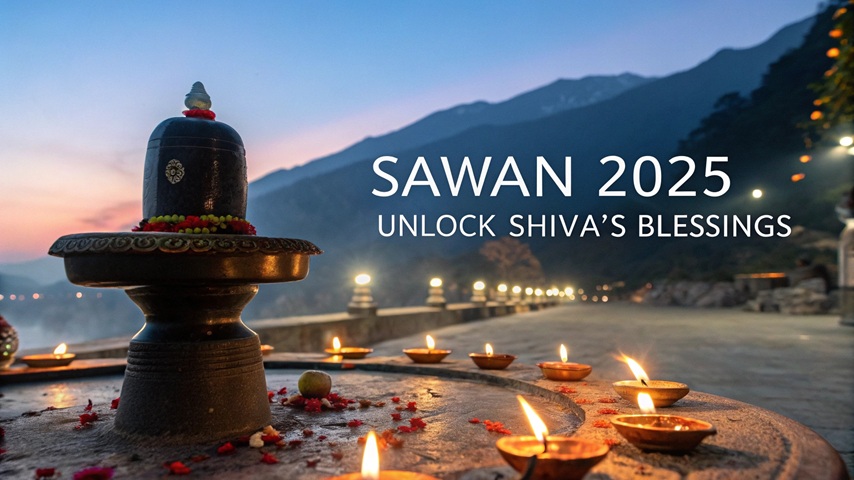
Sawan 2026 — The Most Sacred Month of Lord Shiva
Complete guide to dates, Sawan Somwar, mythology, and the divine power of Rudrabhishek in Kashi
When Does Sawan Start & End in 2026?
The month of Shravan (Sawan) 2026 is one of the most auspicious periods in the Hindu calendar, dedicated entirely to the worship of Lord Shiva. Based on the Hindu Panchang, dates vary slightly between North and South India due to different calendar systems followed in each region.
🗓️ North India (Purnimant): Sawan 2026 begins on Saturday, July 30, 2026 and ends on Saturday, August 28, 2026 — coinciding beautifully with India’s Independence Day.
| Region | Start Date | End Date | Calendar System |
|---|---|---|---|
| 🇮🇳 North India (UP, Bihar, MP, Rajasthan) | July 30, 2026 (Saturday) | August 28, 2026 (Saturday) | Purnimant |
| 🕉️ Varanasi / Kashi | July 30, 2026 | August 28, 2026 | Purnimant |
Dates may vary slightly depending on your local Panchang. We recommend consulting your family pandit or visiting TheVedicPuja Panchang for precise regional timings.
All Four Sawan Monday Dates & Muhurts
Each Monday (Somvar) during the Sawan month is considered extraordinarily auspicious. Observing a fast and performing Shiva Puja on these days is believed to fulfill desires, bring marital bliss, and cleanse accumulated sins. Here are all four Sawan Somwar dates for 2026:
| # | Date | Day | Puja Muhurt (Approx.) | Special Notes |
|---|---|---|---|---|
| 1st | August 3, 2026 | Monday | Brahma Muhurt: 4:14 AM – 5:02 AM Abhishek: 5:30 AM onwards |
Opening Somwar |
| 2nd | August 10, 2026 | Monday | Brahma Muhurt: 4:16 AM – 5:03 AM Abhishek: 5:30 AM onwards |
Mid-Sawan |
| 3rd | August 17, 2026 | Monday | Brahma Muhurt: 4:20 AM – 5:06 AM Abhishek: 5:30 AM onwards |
Peak Devotion |
| 4th | August 24, 2026 | Monday | Brahma Muhurt: 4:24 AM – 5:10 AM Abhishek: 5:30 AM onwards |
Final Somwar — most elaborate |
*Muhurt timings are approximate for Varanasi, Uttar Pradesh. Check local Panchang for precise Tithi details.
Mythological Significance of Sawan
The month of Sawan holds a uniquely powerful place in Hindu cosmology. Its deep spiritual significance is rooted in multiple ancient scriptures — the Puranas, Shiva Mahapurana, and Vedic texts — each revealing a different dimension of why this month belongs to Lord Shiva.
🌊 The Samudra Manthan — Poison of the Universe
The most celebrated mythological account is from the Samudra Manthan (churning of the cosmic ocean), described in the Bhagavata Purana. When the gods (Devas) and demons (Asuras) churned the ocean of milk using Mount Mandara as the churning rod and Vasuki the serpent as the rope, the first thing that emerged was Halahala — a deadly poison so potent it threatened to destroy all of creation.
Mythological insight: This is why Sawan is called Shiva’s most beloved month. It was during this period that the great god sacrificed his own comfort for the welfare of the universe — and devotees honor that sacrifice through jal abhishek, milk offerings, and fasting.
🌙 Sawan & The Cosmic Connection of Shiva
According to the Shiva Purana, Lord Shiva descended to earth during Shravan month and stayed at Somnath. The month is connected to Chandra (the Moon) — the celestial body adorning Shiva’s head. Mondays are ruled by Chandra, which is why Sawan Somwar carries double the spiritual potency. Worshipping Shiva on these days is said to bring the blessings of both Shiva and his celestial consort, Chandra.
🕉️ Why Lord Shiva is Most Pleased in Sawan
The Skanda Purana states: “In no other month does Shiva’s grace flow as freely as in Shravan. A devotee who performs even one Abhishek with Gangajal in this month earns the merit of a thousand Abhisheks performed at other times.” This is why millions of Kanwariyas (Shiva devotees) carry Gangajal from Haridwar and Varanasi to offer at their nearest Shiva temple during Sawan.
Rudrabhishek — The Most Powerful Puja in Sawan
Among all forms of Shiva worship, Rudrabhishek stands as the supreme Vedic ritual. The word itself comes from two Sanskrit roots — Rudra (the fierce, storm-like aspect of Shiva who destroys evil) and Abhishek (ceremonial bathing with sacred liquids). When performed during Sawan, its power is believed to multiply manifold.
This ritual is described in the Rigveda, one of humanity’s oldest living texts, where hymns dedicated to Rudra form the Shri Rudram — a set of 11 sacred passages chanted during the Abhishek. The Shri Rudra Chamakam that follows enumerates all the blessings the devotee asks of Shiva.
📖 Deep Dive: Read the complete significance, items, mantras, and step-by-step procedure of Rudrabhishek at our detailed guide: Rudrabhishek Rituals: Items, Mantras & Significance →
What Happens During Rudrabhishek?
A trained Vedic pandit chants the Shri Rudram (from the Krishna Yajurveda) while ceremonially bathing the Shivalinga with each of the sacred Panchamrit offerings in sequence. Each substance has a specific spiritual meaning and benefit:
| Offering (Abhishek Dravya) | Spiritual Significance | Benefit Bestowed |
|---|---|---|
| 🥛 Milk (Dugdha) | Purity & nourishment | Longevity, good health, and prosperity |
| 🍯 Honey (Madhu) | Sweetness of life | Harmony in relationships, sweetness in speech |
| 🧈 Ghee (Ghrita) | Clarity and light | Wisdom, intelligence, and success |
| 🍚 Curd (Dadhi) | Abundance | Wealth, children, and family happiness |
| 🍬 Sugar (Sharkara) | Joy and fulfillment | Removal of sorrow, mental peace |
| 💧 Gangajal (Holy Water) | Liberation (Moksha) | Purification of sins, spiritual liberation |
| 🌸 Sandalwood Paste | Cooling the divine | Peace, relief from diseases, cooling of Shiva’s throat |
| 🌿 Bel Patra (Bilva Leaves) | Triad of creation | Fulfillment of all three types of desires (dharma, artha, kama) |
Essential Items for Rudrabhishek (Samagri)
Spiritual Benefits of Rudrabhishek in Sawan
When Rudrabhishek is performed during the month of Sawan, the Shiva Mahapurana promises these specific blessings to sincere devotees:
Why Varanasi is the Holiest Place for Sawan Puja
Among all places on earth, Varanasi (Kashi) holds the highest sanctity for Sawan worship. This is not merely tradition — it is rooted in deep Puranic truth. Lord Shiva himself is said to reside eternally in Kashi as Vishwanatha — the Lord of the Universe. The city sits on the trishul (trident) of Shiva and is believed to never be submerged in the great dissolution (Mahapralaya).
The Kashi Vishwanath Temple — Lord Shiva’s Own Home
The Shri Kashi Vishwanath Jyotirlinga is one of the 12 Jyotirlingas — the most sacred Shiva shrines in India. Performing Rudrabhishek here during Sawan is believed to be equivalent to performing 1,000 Rudrabhisheks at other temples. Ancient texts declare that a single drop of Gangajal poured on the Vishwanath Jyotirlinga during Sawan carries the merit of a full year of tapasya (austerity).
Ganga Snan + Rudrabhishek — The Unbeatable Combination
In Varanasi, Sawan rituals traditionally begin with a holy dip in the Ganga Ghats (particularly Dashashwamedh, Manikarnika, or Assi Ghat) before sunrise. The devotee then carries Gangajal in a copper pot to the Shiva temple for Abhishek. This combination — Ganga Snan followed by Rudrabhishek with freshly collected Gangajal — is considered one of the most powerful acts of devotion possible in the Kali Yuga.
🕉️ Puranic Statement (Kashi Khanda, Skanda Purana):
“Those who perform Abhishek to Vishwanatha in Kashi during Shravan shall have all desires fulfilled, all sins washed away, and shall attain the abode of Shiva.”
Special Sawan Observances at Kashi Vishwanath (2026)
| Date / Occasion | Special Ritual | Significance |
|---|---|---|
| July 30 (Sawan Begins) | Mangala Aarti + Rudrabhishek | Opening of Sawan — the temple opens at 3 AM |
| August 3(1st Somwar) | Shri Rudra Abhishek, Panch Upachar Puja | First Monday — lakhs of devotees expected |
| August 10 (2nd Somwar) | Sahasradhara Abhishek | Abhishek with 1,008 sacred vessels |
| August 17 (3rd Somwar) | Laghu Rudra Patha | 11 pandit recitation of Rudrashtadhyayi |
| August 10 (4th & Final Somwar) | Maha Rudrabhishek + Rudra Homa | Most elaborate ritual of Sawan — highly auspicious |
| August 29 (Sawan Ends) | Shravan Purnima Puja + Raksha Bandhan | Closing of Sawan — blessed conclusions |
Sacred Mantras for Sawan & Rudrabhishek
Chanting these mantras during Sawan — especially on Sawan Somwar and during Rudrabhishek — amplifies your prayers and devotion manifold. Each mantra carries the Vedic vibration of Lord Shiva’s grace.
उर्वारुकमिव बन्धनान् मृत्योर्मुक्षीय मामृतात् ॥
भवे भवे नाति भवे भवस्व मां भवोद्भवाय नमः ॥
सदावसन्तं हृदयारविन्दे भवं भवानीसहितं नमामि ॥
🙏 Sawan Vrat Sankalp Mantra: Before beginning a Sawan Somwar fast, take Sankalp by holding water in your right palm and chanting: “Om Namah Shivaya, Aham Shravan Somwar Vrat Karomi” — then offer the water to a Shivalinga or a Tulsi plant facing east.
Sawan Rituals, Observances & Guidelines
Sawan Somwar Vrat (Monday Fast)
The Sawan Somwar fast is among the most widely observed Hindu fasts. Devotees abstain from grains, onion, garlic, and non-vegetarian food. Some observe a complete fast (Nirjala — without water), while others take Phalahar (fruit diet). The fast is broken after evening Aarti at the Shiva temple.
| Practice | Description | Who Observes |
|---|---|---|
| 🚿 Jal Abhishek | Pouring water (preferably Gangajal) on Shivalinga | All devotees |
| 🌿 Bel Patra Offering | Offering 3 or 5 bilva leaves with Om Namah Shivaya | All devotees |
| ⚗️ Rudrabhishek | Full ceremonial bathing with Panchamrit by Vedic pandits | Families seeking specific blessings |
| 🚶 Kanwar Yatra | Carrying Gangajal on foot from sacred rivers to Shiva temples | Kanwariyas (young devotees) |
| 🍃 Sattvik Diet | Vegetarian food without garlic/onion for the full month | Devout Shiva worshippers |
| 📿 Rudraksha Wearing | Wearing Rudraksha mala during Sawan for divine protection | Shiva devotees |
What to Offer & Avoid in Sawan
Book Your Sawan Puja in Varanasi
Let our experienced Kashi pandits perform Rudrabhishek, Laghu Rudra, or Maha Rudrabhishek on your behalf at the sacred ghats and temples of Varanasi — so Shiva’s blessings reach you and your family no matter where you are in the world.