What Are Lokas?
The word Loka comes from Sanskrit, meaning ‘world,’ ‘realm,’ or ‘plane of existence.’ In Hindu cosmology, Lokas are not merely physical places — they are multi-dimensional planes of consciousness and existence through which souls travel based on their karma, spiritual evolution, and divine grace.
Unlike the modern concept of heaven and hell as simple reward-punishment systems, the Lokas of Hinduism represent a sophisticated, layered understanding of the cosmos. Each Loka has its own time scale, inhabitants, laws of nature, and spiritual frequency. Together, they form a grand cosmic architecture that maps the journey of every soul in the universe.
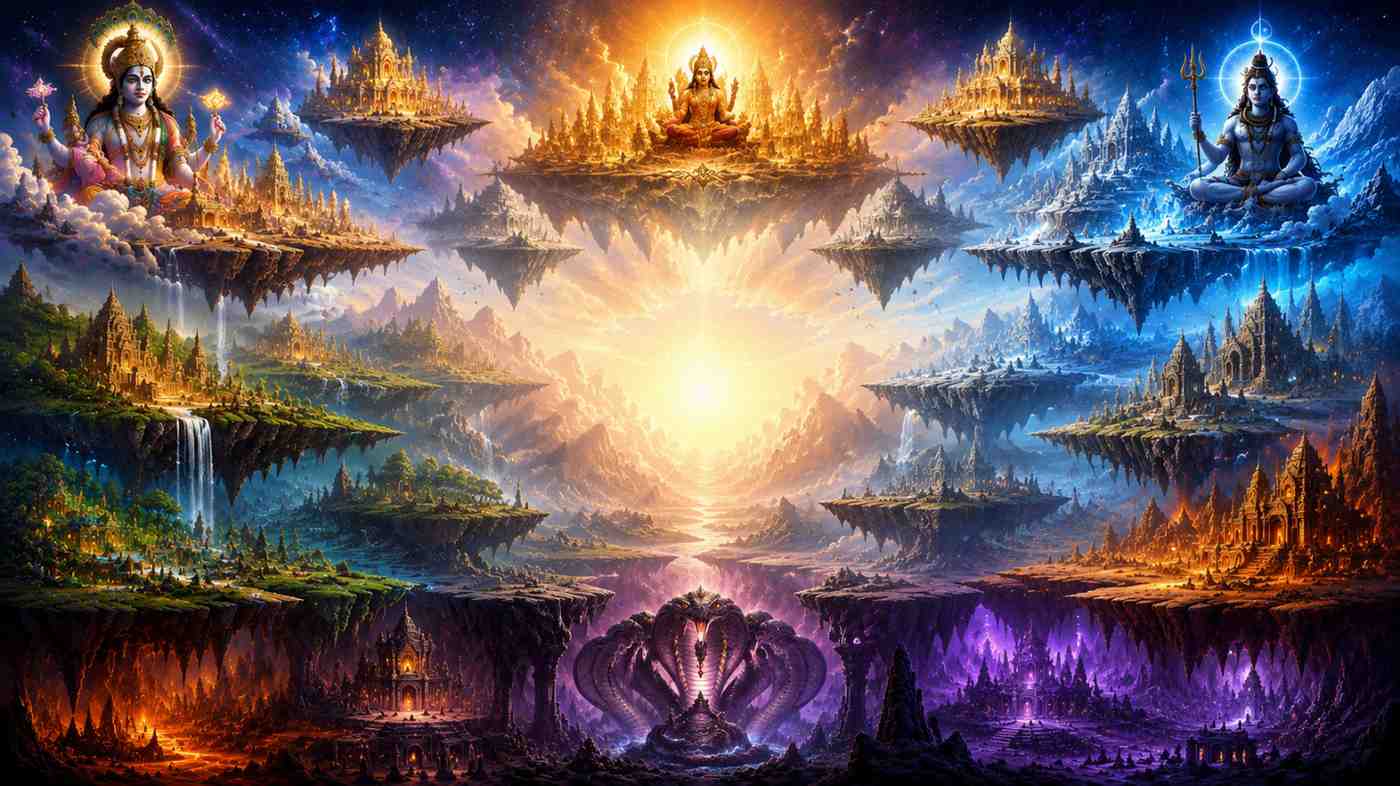
The concept of Lokas appears throughout the Vedas, Puranas, Upanishads, and the Bhagavad Gita, making it one of the most ancient and comprehensive cosmological frameworks ever conceived by the human mind.
Importance of Lokas in Hindu Cosmology
The 14 Lokas are not just mythological realms — they are deeply symbolic of the spiritual journey of every living being. Understanding the Lokas helps us grasp:
- How karma determines our path after death
- Why spiritual practice leads to liberation
- How the universe is organized across multiple dimensions
- Where divine beings, sages, and celestial entities reside
- How time, space, and consciousness vary across realms
The Lokas give Hinduism its remarkable depth, connecting cosmic geography with personal spiritual evolution. They remind every seeker that this Earth is just one stop on a much grander journey of the soul.
The Structure of the Hindu Universe
The 14 Lokas Explained
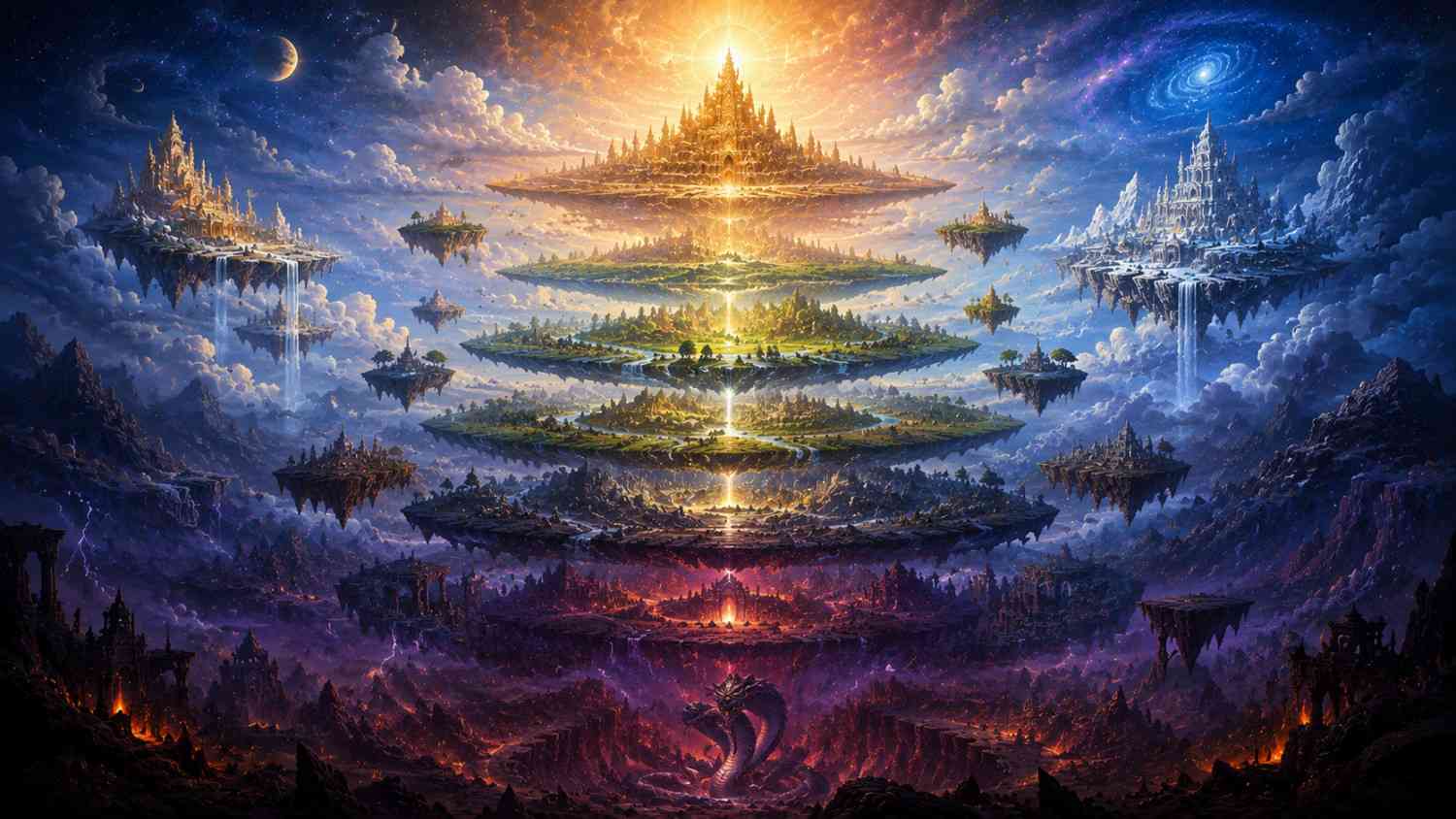
The Hindu universe is organized into 14 Lokas — 7 higher worlds (Urdhva Lokas) and 7 lower worlds (Adho Lokas or Patala Lokas). Earth, known as Bhuloka, sits at the center of this cosmic structure, serving as the critical junction where karma is created and liberation becomes possible.
These 14 realms are described in detail in the Vishnu Purana, Bhagavata Purana, and other Puranic texts. Together, they span the full range of conscious experience — from the densest material existence in the lower realms to the most refined spiritual states near the divine source.
Upper Worlds and Lower Worlds
The seven upper worlds (Urdhva Lokas) ascend from Earth toward pure divine consciousness, with each realm becoming progressively more refined, luminous, and spiritually elevated. Souls who accumulate good karma and spiritual merit travel upward through these realms.
The seven lower worlds (Adho Lokas) descend below Earth into realms of denser energy and experience. Importantly, these are not necessarily places of punishment — many of them are described in the Puranas as luxurious, wealthy, and inhabited by powerful beings who possess great material pleasures but lack spiritual knowledge.
The Seven Higher Lokas (Urdhva Lokas)
Bhuloka — The Earthly Realm
Bhuloka is our world — the Earth as we know it. It is the only Loka where karma can be both created and resolved, making it the most precious realm in Hindu cosmology. The Bhagavata Purana calls it the action realm, where souls incarnate to work out their spiritual destiny.
Time in Bhuloka flows at a normal human pace. Human beings, animals, plants, and all mortal creatures inhabit this realm. Despite being the lowest of the upper Lokas, Bhuloka holds the greatest spiritual potential because it is the realm of free will, action, and transformation.
The great sages and even the gods themselves are said to desire a human birth in Bhuloka because only here can a soul attain final liberation (Moksha). This makes life on Earth extraordinarily precious in Hindu spiritual philosophy.
Bhuvarloka — The Realm of Spirits and Celestial Beings
Bhuvarloka is the intermediate realm between Earth and the higher heavens. It extends from the surface of the Earth to the Sun and is inhabited by semi-divine beings, celestial spirits, and souls that have not yet completed their transition after death.
This realm is home to Preta (departed souls in transition), Yaksha (nature spirits), Gandharvas (celestial musicians), and various beings of light who serve as messengers between the material and divine worlds. Ancient sages described Bhuvarloka as a luminous astral plane where the distinction between physical and spiritual reality begins to dissolve.
Svarloka (Swarga Lok) — The Heaven of the Devas
Swarga Lok is the most celebrated heavenly realm in Hindu tradition — the paradise of the Devas (gods). It is ruled by Lord Indra, the king of the gods, and is described in the Puranas as a realm of extraordinary beauty, abundance, and pleasure.
In Swarga Lok, divine beings enjoy celestial pleasures, listen to the music of the Gandharvas, and witness the dances of the Apsaras (heavenly nymphs). Time flows differently here — one human year equals just one day in Swarga Lok.
However, Swarga Lok is not permanent. Souls who earn their place in heaven through virtuous deeds eventually exhaust their merit and return to Earth for rebirth. This is why the Bhagavad Gita distinguishes between temporary heavenly rewards and the eternal liberation of Moksha.
Maharloka — The Realm of Great Sages
Maharloka is a realm beyond the reach of ordinary heaven, inhabited by the Maharishis — the great cosmic sages who have transcended ordinary human limitations. Beings such as Bhrigu, Atri, and other ancient sages of immense spiritual power reside here between cosmic cycles.
Maharloka endures through the dissolution of the lower three worlds (Bhuloka, Bhuvarloka, and Svarloka) during the Pralaya (cosmic dissolution). The sages here witness entire cycles of creation and destruction, giving them a perspective of cosmic time that stretches across billions of years.
Janaloka — The World of Divine Knowledge
Janaloka is even more elevated than Maharloka, and is the home of the four Kumaras — Sanaka, Sanandana, Sanatana, and Sanatkumara — the eternal youthful sages who were among the first created beings in the universe. These divine beings exist in a perpetual state of spiritual contemplation.
In Janaloka, the inhabitants possess supreme divine knowledge and are free from the cycle of birth and death as experienced in the lower realms. However, they still exist within the framework of cosmic creation and are therefore not yet fully liberated.
Tapoloka — The Realm of Intense Spiritual Practice
Tapoloka is the realm of those who have attained extraordinary spiritual heights through intense tapasya (austerities). The divine beings here, known as Vairagis, have completely transcended material desire and exist in a state of pure, concentrated spiritual energy.
This realm is described as existing beyond the boundaries of ordinary cosmic dissolution. The inhabitants of Tapoloka observe even the destruction of lower worlds with perfect equanimity, their consciousness stabilized in deep meditative absorption.
Satyaloka (Brahmaloka) — The Abode of Lord Brahma
Satyaloka, also known as Brahmaloka, is the highest of the 14 Lokas and the seat of Lord Brahma, the Creator of the universe. It is the realm of ultimate truth (Satya), where illusion and ignorance are completely dissolved.
The time scale here is almost incomprehensible — one day of Brahma (called a Kalpa) equals 4.32 billion human years. Brahma’s full lifespan spans trillions of years, after which even Satyaloka itself dissolves back into the divine source.
Souls who reach Satyaloka are on the very threshold of Moksha. They dwell in the presence of Brahma, witnessing the cosmic dance of creation, preservation, and dissolution. However, true liberation is only attained by merging with the Absolute — which lies beyond even Satyaloka.
The Seven Lower Lokas (Adho Lokas)
The seven lower worlds sit beneath the surface of the Earth and descend into increasingly dense planes of material existence. They are often misunderstood as hellish realms, but the Puranas describe them quite differently — as places of great material wealth, power, and pleasure, albeit lacking in spiritual wisdom.
Atala
Atala is the first and highest of the seven lower worlds, ruled by Bala, the son of the great demon architect Maya. Atala is described in the Bhagavata Purana as a realm of supernatural pleasures and magical powers. Its inhabitants possess extraordinary abilities and live in great splendor.
The Puranas describe Atala’s ruler, Bala, as having created 96 types of illusion (maya) and supernatural intoxicants. The realm itself is rich in material abundance, though its inhabitants are deeply attached to sensory pleasure and lack spiritual aspiration.
Vitala
Vitala is ruled by Lord Shiva in his form as Hara-Bhava, accompanied by his consort Bhavani and hosts of Ganas (divine attendants). This makes Vitala unique among the lower worlds — it is under the direct rulership of one of the supreme deities of Hinduism.
The realm is described as rich with gold mines, and its inhabitants — known as the Danavas and Daityas — wear golden ornaments and live in great luxury. Despite its material splendor, Vitala is still characterized by spiritual darkness and attachment to material possessions.
Sutala
Sutala holds a special place of honor in Hindu cosmology because it is the kingdom of the virtuous demon king Bali. After the great Vamana avatar of Lord Vishnu pressed Bali’s entire kingdom into the lower worlds, Vishnu was so impressed by Bali’s extraordinary generosity and devotion that He personally granted Bali rulership over Sutala.
The Bhagavata Purana describes Sutala as being even more beautiful and prosperous than Swarga Lok (heaven). Lord Vishnu Himself guards the gates of Sutala with His Sudarshana Chakra, and Bali — despite being a demon king — is considered highly blessed for having the personal presence of Vishnu in his realm.
Talatala
Talatala is ruled by Maya, the great architect and master of illusion who created the magnificent cities of the demons. Maya is considered one of the greatest craftsmen in all the cosmos — it was he who built the famous city of Dwaraka and designed many of the celestial palaces described in Hindu epics.
Lord Shiva serves as Maya’s personal protector, shielding him from all enemies including the power of Lord Vishnu’s Sudarshana Chakra. Talatala is a realm of extraordinary architectural beauty, though like other lower worlds, it is characterized by deep material attachment.
Mahatala
Mahatala is the home of the great multi-headed serpent beings known as Krodhavasha — the offspring of Kadru, the mother of all serpents. These beings are described as possessing many hoods and living in constant fear despite their immense power.
The inhabitants of Mahatala live in perpetual anxiety, always afraid of Garuda, the divine eagle who is the eternal enemy of serpents and the mount of Lord Vishnu. This perpetual fear, despite their physical power and material wealth, illustrates the spiritual poverty of the lower realms.
Rasatala
Rasatala is the home of the Panis — a class of powerful demons — and the Danavas and Daityas who are the eternal enemies of the Devas. The Puranas describe Rasatala as a realm of great darkness and conflict, where powerful beings struggle constantly for dominance.
Rasatala is also mentioned in connection with the Nagas (serpent beings) who protect great treasures in its depths. The realm’s name suggests a connection to rasa (essence or taste), and its inhabitants are deeply absorbed in the material essence of existence.
Patala Lok
Patala Lok is the deepest and most famous of the seven lower worlds. Despite being the lowest realm, it is described in the Bhagavata Purana as extraordinarily beautiful — more magnificent than even the heavenly realms. Its cities shine with the light of brilliant gems, and its inhabitants — primarily the Nagas (divine serpent beings) — live in extraordinary luxury.
The Puranas describe Patala as having a sky illuminated by the jewels on the hoods of the great serpents. Gardens of divine trees, pure water, and fragrant flowers fill this realm. Vasuki, the king of the Nagas, is considered the supreme ruler of Patala Lok.
Patala Lok: Myths, Mysteries, and Misconceptions
Who Lives in Patala Lok?
Patala Lok is primarily inhabited by the Nagas — powerful divine serpent beings who possess great wisdom, wealth, and spiritual power. The most famous Naga rulers include Vasuki (who serves as Lord Shiva’s garland), Shesha Naga (the cosmic serpent on whom Lord Vishnu rests), and Takshaka (one of the most powerful Naga kings mentioned in the Mahabharata).
Beyond the Nagas, Patala Lok is also home to various Daityas, Danavas, and Siddhas who have chosen to inhabit the deeper worlds. Many of these beings possess extraordinary powers and spiritual knowledge despite their residence in the lower realms.
Nagas and Serpent Kingdoms
The Nagas of Patala Lok are not merely giant snakes — they are semi-divine beings who can take both serpent and human form. They are guardians of the Earth’s treasures, protectors of sacred waters, and keepers of ancient wisdom. In Hindu tradition, the Nagas are deeply revered and their blessings are sought for fertility, prosperity, and protection.
Famous Naga kings like Shesha Naga are associated directly with Lord Vishnu — Shesha forms the divine couch on which Vishnu rests during his cosmic sleep between creation cycles. Vasuki was used as the churning rope during the Samudra Manthan (churning of the cosmic ocean) that produced Amrita, the nectar of immortality.
Is Patala Lok a Hell?
This is one of the most common misconceptions about Hindu cosmology. Patala Lok is NOT a hell. The Bhagavata Purana explicitly describes it as a realm of great beauty, luxury, and power — more magnificent than the heavenly realms in many respects. Its inhabitants, though dwelling in material splendor, are not being punished.
Hell in Hindu cosmology is represented by the Narakas — a separate category of realms entirely, not part of the 14 Lokas. The Narakas are temporary purificatory realms where souls experience the consequences of their negative karma before being reborn. The 14 Lokas, including Patala Lok, are permanent cosmic realms, not places of divine punishment.
The Divine Abodes Beyond the 14 Lokas
Beyond the framework of the 14 Lokas exist transcendental realms that are eternal and beyond cosmic dissolution. These divine abodes are not destroyed even during the Pralaya (universal dissolution) and represent the true eternal homes of the supreme deities.
Vaikuntha — Abode of Lord Vishnu
Vaikuntha is the supreme, eternal realm of Lord Vishnu, described in the Bhagavata Purana as a place of absolute transcendence. Unlike the temporary heavenly realms within the 14 Lokas, Vaikuntha exists beyond the material universe entirely. It is eternal, ever-blissful, and free from the cycles of creation and destruction.
In Vaikuntha, Lord Vishnu resides with his consort Goddess Lakshmi, attended by millions of liberated souls (Muktas) who have attained divine liberation. The entire realm is described as made of pure consciousness — every flower, tree, lake, and being in Vaikuntha is spiritually alive and radiating divine bliss.
Souls who attain Vaikuntha through pure devotion to Lord Vishnu (Bhakti Yoga) never return to the cycle of birth and death. This is the goal of Vaishnavism — the attainment of eternal service to Lord Vishnu in the divine realms of Vaikuntha.
Kailasa — Sacred Realm of Lord Shiva
Kailasa is the eternal abode of Lord Shiva, simultaneously understood on multiple levels in Hindu tradition. On the physical level, it corresponds to Mount Kailash in the Himalayas — one of the most sacred mountains in the world. On the cosmic level, Kailasa is a transcendental realm of pure consciousness that exists beyond ordinary time and space.
In Kailasa, Lord Shiva resides with his divine consort Goddess Parvati, their sons Ganesha and Kartikeya, and his devotee Nandi, along with Ganas and liberated souls. The realm is described as a place of perpetual meditation, divine music, and the constant vibration of Om — the cosmic sound that underlies all creation.
Shiva devotees (Shaivites) aspire to attain Shivaloka — the realm of Shiva’s presence — where they can dwell eternally in the bliss of Lord Shiva’s consciousness. Like Vaikuntha, Kailasa is beyond the 14 Lokas and therefore beyond cosmic dissolution.
Goloka Vrindavan — Eternal Home of Lord Krishna
Goloka Vrindavan is the highest of all divine abodes according to Vaishnava tradition, particularly in Gaudiya Vaishnavism as established by Sri Chaitanya Mahaprabhu. It is the personal realm of Lord Krishna, described as the topmost spiritual world that surpasses even Vaikuntha in its sweetness and intimacy of divine love.
Goloka Vrindavan is described as a realm of eternal youth, beauty, and blissful love, where Lord Krishna eternally plays his divine flute, dances with the Gopis (cowherd maidens), and tends to divine cows in a landscape of extraordinary beauty. The Gopis represent the highest form of devotion — pure, selfless, and completely surrendered love for the divine.
According to the Brahma Samhita, a key Vaishnava scripture, Goloka exists above all other realms and radiates spiritual light that illuminates the entire cosmos. Souls who attain Goloka through the highest form of devotional love (Prema Bhakti) reside eternally in the personal company of Lord Krishna.
Saketa — Divine Realm of Lord Rama
Saketa is the divine realm of Lord Rama, also referred to as Saket Dham or Rama Loka. It is described in Vaishnava scriptures as an eternal spiritual world where Lord Rama resides with his divine consort Sita, his brothers Lakshmana and Bharata, and his devoted servant Hanuman.
Devotees of Lord Rama (particularly in the Ram Bhakti tradition) aspire to attain Saketa after liberation, where they can serve Lord Rama eternally in a realm of divine sweetness and familial love. Like other transcendental abodes, Saketa is beyond the 14 Lokas and eternally free from the cycles of creation and dissolution.
The Gods and Their Realms
Lord Brahma and Brahmaloka
Lord Brahma, the Creator deity, resides in Satyaloka (also called Brahmaloka) — the highest of the 14 Lokas. From this supreme position, Brahma oversees and directs the creation of the material universe. His four faces correspond to the four Vedas, and his four arms hold the symbols of creative power.
Brahmaloka is described as a realm of pure golden light, where time flows at a scale almost impossible to comprehend from a human perspective. Brahma’s creative intelligence permeates the entire cosmos from this divine seat. Those who attain Brahmaloka through spiritual merit eventually achieve liberation at the end of Brahma’s lifespan, when the entire cosmos dissolves.
Lord Vishnu and Vaikuntha
Lord Vishnu, the Preserver of the universe, does not reside within the 14 Lokas but in the transcendental realm of Vaikuntha, which lies entirely beyond the material cosmos. This is theologically significant — it means Vishnu’s realm is untouched by the cycles of creation and dissolution that affect all 14 Lokas.
Vishnu periodically descends into the material universe in the form of Avatars (divine incarnations) to restore cosmic order (Dharma). These descents include Ram, Krishna, Vamana, Narasimha, and others. But his eternal home remains Vaikuntha, where he resides in the highest bliss with Goddess Lakshmi and millions of liberated souls.
Lord Shiva and Kailasa
Lord Shiva, the Destroyer and transformer, resides primarily in Kailasa — which exists simultaneously as a physical mountain in the Himalayas and as a transcendental spiritual realm beyond the material cosmos. Shiva’s presence permeates all of existence, and he is described in the Puranas as residing in cremation grounds, deep forests, and the very core of every being’s consciousness.
Shiva is also associated with Kashi (Varanasi), the sacred city that exists in a special state between the material and divine worlds. According to the Shiva Purana, when a person dies in Kashi, Lord Shiva himself whispers the Taraka Mantra (liberation mantra) in their ear, granting them immediate Moksha regardless of their karma.
Lord Krishna and Goloka
Lord Krishna eternally resides in Goloka Vrindavan — the supreme spiritual realm beyond all other divine abodes. However, the Bhagavad Gita reveals that Krishna is simultaneously present everywhere in the cosmos as the Paramatma (Supersoul), residing in the heart of every living being as the witness and guide.
Krishna’s dual nature — eternally playing in Goloka while simultaneously pervading all of creation — reflects one of Hinduism’s deepest theological insights: the divine is both transcendent and immanent, both distant and intimately near.
How Souls Travel Through Different Lokas
Karma and Rebirth
In Hindu cosmology, the Lokas a soul inhabits are determined entirely by its karma — the accumulated results of all actions, thoughts, and desires from all past lives. This is not a system of arbitrary divine judgment but a natural cosmic law, like gravity, that operates with perfect precision.
Virtuous actions (Dharmic karma) — charity, truth, compassion, spiritual practice, and devotion — generate positive karma that elevates the soul toward higher Lokas. Harmful actions — violence, deceit, greed, and spiritual negligence — generate karma that pulls the soul toward lower realms of experience.
The Bhagavad Gita teaches that even the highest heavenly realms are temporary, because they depend on accumulated merit that eventually gets exhausted. Only liberation (Moksha) — which transcends all Lokas — is permanent and eternal.
The Journey After Death
Hindu scriptures describe the journey of the soul after death in considerable detail. Upon death, the subtle body (sukshma sharira) separates from the physical body and begins its journey through the realms. The soul is accompanied by the Yamadutas (messengers of Yama, the lord of death) and is brought before Yama for a cosmic accounting of its karma.
Based on this accounting, the soul may be sent to Swarga Lok (heaven) to enjoy the fruits of its good deeds, or to Naraka (purgatorial realms) to experience the consequences of harmful actions, before ultimately being reborn on Earth. Great sages and saints may ascend to higher Lokas like Maharloka or Janaloka, while the most spiritually advanced souls may attain one of the transcendental abodes — Vaikuntha, Kailasa, or Goloka.
Moksha and Liberation
Moksha — liberation from the cycle of birth, death, and rebirth — is the ultimate goal of Hindu spiritual practice. It is the state of complete freedom from all karma, all limitation, and all the transitions between Lokas. A liberated soul is no longer subject to the cosmic laws that govern the 14 Lokas.
Different Hindu philosophical schools understand Moksha differently. Advaita Vedanta (non-dualism) describes Moksha as the complete dissolution of individual identity into the infinite Brahman (absolute consciousness). Vaishnavism describes it as eternal blissful service to Lord Vishnu in Vaikuntha. Shaivism describes it as union with Shiva’s divine consciousness. All paths, however, agree that Moksha represents the soul’s final homecoming — a return to its true, eternal nature beyond all Lokas.
Lokas in Hindu Scriptures
References in the Vedas
The concept of Lokas is as old as the Vedas themselves — the oldest scriptures in the world, composed over 5,000 years ago. The Rigveda, the most ancient of the four Vedas, references three primary worlds: the Earth (Prithvi), the atmosphere (Antariksha), and the heavens (Dyaus). These correspond to the lower three of the seven upper Lokas.
The Atharva Veda expands this cosmic vision and references multiple planes of existence, laying the groundwork for the more elaborated cosmology found in later Puranic texts. The Vedic hymns describe the soul’s journey through these realms and the importance of righteous living for attaining higher worlds.
Mentions in the Puranas
The most detailed descriptions of all 14 Lokas are found in the Puranas — particularly the Bhagavata Purana (Srimad Bhagavatam), the Vishnu Purana, and the Vamana Purana. The fifth canto of the Bhagavata Purana provides extraordinary detail about each Loka — its geography, inhabitants, time scale, and spiritual qualities.
The Puranas describe the lower Lokas with surprising richness and nuance, countering any simplistic interpretation of them as hellish places. The vivid descriptions of Sutala as more beautiful than heaven, and Patala as glittering with jeweled light, reveal a sophisticated and non-judgmental cosmological vision that celebrates the full spectrum of existence.
Insights from the Bhagavad Gita
While the Bhagavad Gita does not provide exhaustive descriptions of each Loka, it offers profound theological insights about the nature of cosmic realms and the soul’s relationship to them. Lord Krishna famously tells Arjuna that all realms within the material cosmos — from the highest Brahmaloka down to the lowest Loka — are places of temporary residence that involve return and rebirth.
The Gita’s most important teaching about the Lokas is its emphasis on transcending them through devotion and self-knowledge. ‘From Brahmaloka downward, all worlds are places of suffering,’ Krishna tells Arjuna, pointing beyond even the highest material realm toward the eternal freedom of liberation. This teaching gives the entire cosmological framework of the Lokas its ultimate spiritual purpose.
Symbolic Meaning of the 14 Lokas
Spiritual Interpretation
Beyond their cosmological significance, the 14 Lokas carry profound spiritual symbolism. The seven upper Lokas represent the seven levels of spiritual elevation that a soul can achieve — from ordinary earthly consciousness (Bhuloka) to the pure awareness of divine truth (Satyaloka). Each ascending realm represents a deeper purification of consciousness, a greater freedom from ego and illusion.
The seven lower Lokas represent the descent into denser states of material consciousness — realms where the attachment to sensory pleasure, power, and material wealth becomes increasingly dominant. They symbolize the soul’s tendency to become absorbed in the outer world and lose sight of its spiritual nature.
Lokas as States of Consciousness
Many contemporary Hindu spiritual teachers — including Swami Vivekananda, Sri Aurobindo, and modern Vedantic scholars — have interpreted the 14 Lokas as maps of human consciousness rather than literal physical places. In this interpretation, each Loka corresponds to a different state or level of awareness that can be experienced in meditation.
Bhuloka represents ordinary waking consciousness. Bhuvarloka corresponds to the dream state and subtle perception. Svarloka represents heightened states of awareness and spiritual ecstasy. The higher Lokas of Maharloka, Janaloka, Tapoloka, and Satyaloka correspond to increasingly deep meditative states, culminating in the pure awareness of Samadhi. The lower Lokas represent subconscious states driven by primal desires and instincts.
This psychological interpretation makes the ancient cosmology immediately relevant to modern spiritual practitioners. The journey through the Lokas becomes an inner journey — a mapping of the full range of human consciousness from its most contracted to its most expanded states.
Interesting Facts About Hindu Cosmology
Time in Different Lokas
One of the most fascinating aspects of Hindu cosmology is its understanding of relative time — the idea that time flows at vastly different rates in different Lokas. Modern physics, with its theory of relativity, has given us a scientific framework for understanding how time can be relative — and the ancient Vedic texts described this concept thousands of years ago.
- In Bhuloka (Earth): Time flows at normal human pace.
- In Svarloka (Heaven): One human year = one day in heaven.
- In Brahmaloka: One day = 4.32 billion human years (one Kalpa).
- Brahma’s full lifespan = 311 trillion human years.
- The universe has existed through countless cycles of Brahma’s lifetimes.
This cosmic time scale dwarfs even modern astronomical estimates of the universe’s age (~13.8 billion years) and suggests that the ancient Vedic seers had a profound intuition about the vast scales of cosmic time.
Celestial Beings and Their Roles
The various Lokas are populated by diverse categories of divine and semi-divine beings, each with specific cosmic functions:
- Devas (gods): Maintain cosmic order and inhabit the heavenly realms.
- Asuras (demons): Powerful beings who represent the forces of material attachment. Despite their negative portrayal, many Asuras like Prahlada and Bali are revered as great devotees of Vishnu.
- Gandharvas: Celestial musicians whose divine music fills the heavenly realms.
- Apsaras: Heavenly nymphs who serve as dancers in the celestial courts.
- Nagas: Divine serpent beings who guard the Earth’s treasures and possess great wisdom.
- Yakshas: Nature spirits who protect forests, waters, and treasures.
- Siddhas: Spiritually perfected beings who have attained divine powers through intense practice.
Unique Features of Each Realm
Each Loka possesses unique characteristics that make it cosmologically distinct:
- Bhuloka: The only realm where Moksha can be attained through direct action and free will.
- Swarga Lok: Has celestial wish-fulfilling trees (Kalpa Vriksha) and the divine nectar Amrita.
- Sutala: Personally guarded by Lord Vishnu’s Sudarshana Chakra — an honor given to no other lower realm.
- Patala: Illuminated by jewel-light from serpent hoods rather than sunlight or moonlight.
- Satyaloka: The only Loka that exists beyond the first Pralaya (partial cosmic dissolution).
- Vaikuntha: Made entirely of pure spiritual substance (Chit) — consciousness itself is the building material.
Conclusion
The Spiritual Significance of the 14 Lokas
The 14 Lokas of Hinduism represent one of the most sophisticated cosmological visions ever articulated in human history. They map the full spectrum of conscious existence — from the densest material states to the most refined spiritual heights — and place every soul within a grand, purposeful cosmic journey.
Understanding the Lokas helps us see our human life in its true cosmic context: as a precious, rare, and spiritually potent opportunity. Of all the realms in the 14-Loka system, Bhuloka — our Earth — holds a unique position. It is the only realm where karma can be fully resolved, where liberation can be directly attained, and where the soul has the free will to choose its eternal destiny.
The saints and sages of ancient India, through extraordinary powers of spiritual insight and deep meditative experience, mapped these realms not as fantasy but as cartography — a guide for the soul’s journey home. Whether we understand the Lokas as literal cosmic realms, as metaphors for states of consciousness, or as both simultaneously, their wisdom remains profoundly relevant for modern seekers.
Lessons for Modern Life
The wisdom of the 14 Lokas offers us several timeless lessons that apply directly to our modern lives:
- Life is precious: Human birth in Bhuloka is a rare and precious gift. Even the gods desire human incarnation because only here can Moksha be attained.
- Karma is real: Every action has cosmic consequences. Living with awareness, integrity, and compassion is not just morally right — it literally shapes our cosmic journey.
- Material pleasures are temporary: Even the highest heavenly realms within the 14 Lokas are temporary. True fulfillment lies in spiritual liberation, not the accumulation of pleasures.
- Every being has spiritual value: Even the inhabitants of the lower Lokas — Asuras, Nagas, and others — are part of the divine cosmic plan. No being is permanently condemned.
- Liberation is possible: The entire structure of the Lokas exists to support the soul’s journey toward Moksha. The cosmos itself is a spiritual classroom, and every experience — in any realm — is an opportunity for growth.
May this exploration of the Secret Realms of the Gods inspire you to deepen your spiritual practice, honor the sacred gift of human life, and walk with renewed purpose on the path toward liberation.
Frequently Asked Questions (FAQs)
These questions reflect what real seekers genuinely want to know about the 14 Lokas. The answers are designed to be clear, honest, and spiritually useful — not just keyword-optimized filler.
How many Lokas are there in Hinduism?
There are 14 Lokas in Hindu cosmology — 7 upper worlds (Urdhva Lokas) and 7 lower worlds (Adho Lokas or Patala Lokas). Earth (Bhuloka) is considered the center of this cosmic structure. Beyond the 14 Lokas exist transcendental abodes like Vaikuntha, Kailasa, and Goloka, which are eternal and beyond the cycles of cosmic creation and dissolution. Some texts also mention three primary worlds (Triloka) — Bhuloka, Bhuvarloka, and Svarloka — which are referenced most frequently in daily Hindu prayers.
Is Patala Lok the same as Hell?
No. This is one of the most widespread misconceptions about Hindu cosmology. The Bhagavata Purana describes Patala Lok as extraordinarily beautiful — even more luxurious than the heavenly realms in some respects. Its cities shine with jeweled light, and its inhabitants, the Nagas, live in magnificent splendor. Hell in Hinduism is represented by the Narakas — a completely separate set of temporary purgatorial realms where souls experience the consequences of harmful karma before rebirth. The 14 Lokas, including Patala, are permanent cosmic realms, not places of punishment.
Which Loka is considered the highest?
Within the 14 Lokas, Satyaloka (Brahmaloka) is the highest. It is the realm of Lord Brahma, the Creator, and the abode of ultimate truth. However, beyond the 14 Lokas exist the transcendental realms — Vaikuntha (Vishnu’s abode), Kailasa (Shiva’s realm), Goloka Vrindavan (Krishna’s eternal home), and Saketa (Rama’s realm). Among these, Goloka Vrindavan is considered the supreme abode in Vaishnava tradition, as it is the personal realm of Lord Krishna himself and is described as radiating spiritual light throughout the entire cosmos.
Where do Vishnu and Shiva reside?
Lord Vishnu resides in Vaikuntha, an eternal transcendental realm beyond the material cosmos and entirely outside the 14 Lokas. Lord Shiva resides in Kailasa — understood both as the physical Mount Kailash in the Himalayas and as a transcendental spiritual realm beyond ordinary creation. Both realms are eternal and untouched by the cycles of cosmic dissolution that eventually destroy even the highest of the 14 Lokas, including Satyaloka.
Can a human being reach higher Lokas in this lifetime?
According to Hindu scriptures, a human being can access the higher Lokas through advanced spiritual practice — particularly deep states of meditation (Samadhi) where the meditator’s consciousness temporarily transcends the ordinary limitations of Bhuloka. Many yogis and sages are described as having visited higher realms in their subtle bodies during deep meditative absorption. More importantly, the goal of Hindu spiritual practice is not to visit higher Lokas temporarily, but to attain Moksha — liberation that transcends all Lokas and the entire cycle of cosmic existence.
What is the difference between Swarga Lok and Vaikuntha?
Swarga Lok is the heavenly realm within the 14 Lokas, ruled by Lord Indra. It is a temporary realm — souls who accumulate sufficient merit are born there to enjoy heavenly pleasures, but they eventually exhaust their merit and are reborn on Earth. Vaikuntha, by contrast, is the eternal, transcendental abode of Lord Vishnu that exists beyond the material cosmos. Once a soul attains Vaikuntha through pure devotion (Bhakti), it never returns to the cycle of birth and death. Swarga Lok is therefore a reward; Vaikuntha is liberation.
Ready to Connect with Your Spiritual Roots?
Explore authentic Vedic pujas performed by learned pandits to bring divine blessings, clarity, and peace into your life.