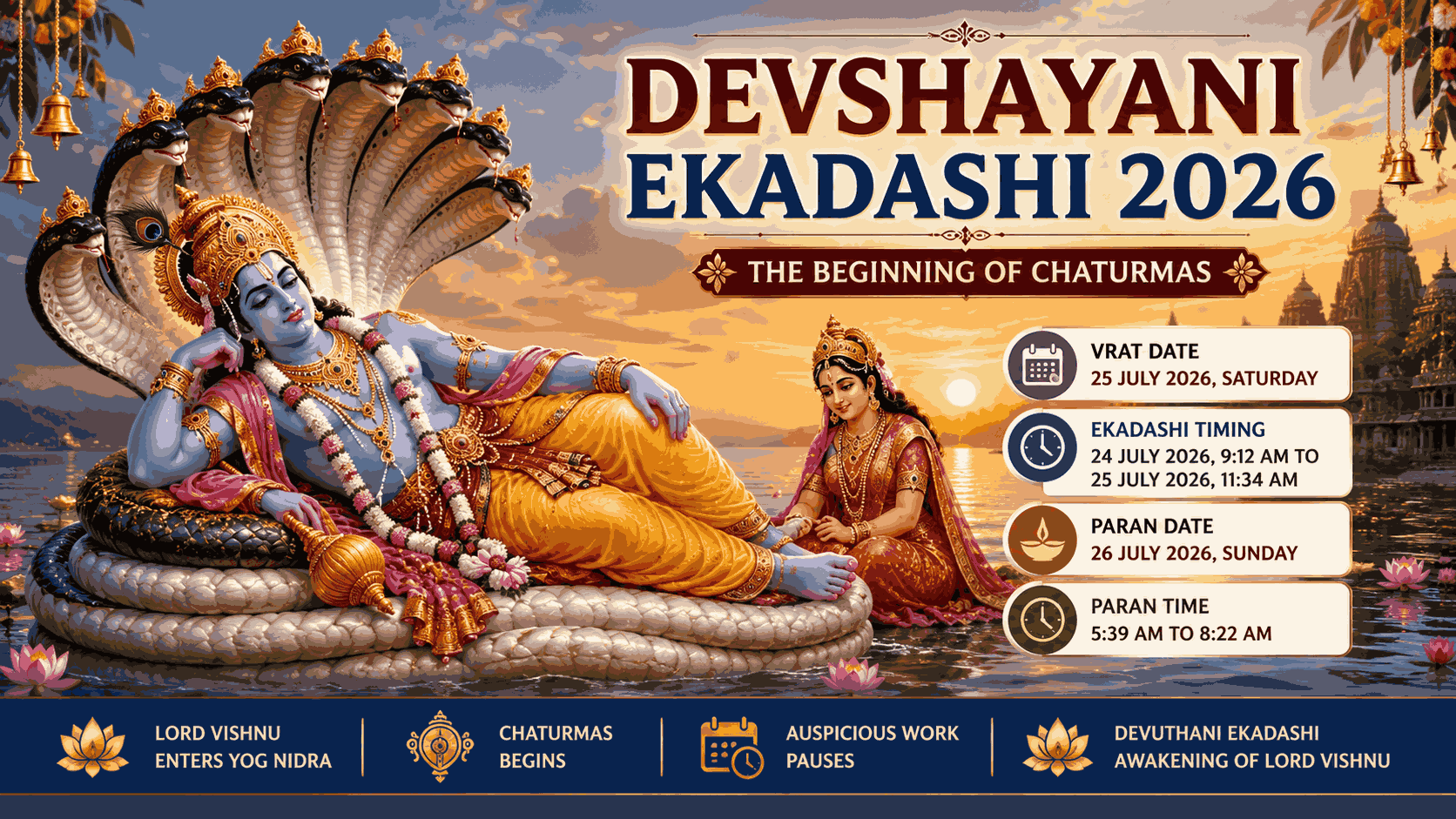
Devshayani Ekadashi, also known as Ashadha Shukla Ekadashi, holds profound spiritual significance in the Hindu faith. Observed in the month of Ashadha (June-July), this sacred Ekadashi marks the beginning of Chaturmas—the four-month period during which Lord Vishnu enters a state of divine sleep known as Yog Nidra. This period carries immense importance in Vaishnav traditions and is considered highly auspicious for devotional practices.
In 2026, Devshayani Ekadashi falls on July 25, though many devotees remain confused about whether to observe the fast on July 24 or July 25. This confusion arises from the difference between the Gregorian calendar and the Hindu lunar calendar, combined with the scriptural rule of Udaya Tithi (tithi at sunrise). Understanding the exact date and timing is crucial for authentic worship and maximum spiritual benefits.
This comprehensive guide provides you with everything you need to know: the precise vrat timing, puja muhurat, paran time, complete puja vidhi, mantras, significance, and the spiritual importance of Chaturmas. Whether you are a seasoned devotee or observing Devshayani Ekadashi for the first time, this article will help you perform the worship correctly and derive maximum spiritual benefit from this sacred occasion.
Devshayani Ekadashi 2026 Date
Devshayani Ekadashi in 2026 will be observed on July 25, 2026.
Ekadashi Tithi Details
The Ekadashi tithi (lunar day) has specific timings that determine the actual fasting date:
- Ekadashi Tithi Begins: July 24, 2026 at 9:12 AM
- Ekadashi Tithi Ends: July 25, 2026 at 11:34 AM
Why Fasting is NOT Observed on July 24
Many devotees wonder why the fast is observed on July 25 when the Ekadashi tithi technically begins on July 24 at 9:12 AM. The answer lies in understanding the Udaya Tithi principle, which is fundamental to Hindu festival calculations.
According to Hindu scriptures, a tithi’s relevance for fasting depends on its presence at sunrise on that particular day, not when it begins or ends. Since the Ekadashi tithi begins at 9:12 AM on July 24 (after sunrise), it is not considered the Ekadashi fasting day. The actual fasting day is July 25, when the entire sunrise period falls within the Ekadashi tithi window.
This principle ensures that devotees fast on the day that carries the full spiritual essence of Ekadashi, making their observance more authentic and spiritually powerful.
Why Is There Confusion Between July 24 and July 25?
Understanding the source of this common confusion helps devotees observe Devshayani Ekadashi correctly.
The Gregorian vs. Lunar Calendar Difference
The Hindu calendar operates on a lunar system, unlike the Gregorian calendar used in most of the world. The lunar calendar is based on the moon’s phases and is approximately 354 days long, compared to the Gregorian calendar’s 365 days. This fundamental difference creates variation in festival dates from year to year.
What is a Tithi?
A tithi is a lunar day calculated on the basis of the angular distance between the sun and moon. There are 15 tithis in each lunar fortnight, and Ekadashi is the eleventh tithi. Unlike solar days, tithis can span across two Gregorian calendar dates or fall entirely within one day.
The Panchang (Hindu Almanac)
The Panchang is the authoritative Hindu calendar that determines festival dates. It provides precise calculations of planetary positions, tithis, and auspicious moments. When a tithi spans two Gregorian dates, the Panchang helps determine which date should be observed based on sunrise rules.
The Sunrise Rule (Udaya Tithi)
The decision of whether to observe a festival on one date or another depends on which tithi is present at sunrise. This is called the Udaya Tithi rule. If Ekadashi tithi is present at sunrise, that day is designated for fasting. If Ekadashi ends before sunrise, the previous day might be chosen, but if it begins after sunrise, the next day becomes the fasting date.
For Devshayani Ekadashi 2026, since Ekadashi is present at sunrise on July 25, that is the correct fasting date.
Udaya Tithi Rule
What is Udaya Tithi?
Udaya Tithi literally means “the tithi at sunrise.” This is the foundational principle used in Hindu festival calculations to determine the correct date of observance for any tithi-based festival, including all Ekadashis.
Scriptural Basis
The Udaya Tithi rule is rooted in ancient Hindu scriptures and astronomical texts that recognize sunrise as the primary marker for distinguishing one day from another. The Vishnu Puranas, Narada Puranas, and other sacred texts emphasize that a tithi’s presence at sunrise determines its relevance for fasting and ritual observance.
Why Sunrise Determines Fasting
Sunrise is considered the beginning of a new day in Hindu tradition. The period from sunrise to the next sunrise defines a solar day. Since Ekadashi is significant based on lunar calculations, the rule is to observe it on whichever solar day the Ekadashi tithi appears at sunrise.
This principle ensures uniformity, clarity, and scriptural compliance across all Hindu communities and regions.
Why July 25 is the Correct Fasting Date
In 2026, the Ekadashi tithi is present at sunrise on July 25. Therefore, July 25 is the spiritually and scripturally correct date for observing Devshayani Ekadashi fast. Fasting on July 24, despite the tithi beginning on that date, would be against established Hindu principles and would diminish the spiritual efficacy of the fast.
Devshayani Ekadashi 2026 Timing
| Event | Date | Time |
|---|---|---|
| Ekadashi Begins | July 24, 2026 | 9:12 AM |
| Ekadashi Ends | July 25, 2026 | 11:34 AM |
| Vrat (Fasting) Date | July 25, 2026 | From sunrise |
| Paran (Breaking Fast) | July 26, 2026 | 5:39 AM – 8:22 AM |
| Dwadashi Ends | July 26, 2026 | 1:57 PM |
Detailed Explanation
- Vrat Commencement: Devotees should begin their fast on July 25, 2026, from sunrise or a little before. Many observe a strict water-only fast, while some follow sattvic diet guidelines.
- Paran Time: The fast should be broken on July 26, 2026, between 5:39 AM and 8:22 AM. This period is optimal for breaking the fast. It is recommended to perform the paran after sunrise and before the end of the specified window.
- Dwadashi Consideration: The Dwadashi tithi (twelfth lunar day) ends at 1:57 PM on July 26. Ideally, the paran should be completed before Dwadashi ends for maximum spiritual benefit.
Devshayani Ekadashi Puja Muhurat
Performing puja during auspicious time windows enhances the spiritual benefits of worship. Below are the most favorable muhurats for Devshayani Ekadashi 2026:
| Muhurat Name | Time |
|---|---|
| Brahma Muhurta | 4:32 AM – 5:16 AM |
| Abhijeet Muhurta | 12:06 PM – 12:58 PM |
| Vijay Muhurta | 2:43 PM – 3:35 PM |
| Twilight (Sandhya Kaal) | 7:04 PM – 7:26 PM |
| Amrit Kaal | 11:11 AM – 12:59 PM |
Best Time for Devshayani Ekadashi Puja
Brahma Muhurta (4:32 AM – 5:16 AM) is considered the most auspicious time for Ekadashi puja. This sacred time, just before sunrise, is when the mind is naturally pure, and spiritual practices yield maximum benefits. Waking up during Brahma Muhurta and performing puja ensures your worship is conducted in the most spiritually charged period of the day.
If you cannot perform puja during Brahma Muhurta, Abhijeet Muhurta (midday) is an excellent alternative. Amrit Kaal is also highly favorable for worship.
Puja Samagri (Required Materials)
Proper preparation of puja materials ensures that your worship is authentic and complete. Gather the following items before beginning:
- Lord Vishnu Idol or Photo: A statue or image of Lord Vishnu in any form (Narayan, Krishna, or Ram)
- Lakshmi Idol or Photo: Goddess Lakshmi’s image, as she is Vishnu’s eternal consort
- Yellow Flowers: Marigold, sunflower, or other yellow blooms (yellow symbolizes Lord Vishnu)
- Tulsi Leaves: Fresh tulsi (holy basil) branches are essential
- Incense Sticks: Preferably sandalwood or rose varieties
- Ghee Lamp: Clarified butter and cotton wicks for the diya
- Fresh Fruits: Banana, apple, or other seasonal fruits
- Panchamrit: A mixture of milk, yogurt, honey, ghee, and sugar
- Kalash (Pot): A small brass or copper pot filled with water
- Gangajal: Water from the Ganges River (or water sanctified with mantras)
- Yellow Cloth: For covering the idol or altar
- Prasad: Kheer (rice pudding), halwa, or other vegetarian sweets
- Rice: Uncooked rice for offering
- Kumkum: Red vermillion for tilak
- Sandalwood Paste: For applying to the idol and forehead
- Bell: For ringing during aarti
Devshayani Ekadashi Puja Vidhi
The puja vidhi (ritual procedure) outlined below should be followed step-by-step for authentic worship of Lord Vishnu on Devshayani Ekadashi.
1: Prepare Yourself
- Wake Early: Rise before sunrise, ideally during Brahma Muhurta (4:32 AM – 5:16 AM)
- Bathe: Take a ritual bath with water. This purifies your body and mind
- Wear Yellow Clothes: Yellow represents Lord Vishnu. Wear a fresh yellow saree, dhoti, or any yellow garment
- Clean the Puja Area: Sweep and clean the space where you will perform puja. Cleanliness is paramount in worship
2: Arrange the Altar
- Place the Kalash (pot) at the center of your puja altar
- Fill it with water and place the Lord Vishnu idol in front of or beside the Kalash
- Keep the Lakshmi idol to the left of Vishnu
- Spread a yellow cloth beneath the idols
- Arrange all puja materials (flowers, fruits, incense, lamp, etc.) around the altar
3: Purify the Altar
- Sprinkle Gangajal (sacred water) around the altar to purify it
- This sanctifies the space and invites divine presence
- Chant “Om” three times while sprinkling the water
4: Offer Arghya (Water Offering)
- Take water in your right palm or a small vessel
- Face the East and offer water toward the sun while chanting: “Om Surya Namah” (Salutations to the Sun God)
- Arghya to the sun establishes a connection between the cosmic and personal divinity
5: Install the Idols
- Gently place the Lord Vishnu idol at the center
- Position the Lakshmi idol respectfully beside Vishnu
- Bow respectfully before both idols
6: Offer Tulsi Leaves
- Place fresh tulsi leaves at the feet of Lord Vishnu’s idol
- Tulsi is the sacred plant most dear to Lord Vishnu
- Chant: “Om Namo Bhagavate Vasudevaya” while offering Tulsi
7: Offer Flowers
- Offer yellow flowers to Lord Vishnu while chanting Vishnu mantras
- Scatter flowers around the idol
- Flowers represent devotion and purity
8: Light the Lamp
- Light the ghee lamp (diya) with a cotton wick
- The lamp symbolizes the removal of darkness and ignorance
- Keep it burning throughout your worship
9: Offer Fruits and Sweets
- Present fresh fruits and prasad (sweets) to the idol
- Offer Panchamrit to Lord Vishnu
- These offerings represent your gratitude and devotion
10: Apply Sandalwood and Kumkum
- Apply sandalwood paste and kumkum tilak to the idol’s forehead
- Also apply tilak to your own forehead
- This marks spiritual awakening and devotion
11: Recite Mantras and Prayers
- Chant the Vishnu Sahasranama (thousand names of Vishnu) or at least the mantras provided in this guide
- Recite Om Namo Bhagavate Vasudevaya 108 times (one mala of beads)
- Sing devotional hymns if you know them
12: Read the Vrat Katha
- If possible, read or listen to the Devshayani Ekadashi Vrat Katha (story)
- The story details the significance of this Ekadashi and its spiritual importance
- This reading reinforces the purpose of your fast
13: Perform Aarti
- Ring the bell while waving the lamp in circular motions before the idol
- Sing aarti songs or chant “Om” during aarti
- This acknowledges Lord Vishnu’s supreme power and presence
14: Circumambulate and Bow
- Respectfully walk around the altar in a clockwise direction
- Bow before the idols with folded hands
- Express your devotion and surrender
15: Distribute Prasad and Perform Charity
- Consume the prasad yourself
- Distribute it to family members and guests
- Give food to poor people and animals
- Donate clothes or money to those in need
Importance of Devshayani Ekadashi
Devshayani Ekadashi stands as one of the most significant festivals in the Hindu calendar, marking a pivotal spiritual event.
Lord Vishnu Enters Yog Nidra
On this sacred day, Lord Vishnu begins his divine sleep, known as Yog Nidra (the yoga sleep or cosmic slumber). This is not ordinary sleep but a transcendent state in which Vishnu continues to protect and sustain the universe. During this period, Vishnu withdraws his active intervention in worldly affairs, allowing natural cosmic cycles to continue.
Beginning of Chaturmas
Devshayani Ekadashi marks the commencement of Chaturmas (the four-month period), which lasts until Kartik Purnima (the full moon in October-November). During these four months, devotees deepen their spiritual practices, as Lord Vishnu’s presence is more inward-focused.
Importance in Vaishnav Tradition
For followers of Vaishnavism (the worship of Lord Vishnu and his avatars), Devshayani Ekadashi is deeply sacred. Vaishnavs consider this day as a renewed covenant with their deity, reaffirming their devotion and commitment to righteous living during the coming four months.
Spiritual Significance
Spiritually, this Ekadashi reminds devotees of the cyclical nature of existence. Just as Vishnu enters rest, devotees are encouraged to turn inward, meditate, and strengthen their connection with the divine. It is a time for spiritual renewal and introspection.
Religious Beliefs
Observing Devshayani Ekadashi with sincerity is believed to:
- Grant liberation from the cycle of birth and death
- Fulfill desired wishes and aspirations
- Remove obstacles on the spiritual path
- Bring peace, prosperity, and divine grace into one’s life
Why Lord Vishnu Sleeps During Chaturmas
The Mythological Perspective
Hindu mythology provides profound insights into why Lord Vishnu enters Yog Nidra during Chaturmas. According to the Puranas, after completing his cosmic duties and maintaining universal balance, Vishnu rests to conserve energy for the next phase of creation. This rest is not a sign of fatigue but a deliberate withdrawal into a state of supreme consciousness.
The Bhagavata Purana describes how Vishnu lies on the serpent Ananta Shesha in the cosmic ocean, in the Vaikuntha (his heavenly abode), entering a meditative sleep. During this period, the universe continues to function through the established cosmic order (Rta).
Symbolic Meaning
On a spiritual level, Vishnu’s sleep symbolizes:
- The Inward Journey: Just as Vishnu withdraws, devotees are encouraged to look within and deepen their inner spiritual experience
- Nature’s Rest: The monsoon season (which corresponds to Chaturmas) is a time when nature rests. Vishnu’s sleep mirrors this natural rhythm
- Spiritual Hibernation: This period is ideal for introspection, meditation, and spiritual growth away from external distractions
Why Marriages and Auspicious Ceremonies Stop
During Chaturmas, marriages and auspicious ceremonies are traditionally avoided. This practice stems from the belief that:
- Lord Vishnu, the witness and sanctioner of all auspicious events, is in a state of divine sleep
- Without Vishnu’s active blessings, ceremonies lack their full spiritual potency
- It is considered inauspicious to initiate major life events when the universe’s sustainer is resting
This tradition has been followed for millennia and remains respected in orthodox Hindu households.
Devuthani Ekadashi – The Awakening
Just as Devshayani Ekadashi marks the beginning of Vishnu’s sleep, Devuthani Ekadashi (also called Utthana Ekadashi), observed during Kartik month, marks Vishnu’s awakening. On this day, Vishnu is believed to wake from his cosmic slumber, and auspicious ceremonies resume.
Benefits of Devshayani Ekadashi Fast
Observing the Devshayani Ekadashi fast with devotion yields numerous spiritual, mental, and emotional benefits:
Spiritual Benefits
- Liberation and Moksha: Fasting on Ekadashi is believed to accelerate the soul’s journey toward liberation from the cycle of rebirth
- Divine Grace: Sincere observance attracts Lord Vishnu’s grace and blessings
- Spiritual Elevation: The practice elevates consciousness and strengthens the connection between the devotee and the divine
- Purification of Karma: Fasting purifies accumulated negative karma and facilitates spiritual progress
Mental and Emotional Benefits
- Mental Clarity: Fasting sharpens the mind, reduces mental clutter, and enhances focus
- Emotional Stability: The discipline required during fasting cultivates emotional resilience and inner peace
- Reduced Anxiety: Regular Ekadashi fasting has been reported to reduce stress and anxiety levels
- Enhanced Devotion: The fast deepens one’s relationship with Lord Vishnu and strengthens faith
Physical and Health Benefits
- Detoxification: Fasting gives the digestive system a complete rest, allowing the body to eliminate toxins
- Metabolic Reset: A regular fasting practice can improve metabolism and digestive health
- Weight Management: Controlled fasting helps maintain healthy body weight
- Improved Vitality: Many observers report increased energy levels after completing the fast
Personal Development
- Self-Discipline: Fasting cultivates self-control and willpower
- Patience and Perseverance: Extended fasting develops these essential virtues
- Compassion: By experiencing hunger, one develops empathy for the less fortunate
- Humility: The practice fosters humility and surrender to a higher power
Rules During the Fast
To maximize the spiritual benefits of Devshayani Ekadashi fast, certain rules and principles must be followed:
Rise Early
- Wake up before sunrise, ideally during Brahma Muhurta (4:32 AM – 5:16 AM)
- Early rising aligns you with natural spiritual rhythms and allows for uninterrupted meditation and prayer
Maintain Celibacy
- Abstain from all sexual relations during the fast
- This practice conserves vital energy (Ojas) needed for spiritual practice
Practice Truthfulness
- Speak only truth during the fasting period
- Avoid gossip, unnecessary conversation, and negative speech
- Truthfulness purifies the mind and aligns it with divine principles
No Anger and Negativity
- Keep your mind free from anger, jealousy, and negative emotions
- Approach the day with patience, compassion, and positive thoughts
- Negativity weakens the spiritual potency of the fast
Avoid Onion and Garlic
- These pungent foods are traditionally avoided during fasts as they are believed to stimulate passions and cloud spiritual awareness
- They are considered Tamasic foods (foods that induce inertia and dullness)
Avoid Grains (Anaj Vichar)
- Do not consume rice, wheat, or any grains during the fast
- Grains are reserved for breaking the fast (paran) on the next day
- This restriction is a defining characteristic of Ekadashi fasting
Chant Vishnu’s Name
- Dedicate time to chanting “Om Namo Bhagavate Vasudevaya” or other Vishnu mantras
- Chanting purifies the mind and strengthens your connection with the divine
- Aim for at least 108 repetitions or one mala
Practice Charity
- Give generously to the poor, needy, and animals
- Distribute food, clothes, or money according to your capacity
- Charity amplifies the spiritual benefits of your fast
Maintain Purity
- Keep your body and surroundings clean
- Bathe regularly during the fasting period
- Wear clean, preferably white or yellow, clothing
Avoid Entertainment and Distractions
- Stay away from movies, television, and other worldly entertainment
- Minimize social media and unnecessary conversations
- Dedicate your time to spiritual activities
Foods Allowed During Fast
While fasting on Ekadashi, several sattvic (pure) foods can be consumed:
- Fruits: Banana, apple, orange, mango, papaya, watermelon, and other seasonal fruits
- Milk Products: Milk, yogurt, buttermilk, paneer (cottage cheese), and ghee
- Nuts: Almonds, cashews, walnuts, and other unsalted nuts
- Seeds: Pumpkin seeds and sunflower seeds
- Vegetables: Potato, sweet potato, bottle gourd, and cucumber (after removing seeds)
- Honey: Pure honey as a sweetener
- Saindhav Salt: Rock salt (mineral salt) instead of table salt
- Herbs: Tulsi leaves, ginger, and cinnamon
- Herbal Teas: Ginger tea, tulsi tea, or herbal infusions without caffeine
- Specific Flours: Amaranth flour, buckwheat flour, and water chestnut flour for making light foods
- Sweets: Kheer made with milk and amaranth flour, halwa made with water chestnut flour
Foods to Avoid During Fast
The following foods should strictly be avoided during Ekadashi fasting:
- Grains: Rice, wheat, barley, oats, and any cereal grains
- Pulses: Lentils, chickpeas, beans, and other legumes
- Onion and Garlic: Both are strictly prohibited
- Egg and Non-Vegetarian Foods: Meat, fish, poultry, and all animal flesh
- Alcohol and Intoxicants: Any form of alcohol or mind-altering substances
- Tea and Coffee: Regular tea and coffee contain caffeine and should be avoided
- Refined Sugar: White sugar; honey or jaggery are preferable
- Table Salt: Use rock salt (saindhav namak) instead
- Spicy Foods: Highly spiced foods that agitate the mind
- Leafy Vegetables: Spinach, lettuce, and other greens (except tulsi)
- Tomato and Pepper: These are considered overstimulating
- Fried Foods: All fried items and heavy foods
- Fermented Foods: Pickles and fermented items
Charity on Devshayani Ekadashi
Charity (Daan) is an integral component of Devshayani Ekadashi observance. Acts of generosity not only help those in need but also amplify the spiritual benefits of your fast.
Food Donation
- Distribute free meals to the poor and destitute
- Prepare sattvic prasad and distribute it to neighbors and community members
- Provide grains and essential provisions to those struggling with hunger
Cloth Donation
- Donate new or clean clothes to the needy
- Offer warm clothes during colder months
- This practice cultivates compassion and reduces ego
Cow Feeding
- Feed grass, fodder, or grains to cows, which are considered sacred in Hinduism
- Serving cows is believed to be equivalent to serving Lord Vishnu himself
- Even if direct cow access isn’t available, supporting cow sanctuaries is beneficial
Temple Donation
- Contribute money or materials to the local temple
- Funds support the temple’s maintenance, rituals, and community activities
- Temple donations are considered highly meritorious
Service to the Elderly and Sick
- Help elderly relatives or neighbors with household tasks
- Provide support to the sick and infirm
- Offer money or medicine to those unable to afford medical care
Feeding Animals
- Place out food and water for birds, squirrels, and other animals
- This extends compassion beyond humans to all sentient beings
Vishnu Mantras for Devshayani Ekadashi
Chanting mantras dedicated to Lord Vishnu is central to Devshayani Ekadashi worship. These sacred syllables align your consciousness with the divine and purify your inner space.
Primary Mantra
Om Namo Bhagavate Vasudevaya
This is the most important Ekadashi mantra. Recite it 108 times using a mala (rosary). This mantra directly addresses Lord Vishnu (Vasudeva) and is considered the most powerful invocation on Ekadashi. It can be chanted throughout the day during your fast.
Universal Vishnu Mantra
Om Vishnave Namah
This shorter mantra means “Salutations to Lord Vishnu.” It is simple yet profound and can be chanted as frequently as desired. Many devotees use this as a background chant while performing daily activities.
Dhanvantari Mantra (for Health)
Om Vasudevaya Vidmahe
Vaidhyarajaya Dhimahi
Tanno Dhanvantari Prachodayat
Chant this mantra for health, longevity, and freedom from disease. Dhanvantari is the celestial physician and an avatar of Lord Vishnu. This mantra is particularly powerful when recited during the Puja Muhurat.
Tatpurusha Mantra (for Spiritual Awakening)
Om Tatpurushaya Vidmahe
Amrita Kalasa Hasthaya Dhimahi
Tanno Dhanvantari Prachodayat
This mantra represents Lord Vishnu in his aspect as the primordial form and the holder of immortal nectar (Amrita). It awakens spiritual consciousness and grants divine knowledge.
When to Chant Each Mantra
- Om Namo Bhagavate Vasudevaya: Chant this throughout the entire day and night of your fast. It forms the backbone of your Ekadashi worship
- Om Vishnave Namah: Use this for continuous chanting while doing household chores or any activity during the fast
- Dhanvantari Mantra: Recite this 11 or 21 times during the Puja Muhurat for health and wellness
- Tatpurusha Mantra: Chant this 7 or 11 times for spiritual advancement
How to Chant
- Use a mala (rosary) with 108 beads for counting
- Sit in a comfortable meditation posture (Sukhasana or Padmasana)
- Maintain a steady, rhythmic pace
- Focus your mind on the meaning of the mantra
- Allow the vibration of the mantra to resonate within you
- Chant with devotion and sincere faith
Common Mistakes to Avoid
Even well-intentioned devotees sometimes make mistakes during Devshayani Ekadashi observance. Avoid these common pitfalls:
Wrong Date Selection
- Mistake: Observing fast on July 24 instead of July 25
- Solution: Always follow the Udaya Tithi rule and verify with a reliable Panchang. Confirm the fasting date before beginning your fast
Consuming Prohibited Foods
- Mistake: Eating grains, onion, garlic, or table salt during the fast
- Mistake: Consuming non-vegetarian food or eggs
- Solution: Prepare a list of allowed foods beforehand and avoid temptation
Breaking Fast at Wrong Time
- Mistake: Eating before the paran time begins or after it ends
- Solution: Note the exact paran time (5:39 AM – 8:22 AM on July 26) and break your fast only during this window
Incomplete Puja
- Mistake: Rushing through the puja or omitting important steps
- Solution: Allocate sufficient time and follow the complete puja vidhi systematically
Lack of Intention and Devotion
- Mistake: Fasting mechanically without genuine devotion
- Solution: Approach the fast with sincere faith and a clear spiritual intention
Neglecting Charity
- Mistake: Completing the fast without performing any charitable acts
- Solution: Plan acts of charity in advance and execute them with genuine compassion
Indulgence After Paran
- Mistake: Overeating immediately after breaking the fast
- Solution: Consume light, easily digestible food during paran. Avoid heavy or spicy foods for the next meal
Negative Mental State
- Mistake: Harboring anger, negativity, or resentment during the fast
- Solution: Consciously cultivate positive thoughts, gratitude, and compassion throughout the day
Ignoring Water Consumption
- Mistake: Not drinking enough water during the fast
- Solution: Stay hydrated, especially during daytime, to maintain health and energy
Wrong Paran Food
- Mistake: Consuming heavy, oily, or spicy foods to break the fast
- Solution: Begin paran with light foods like milk, kheer, or fresh fruits, gradually moving to normal diet
Frequently Asked Questions
When is Devshayani Ekadashi 2026?
Devshayani Ekadashi in 2026 is observed on July 25, 2026. Though the Ekadashi tithi begins on July 24 at 9:12 AM, the fasting is done on July 25 because of the Udaya Tithi rule—the tithi must be present at sunrise for that day to be chosen as the fasting date.
Is Devshayani Ekadashi on July 24 or July 25?
Devshayani Ekadashi is on July 25, 2026. Many people mistakenly think it’s July 24 because that’s when the Ekadashi tithi technically begins. However, since the tithi starts at 9:12 AM (after sunrise), the fasting date is July 25, when Ekadashi is present at sunrise.
What is the Udaya Tithi Rule?
The Udaya Tithi rule states that the tithi (lunar day) present at sunrise determines the fasting date. This ancient principle ensures that Ekadashi fasting occurs on the solar day when the Ekadashi tithi is dominant at sunrise, making it spiritually valid and scripturally compliant.
Who should observe Devshayani Ekadashi Fast?
All Hindus, especially devotees of Lord Vishnu, can observe this fast. However, certain individuals should consult with a spiritual guide:
- Pregnant women
- People with serious health conditions
- Young children (who can observe modified fasts)
- Elderly individuals with weak digestion
Even those unable to fast completely can observe partially or simply honor the day by maintaining ethical conduct and worshipping Lord Vishnu.
Can I consume water during the fast?
Yes, water can be consumed freely during Ekadashi fast. In fact, staying hydrated is important for health. You can also consume water infused with herbs, tulsi water, or coconut water without adding sugar.
Can fruits be eaten during the fast?
Yes, fresh fruits are allowed and encouraged during Ekadashi fast. You can eat bananas, apples, oranges, melons, and other seasonal fruits. Fruit provides essential nutrients and helps sustain energy during the fasting period. Avoid canned or processed fruits.
When should I break my fast (Paran)?
The paran time for Devshayani Ekadashi 2026 is 5:39 AM to 8:22 AM on July 26. Breaking the fast during this window ensures maximum spiritual benefit. It’s best to perform paran after sunrise and before the end of the specified time. Consuming something light like kheer, milk, or fruit is recommended to begin paran.
What should I eat to break my fast (Paran)?
Ideal paran foods include:
- Kheer (rice pudding made with milk)
- Halwa (made with water chestnut flour or semolina)
- Fresh Milk
- Yogurt
- Fresh Fruits
- Nuts and Dates
Avoid heavy, oily, or spicy foods immediately after fasting. Eat slowly and in moderation.
Why does Chaturmas begin after Devshayani Ekadashi?
Chaturmas begins on Devshayani Ekadashi because it marks the beginning of Lord Vishnu’s divine sleep (Yog Nidra). According to Hindu mythology and religious tradition, Vishnu enters a state of meditation during these four months (July to October), after which he awakens on Devuthani Ekadashi. This period corresponds with the monsoon season and is considered ideal for spiritual practices.
Why do marriages and auspicious ceremonies stop during Chaturmas?
Marriages, thread ceremonies, housewarming, and other auspicious ceremonies are avoided during Chaturmas because:
- Lord Vishnu, the witness and sanctioner of auspicious events, is in a state of divine sleep
- His active blessings are believed to be needed for ceremonies to have full spiritual efficacy
- This ancient tradition maintains the sanctity of major life events
Can I observe a partial fast?
Yes, you can observe a partial fast (Phalahar) by consuming only fruits, milk, and sattvic foods while avoiding grains and regular meals. This is a common practice, especially for those with health limitations. The spiritual benefits are proportional to your sincere effort and devotion.
Should I exercise or do yoga during the fast?
Light exercise like walking, yoga, or stretching is allowed and beneficial during Ekadashi. However, avoid strenuous workouts that may deplete your energy. Focus on gentle, meditative practices that align with the spiritual nature of the fast.
What if I accidentally break my fast before the paran time?
If an emergency requires you to eat before paran time, don’t feel discouraged. Complete your fast from that point onward and resume fasting. The sincere intention behind your observance and the time you actually fasted still holds spiritual merit.
Can children observe Devshayani Ekadashi fast?
Children can observe a modified fast. Instead of a strict fast, they can:
- Consume fruits and milk throughout the day
- Avoid grains and non-vegetarian foods
- Participate in puja and chanting
- Learn about the spiritual significance of the day
This introduces them to the tradition while ensuring their health and nutritional needs are met.
What is the significance of Chaturmas?
Chaturmas (the four sacred months) holds immense spiritual significance. It is the period when:
- Lord Vishnu rests in divine meditation
- Devotees deepen their spiritual practices
- The monsoon rejuvenates nature
- Pilgrimages to holy sites like Varanasi, Mathura, and Ayodhya are especially meritorious
- Regular worship and penance yield accelerated spiritual progress
Can people from other religions observe Devshayani Ekadashi fast?
While Devshayani Ekadashi is rooted in Hindu tradition, people from any faith can benefit from its principles of fasting, charity, and spiritual reflection. The core values—self-discipline, compassion, and inner peace—are universal and transcend religious boundaries.
Conclusion
Devshayani Ekadashi 2026 holds a sacred place in the Hindu calendar as the day marking the beginning of Chaturmas and Lord Vishnu’s divine sleep. Observed on July 25, 2026, this Ekadashi carries profound spiritual significance for devotees worldwide.
Understanding the correct date, timing, and puja vidhi ensures that your observance is authentic and yields maximum spiritual benefits. The Udaya Tithi rule clarifies why July 25 is the fasting date despite the tithi beginning on July 24—this principle, rooted in ancient scriptures, honors the sanctity of the solar day in which the lunar day dominates at sunrise.
Devshayani Ekadashi is not merely a day of fasting but an opportunity for deep spiritual connection with the divine. The fast purifies your body and mind, while charity extends compassion to others. Chanting Vishnu mantras, especially “Om Namo Bhagavate Vasudevaya,” aligns your consciousness with the eternal and infinite.
The four months of Chaturmas following Devshayani Ekadashi are ideal for intensifying spiritual practices, meditation, and devotion. Whether you observe a strict fast, a partial fast, or simply honor the day with worship and ethical conduct, your sincere intention matters most.
As you prepare for Devshayani Ekadashi 2026, approach the observance with faith, devotion, and respect for the ancient traditions. Remember that the true essence of fasting lies not in denying food but in redirecting that energy inward, toward spiritual growth and divine union.
May your observance of Devshayani Ekadashi bring you peace, prosperity, and divine grace. May Lord Vishnu’s blessings accompany you throughout Chaturmas and beyond. Honor this sacred day with devotion, practice charity with sincerity, and allow the spiritual transformation that Devshayani Ekadashi promises to unfold in your life.