Hindu Festivals · Sawan 2026
Kanwar Yatra 2026: Complete Guide, Dates, Routes, History & Travel Tips
When it falls, where the Kanwariyas walk, the Puranic stories behind every step — and how to offer Jalabhishek even if you can’t make the walk yourself.
Kanwar Yatra 2026 — Quick Facts
- Yatra Begins
- Thursday, 30 July 2026 (Shravan Pratipada)
- Sawan Shivratri / Jalabhishek
- Tuesday, 11 August 2026
- Shravan Month Ends
- Friday, 28 August 2026 (Shravan Purnima)
- Devotees Called
- Kanwariyas / Kanwarias
- Common Chants
- “Bol Bam”, “Har Har Mahadev”
- Main Starting Points
- Haridwar, Gaumukh, Gangotri, Sultanganj, Nashik
Every year, as the first monsoon clouds settle over North India, highways from Haridwar to Delhi and forest roads from Sultanganj to Deoghar turn saffron. Lakhs of bare feet strike the tarmac in rhythm with cries of “Bol Bam” and “Har Har Mahadev.” This is the Kanwar Yatra — one of the largest annual walking pilgrimages on Earth, undertaken every Sawan (Shravan) month. In 2026 it begins on 30 July, building to its peak on Sawan Shivratri on 11 August. This guide walks through what the yatra means, the mythology that gave rise to it, every major route Kanwariyas take, and how to take part even if you can’t walk the distance yourself.
What Is Kanwar Yatra?
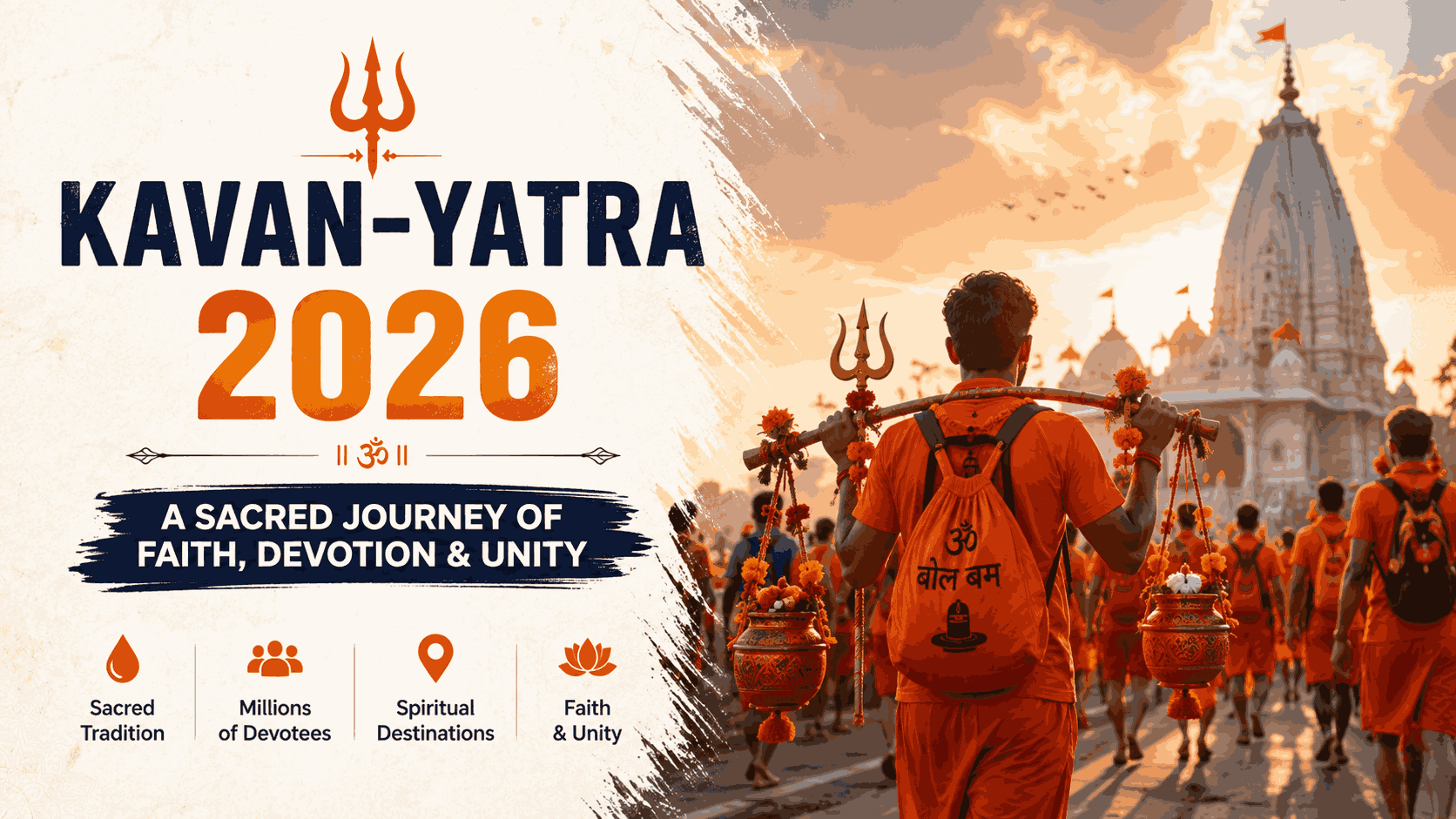
A kanwar is a bamboo pole, bent to a gentle curve, with two decorated pots hanging from either end. During the holy month of Shravan, devotees of Lord Shiva — known as Kanwariyas — fill those pots with sacred water from the River Ganga at pilgrimage points such as Haridwar, Gaumukh, Gangotri or Sultanganj. They then balance the pole across their shoulders and walk, sometimes for a few kilometres and sometimes for several hundred, back to a Shiva temple near their home. There, on an auspicious day, the water is poured over the Shivalingam in a ritual called Jalabhishek — the entire purpose of the journey.
What makes the Kanwar Yatra distinctive is its discipline: the pot of Ganga jal is never meant to touch the ground, and many Kanwariyas observe a strict vegetarian, often fully fasting, regimen for the duration of the walk.
Can’t walk the route this year?
Book a Jalabhishek Seva at Kashi Vishwanath Dham
A verified Pandit performs the Jalabhishek and Rudrabhishek on your behalf, on the banks of the Ganga in Varanasi, with full Shastriya vidhi.
Book Jalabhishek Seva →The Mythological Significance of Kanwar Yatra
Like most living Hindu traditions, the Kanwar Yatra is anchored in Puranic legend. A few stories are told most often to explain why this particular ritual, in this particular month, means so much to Shiva devotees.
Samudra Manthan and the Origin of Neelkanth
According to the Puranas, when the devas and asuras churned the cosmic ocean (Samudra Manthan) in search of the nectar of immortality, a deadly poison called Halahala emerged first, threatening to destroy all creation. To protect the universe, Lord Shiva drank the poison and held it in his throat rather than swallowing it, which turned his throat blue and earned him the name Neelkanth, “the blue-throated one.” It is to cool and soothe that burning that devotees began the tradition of offering him the cool, purifying water of the Ganga.
Ravana, the First Devotee to Offer Ganga Jal
One widely told legend credits Ravana, the great Shiva bhakt of the Ramayana, as the first to carry Ganga water to soothe Shiva after he consumed the poison. This story is closely tied to the Sultanganj–Deoghar route, where the Ganga is believed to flow northward (Uttarvahini) — considered an especially sacred and rare occurrence.
Lord Parashurama — Tradition’s First Kanwariya
Many regional accounts hold that Parashurama, the sixth avatar of Vishnu, was the very first Kanwariya, carrying Ganga water from Haridwar to offer at a Shiva temple in western Uttar Pradesh — making this one of the oldest continuously observed pilgrimage traditions in India.
Why Shravan Is Shiva’s Favourite Month
Shravan itself carries special weight in Shaiva tradition. Some accounts connect it to the period of penance the goddess Parvati undertook to win Shiva as her husband, while others simply hold that this monsoon month is the one Shiva loves best — which is why devotees believe worship and Jalabhishek performed now yield the greatest blessings.
Whether read literally or symbolically, these stories share one thread: Ganga jal, offered with sincere devotion, is believed to cool, purify and heal — which is precisely what the Kanwar Yatra re-enacts every single Sawan.
Why Kanwar Yatra Matters
- Spiritual purification: Walking barefoot, fasting and carrying the Kanwar without setting it down is treated as a form of tapasya (penance).
- Fulfilment of wishes (manokamna): Many devotees walk to seek Shiva’s blessings for health, marriage, employment or a family member’s wellbeing.
- Community and seva: The route is lined with volunteer-run camps offering free food, water and medical aid — one of India’s largest displays of voluntary community service.
- An equalising tradition: On the road, distinctions of class and background fall away; every Kanwariya is simply a devotee.
Why People Undertake This Journey
Ask a hundred Kanwariyas why they walk, and the reasons vary, but a few come up again and again: lifelong family tradition, a prayer that was answered, or the physical and mental challenge itself, seen as proof of devotion and self-discipline. For many young participants it has also become a shared social and cultural event — music, decorated Kanwars and group camaraderie alongside the solemn religious duty.
Kanwar Yatra 2026: Key Dates
The yatra follows the Purnimanta Hindu calendar used across North India. For 2026, the key dates are:
- 30 July 2026 (Thursday): Shravan month begins — Kanwariyas set out to collect Ganga jal.
- 11 August 2026 (Tuesday): Sawan Shivratri — the single most important day, when most Kanwariyas perform Jalabhishek.
- 28 August 2026 (Friday): Shravan Purnima — the month, and the yatra, formally conclude.
Cross-check exact tithi timings against your local Panchang closer to the date, since regional calendars can vary slightly.
Major Kanwar Yatra Routes
Haridwar → Delhi-NCR & Western UP
The busiest, best-organised route in the country, lined with hundreds of sewa camps.
Haridwar → Neelkanth Mahadev Temple, Rishikesh
The shortest major route, popular with families and first-timers, and directly tied to the Neelkanth legend.
Gangotri / Gaumukh → Kashi Vishwanath, Varanasi
The longest and most demanding route, ending at one of Shiva’s twelve Jyotirlingas. If the full walk isn’t possible, you can still complete the ritual — see our guide to performing Sawan Puja and Jalabhishek in Banaras, or book a seva directly.
Sultanganj → Baba Baidyanath Dham, Deoghar
One of the oldest Kanwar routes, walked during the parallel Shravani Mela, where the Ganga flows Uttarvahini (northward).
Nashik → Trimbakeshwar Jyotirlinga
Devotees draw water from the Godavari, treated as equivalent to Gangajal, and carry it to Trimbakeshwar.
Haridwar → Pura Mahadev & Augharnath Temples
Linked directly to the Parashurama legend, among the oldest recorded Kanwar Yatra destinations.
Types of Kanwariyas
- Normal (Padal) Kanwariya: Walks at a steady pace, resting at camps along the way.
- Dak Kanwar: A relay style where teams run continuously without setting the Kanwar down.
- Khadi (Standing) Kanwar: Devotees who vow not to sit or lie down for rest at any point.
- Dandi Kanwar: The most austere form, measuring the route with prostrations.
Rituals, Rules & Kanwar Etiquette
- The Kanwar is never placed directly on the ground; it’s hung from a tree, a stand, or handed to a companion.
- Most Kanwariyas keep a strict satvik (pure vegetarian) diet and avoid alcohol and tobacco throughout.
- Footwear is often given up entirely, the journey completed barefoot as an act of humility.
- Saffron (bhagwa) clothing is worn throughout, marking the wearer as a devotee observing this vow.
Frequently Asked Questions
What is the Kanwar Yatra 2026 start date?
Kanwar Yatra 2026 begins on Thursday, 30 July 2026, the first day (Pratipada) of Shravan month as per the Purnimanta calendar followed in North India.
When is Jalabhishek / Sawan Shivratri in 2026?
Sawan Shivratri, the day most Kanwariyas pour Ganga water on the Shivling, falls on Tuesday, 11 August 2026.
When does Kanwar Yatra 2026 end?
Shravan month, and with it the yatra, concludes on Shravan Purnima, Friday, 28 August 2026, though crowds thin sharply after Shivratri on 11 August.
Which is the longest Kanwar Yatra route?
The Gangotri or Gaumukh to Kashi Vishwanath route is the longest, covering well over 250 km from the source alone through hilly terrain via Uttarkashi, Tehri and Rishikesh.
Can I book a Jalabhishek seva at Kashi Vishwanath instead of walking the full route?
Yes. Devotees who cannot undertake the physical walk can book a verified Pandit to perform Jalabhishek and Rudrabhishek on their behalf at Kashi Vishwanath Dham, Varanasi.
In Closing
The Kanwar Yatra is, at its heart, a very simple act: carrying water, with care, from a sacred river to a sacred idol. What makes it extraordinary is the scale of devotion behind that simple act — millions of ordinary people, year after year, choosing discomfort and discipline as an offering. Whether you’re planning to join the walk in 2026, support a Kanwariya passing through your town, or book a puja to take part from afar, that single word — Bol Bam — carries the whole story.