There are very few days in the Hindu calendar so powerful, so universally auspicious, that even astrologers do not need to calculate a Muhurta for them. Akshaya Tritiya is one of those rare, extraordinary days.
The word Akshaya (अक्षय) comes from Sanskrit and means “that which never diminishes, never decays, never ends.” Every act of charity, every prayer, every investment, every new beginning made on this day is believed to grow and multiply endlessly — carrying its positive energy forward for the rest of a person’s life.
This is why, year after year, millions of Hindus across India and the world plan their most important decisions around this single day. Weddings are solemnised, businesses are launched, homes are purchased, gold is bought, seeds are sown — all on Akshaya Tritiya, with the faith that what begins here never stops growing.
This complete guide covers everything you need to know about Akshaya Tritiya 2026 — the exact date and Muhurat timings, the mythology and spiritual significance, the rituals to follow, what to buy, what to do, and how to make the most of this once-a-year divine opportunity.
Akshaya Tritiya 2026: Date and Timings
Akshaya Tritiya 2026 falls on Sunday, April 19, 2026.
It falls on the third lunar day (Tritiya) of the bright fortnight (Shukla Paksha) of the Vaishakha month — one of the most sacred positions in the entire Hindu calendar year.
Key Timings at a Glance
| Event | Timing |
|---|---|
| Tritiya Tithi Begins | April 19, 2026 at 10:49 AM |
| Tritiya Tithi Ends | April 20, 2026 at 07:27 AM |
| Primary Puja Muhurat | 10:49 AM to 12:20 PM (April 19) |
| Gold Purchase Window Begins | April 19, 2026 at 10:49 AM |
| Gold Purchase Window Ends | April 20, 2026 at approximately 6:14 AM |
Important Note: Any puja, gold purchase, or auspicious activity performed before 10:49 AM on April 19 will not fall within the Akshaya Tritiya Tithi. Plan all activities accordingly.
City-Wise Puja Muhurat (April 19, 2026)
| City | Puja Muhurat |
|---|---|
| New Delhi | 10:49 AM – 12:20 PM |
| Mumbai | 10:49 AM – 12:38 PM |
| Pune | 10:49 AM – 12:34 PM |
| Ahmedabad | 10:49 AM – 12:39 PM |
| Bengaluru | 10:49 AM – 12:19 PM |
| Chennai | 10:49 AM – 12:08 PM |
| Hyderabad | 10:49 AM – 12:15 PM |
| Kolkata | 10:49 AM – 11:36 AM |
| Jaipur | 10:49 AM – 12:26 PM |
| Chandigarh | 10:49 AM – 12:22 PM |
What Makes Akshaya Tritiya So Special? The Swayam Siddha Muhurat
In Hinduism, almost every important activity — from a wedding to a business launch to buying a house — requires a priest or astrologer to calculate a specific auspicious window of time called a Muhurta. This involves carefully examining the planetary positions, the Nakshatra, the Tithi, and several other astrological factors.
Akshaya Tritiya is one of only three days in the entire Hindu year that are classified as a Swayam Siddha Muhurat — a self-auspicious day that requires no separate calculation. Every single moment of this day is considered inherently blessed, free from all malefic planetary influences.
The other two such days are Yugadi (Hindu New Year) and Vijaya Dashami (Dussehra). But Akshaya Tritiya stands apart even among these three because it combines several powerful astrological factors simultaneously:
- The Sun is exalted in Aries (Mesha), which it rules with full strength
- The Moon is exalted in Taurus (Vrishabha), also at peak strength
- The Tritiya Tithi of Vaishakha Shukla Paksha is considered among the most sacred Tithis
- It coincides with Parashurama Jayanti — the birthday of Lord Vishnu’s sixth incarnation
This rare alignment of the Sun and Moon both being in their exalted signs simultaneously occurs only on Akshaya Tritiya — making it a uniquely powerful day in Vedic astrology.
The Meaning of Akshaya Tritiya: Why This Day Matters
The word Akshaya is one of the most beautiful words in Sanskrit. It means that which is inexhaustible, imperishable, and eternal — the opposite of decay, loss, and ending.
When applied to a day in the calendar, it carries a profound promise: anything good that you do, begin, or invest in on this day will not fade. The merit of charity will not diminish. The prosperity from a purchase will not wear away. The blessing from a prayer will not be forgotten. The business begun on this day carries divine tailwind for its entire life.
This is not merely a poetic idea. The scriptures state it directly:
“Akshaya Tritiyaaya daanam, punyam cha na kshiyate” — The charity and virtue earned on Akshaya Tritiya never ends.
This quality of imperishable growth is why Akshaya Tritiya has been celebrated across India for thousands of years, and why it continues to inspire millions of meaningful decisions — financial, spiritual, and personal — to this day.
The Mythology Behind Akshaya Tritiya: Stories That Define the Day
Akshaya Tritiya is not just an astrological event — it is a day loaded with mythological significance. Several extraordinary events from Hindu tradition are believed to have occurred on this very Tithi, each reinforcing its identity as a day of divine grace and abundance.
1. The Beginning of Treta Yuga
According to Hindu cosmology, time moves in great cycles called Yugas. On the day of Akshaya Tritiya, the first great era — Satya Yuga — came to an end, and Treta Yuga began. Treta Yuga was the age of great divine figures: Lord Vamana, Lord Parashurama, and Lord Rama all walked the earth in this era. The transition of the cosmic time cycle on this day is one of the reasons it carries such enormous spiritual weight.
2. The Birth of Lord Parashurama
Akshaya Tritiya is celebrated as Parashurama Jayanti — the birthday of Lord Parashurama, the sixth incarnation of Lord Vishnu. Parashurama was born to the sage Jamadagni and his devoted wife Renuka, and he was the only avatar of Vishnu to be born as a Brahmin. Known as the warrior sage who cleansed the earth of arrogant rulers, Parashurama is worshipped on this day for strength, justice, and the courage to uphold Dharma.
3. The Story of Sudama and Krishna
This is perhaps the most beloved story associated with Akshaya Tritiya — a story not of kings and warriors, but of simple, unassuming friendship and the boundless grace of Lord Krishna.
Sudama was a poor Brahmin, a childhood friend of Lord Krishna, who had fallen into great poverty. At his wife’s gentle urging, he decided to visit Krishna at his palace in Dwarka. Sudama was deeply embarrassed — he had nothing to offer his divine friend except a small bundle of flattened rice (Poha or Aval), which he tried to hide in his tattered cloth.
When Krishna saw his old friend, he embraced him with genuine joy, washed his feet with his own hands, and served him with royal hospitality. When Sudama quietly offered his humble gift of rice, Krishna took it with such love and delight that it moved the entire palace to tears.
Sudama left without asking for anything. But when he returned home, he found his poor hut transformed into a magnificent palace, his family clothed in prosperity, and every comfort of life given to him — all without a single word from Krishna. This story is a timeless reminder that sincere devotion, offered without expectation, is always seen by God.
4. The Akshaya Patra — The Vessel That Never Emptied
During the twelve years of forest exile in the Mahabharata, the Pandavas struggled to feed themselves and the many sages who came to visit them. In their distress, Yudhishthira prayed to the Sun God. Moved by his devotion, Surya appeared before him and gifted the Pandavas a divine vessel called the Akshaya Patra — a pot that would never run empty, providing unlimited food for all who needed it every day, until Draupadi herself had eaten.
This magical vessel, received on Akshaya Tritiya, became the means of survival and hospitality for the Pandavas throughout their exile. The Akshaya Patra is a powerful symbol of how divine grace, when invoked sincerely, ensures that those who are righteous will never lack what they need.
5. Lord Ganesha Began Writing the Mahabharata
Hindu tradition holds that on this day, Lord Ganesha took up his task of writing the Mahabharata as it was narrated by the great sage Veda Vyasa — one of the greatest literary undertakings in human history, resulting in the longest epic ever composed.
6. The Descent of the Holy River Ganga
Akshaya Tritiya is also associated with the day when the sacred River Ganga descended from the heavens to Earth — an event called Ganga Avataran — bringing with it the power to purify all who touched her waters.
7. Significance in Jainism
Akshaya Tritiya holds deep meaning in the Jain tradition as well. It is the day when Lord Rishabhanatha (Adinatha) — the first of the twenty-four Tirthankaras — ended his extraordinary one-year-long fast and asceticism by accepting sugarcane juice from a prince. This event, called Varshi Tapa, marks the first act of charitable feeding in Jain history and is celebrated with great devotion by the Jain community.
Puja Vidhi: How to Perform Akshaya Tritiya Puja at Home
You do not need elaborate arrangements or a large budget to perform a meaningful Akshaya Tritiya puja. What matters far more than the scale of the ritual is the sincerity of your heart.
What you need:
- Clean puja space with idols or framed pictures of Lord Vishnu, Goddess Lakshmi, and Lord Ganesha
- Yellow or red cloth for the altar
- Fresh flowers (marigold, lotus, yellow flowers)
- Fruits and sweets (kheer, halwa, or ladoo are traditional)
- Panchamrit (milk, honey, curd, sugar, ghee)
- Turmeric, Kumkum, Sandalwood paste
- Incense sticks (Agarbatti) and a ghee lamp
- Gangajal
- Betel leaves, betel nuts, and coins
Step-by-Step Puja Process:
Step 1 — Cleanse and Prepare Begin early in the morning. Take a bath before the Muhurta begins. Clean your home and puja space thoroughly. Sprinkle Gangajal in all directions to purify the space.
Step 2 — Set Up the Altar Spread a clean yellow or red cloth on the altar. Place the idols or images of Lord Vishnu and Goddess Lakshmi at the centre. Place Lord Ganesha to the left. Arrange a Kalash (pot with water, mango leaves, and coconut) at the altar.
Step 3 — Invoke Lord Ganesha First Every Hindu ritual begins with Ganesha. Offer flowers and sweets, chant the Ganesha mantra, and seek his blessing to remove all obstacles.
Step 4 — Worship Lord Vishnu and Goddess Lakshmi Perform Abhishekam with Panchamrit and Gangajal. Offer yellow flowers, yellow cloth, fruits, and sweets. Light the ghee lamp and incense sticks. Chant the Vishnu Sahasranama, or simply recite “Om Namo Bhagavate Vasudevaya” 108 times.
Step 5 — Sankalpa (Statement of Intention) Before completing the puja, state your intention clearly — prosperity for your family, success in a new venture, health, or gratitude for existing blessings. Sankalpa gives your puja direction and purpose.
Step 6 — Aarti Perform aarti with the camphor lamp, waving it clockwise before the deities while singing or reciting the aarti.
Step 7 — Daan (Charitable Donation) This step is considered the most important part of Akshaya Tritiya. Donate food, clothes, money, or grains to those in need. Even a small, sincere donation made with a pure heart carries immeasurable spiritual merit on this day.
Step 8 — Prasadam Distribute the blessed food among your family, neighbours, and the needy.
What to Buy on Akshaya Tritiya (Akshaya Tritiya Pe Kya Kharide)
Shopping on Akshaya Tritiya is not materialism — in Hindu tradition, it is a deliberate act of inviting prosperity into your life at the most auspicious moment of the year.
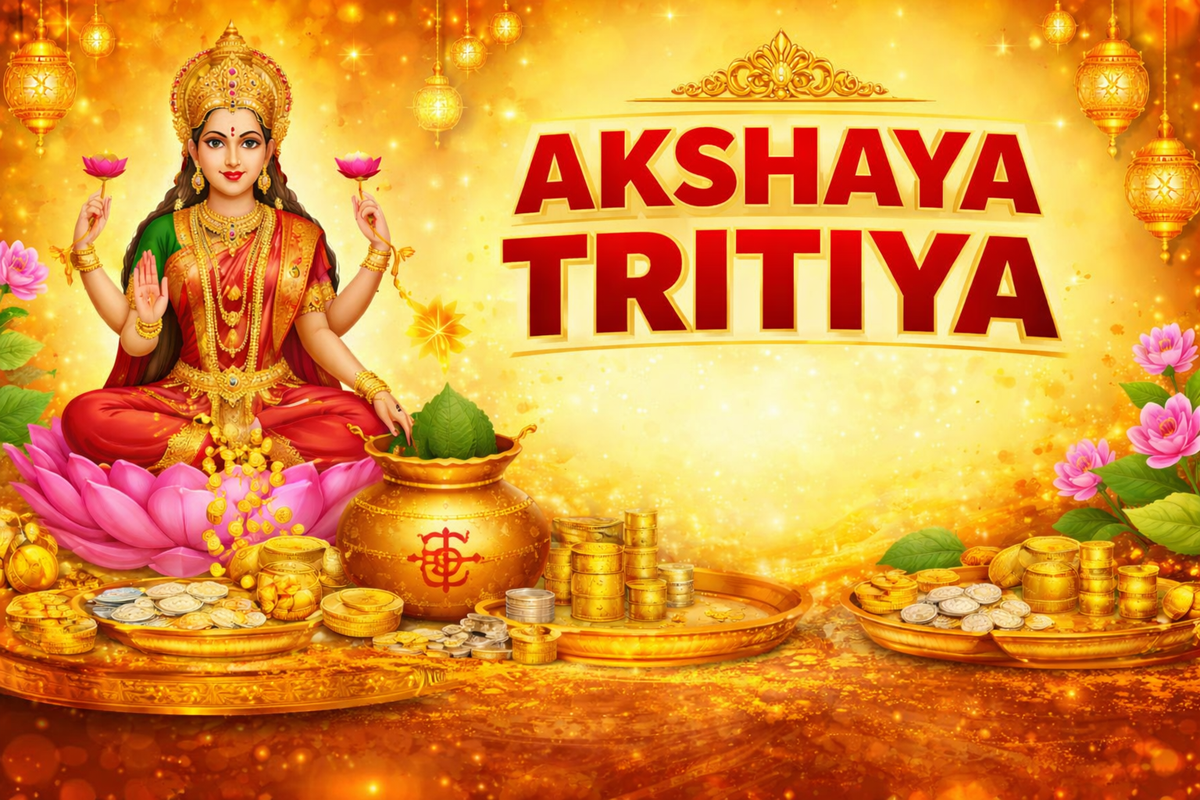
Gold and Silver Buying gold on Akshaya Tritiya is the most popular and time-honoured tradition in India. In Vedic tradition, gold is not merely a metal — it is a physical manifestation of Goddess Lakshmi herself. Gold purchased on this day is believed to never diminish in value or significance, and it carries the blessing of the day’s imperishable energy. Even a small gold coin or gold jewellery is considered highly auspicious.
Property and Real Estate Purchasing land, a home, or a commercial property on Akshaya Tritiya is believed to bring long-term prosperity, stability, and growth to the family. Many real estate developers and families specifically plan signings and registrations on this day.
Vehicles Buying a new vehicle on this day is considered a sign of growth and forward movement in life, blessed with safety and long-term utility.
Business Equipment and Assets Starting a business, purchasing machinery, setting up a shop, or signing a business agreement on Akshaya Tritiya is believed to give the venture a divinely supported foundation.
Household Items Copper, brass, and silver utensils purchased on this day are considered especially auspicious for the home. Many families buy new cooking vessels, water pots, or puja items.
Seeds and Agricultural Beginnings In rural India, many farmers begin their sowing season on Akshaya Tritiya, believing that seeds planted on this day will yield abundant harvests that never fall short.
What to Do on Akshaya Tritiya (Akshaya Tritiya Ko Kya Karna Chahiye)
Worship Lord Vishnu and Goddess Lakshmi The primary deities of this day are Lord Vishnu — the preserver — and Goddess Lakshmi — the goddess of wealth and abundance. Offering sincere prayers to them is the spiritual foundation of the day.
Observe Fasting (Vrat) Many devotees keep a full or partial fast on Akshaya Tritiya, especially in honour of Goddess Lakshmi. Fasting purifies the body and sharpens spiritual focus.
Give Charity (Daan) This is perhaps the single most spiritually powerful act you can perform on this day. Donate food to the hungry, clothes to the poor, money to a temple or charity, water to the thirsty. The scriptures are explicit: charity given on Akshaya Tritiya returns to the giver multiplied many times over, in this life and the next.
Chant Sacred Texts Reciting the Vishnu Sahasranama (the thousand names of Lord Vishnu), the Lakshmi Ashtakam, or the Shri Suktam is considered especially powerful on this day.
Start New Ventures If you have been postponing a new business, a new creative project, a new course of study, or any important new chapter in life — Akshaya Tritiya is the day to begin. The cosmic energy of this day supports new beginnings with particular strength.
Perform Pitra Tarpan Offering water and prayers to one’s ancestors (Pitra Tarpan) on Akshaya Tritiya is believed to bring enormous peace to the departed souls and in turn, blessings and protection to the family.
Begin Construction Work Starting the construction of a new home or building on this day is considered highly auspicious and is believed to ensure that the structure stands strong and prosperous for generations.
Visit a Temple Visiting a Vishnu temple or a Lakshmi temple on this day and participating in the special prayers and pujas performed there carries the blessings of a sacred environment.
What to Avoid on Akshaya Tritiya
While the day is fully auspicious, maintaining the purity of your actions, thoughts, and intentions is essential to fully receive its blessings.
- Avoid anger, arguments, and conflict — Negative emotions disturb the positive energy of the day and diminish the merit of your actions.
- Do not engage in dishonesty — Any act of deception, fraud, or unethical behaviour on this day is considered especially harmful and carries amplified negative karma.
- Avoid intoxication — Alcohol and non-vegetarian food are traditionally avoided by devotees on this day.
- Do not be miserly — The spirit of Akshaya Tritiya is abundance and generosity. Refusing to give, hoarding, or acting selfishly on this day is considered to push away the blessings.
- Avoid debt — If possible, do not take on new debts on this day. Settle existing ones if you can.
The Modern Significance of Akshaya Tritiya
While Akshaya Tritiya has ancient roots, its relevance in modern life has only grown stronger. Today, the day has significance that extends well beyond religious observance.
Financial markets in India consistently report their highest gold sales of the year on Akshaya Tritiya. Real estate registrations spike. New restaurant openings, startup launches, and business signings are deliberately timed to this day across the country.
But beyond commerce, many families use Akshaya Tritiya as a moment for intentional reflection — setting goals, expressing gratitude for the year’s blessings, making resolutions for growth, and consciously beginning the projects and relationships they want to flourish.
In this sense, Akshaya Tritiya functions as a deeply personal New Year — not of the calendar, but of intention and possibility. It is a reminder that every human being carries the potential for unending growth, and that aligned with the right cosmic moment, our small, sincere actions can set in motion effects that outlast us entirely.
Akshaya Tritiya and the Char Dham Yatra
A beautiful tradition associated with Akshaya Tritiya is the opening of the Char Dham pilgrimage circuit in Uttarakhand. The doors (Kapaat) of the four sacred shrines — Yamunotri, Gangotri, Kedarnath, and Badrinath — traditionally open in late April or early May, and in many years the opening of Yamunotri and Gangotri is timed to Akshaya Tritiya. Thousands of devotees begin their pilgrimage journeys on this day, believing that a Char Dham Yatra begun on Akshaya Tritiya carries particular divine merit and protection.
Conclusion: Begin Something That Will Never Stop Growing
Akshaya Tritiya is, at its heart, a declaration of faith in the future. It is the day when the entire cosmos aligns in favour of growth, generosity, and new beginnings — and invites every human being to step into that energy with courage and intention.
Whether you light a lamp and say a quiet prayer, visit a temple with your family, make a donation to someone who needs it, buy gold for your household, or take the first step toward a dream you have been carrying in your heart for months — do it on April 19, 2026, with the knowledge that the day itself is your greatest ally.
Because Akshaya Tritiya does not merely mark time passing. It marks something beginning — something that, if touched with sincerity and goodness, will never diminish.
May your Akshaya Tritiya 2026 bring you prosperity, peace, and a beginning that grows beyond everything you can imagine.