Anant Chaturdashi 2026 will be observed on Friday, September 25, 2026. The festival falls on the Chaturdashi Tithi of Shukla Paksha in the month of Bhadrapada and is dedicated to Lord Vishnu in his Anant form.
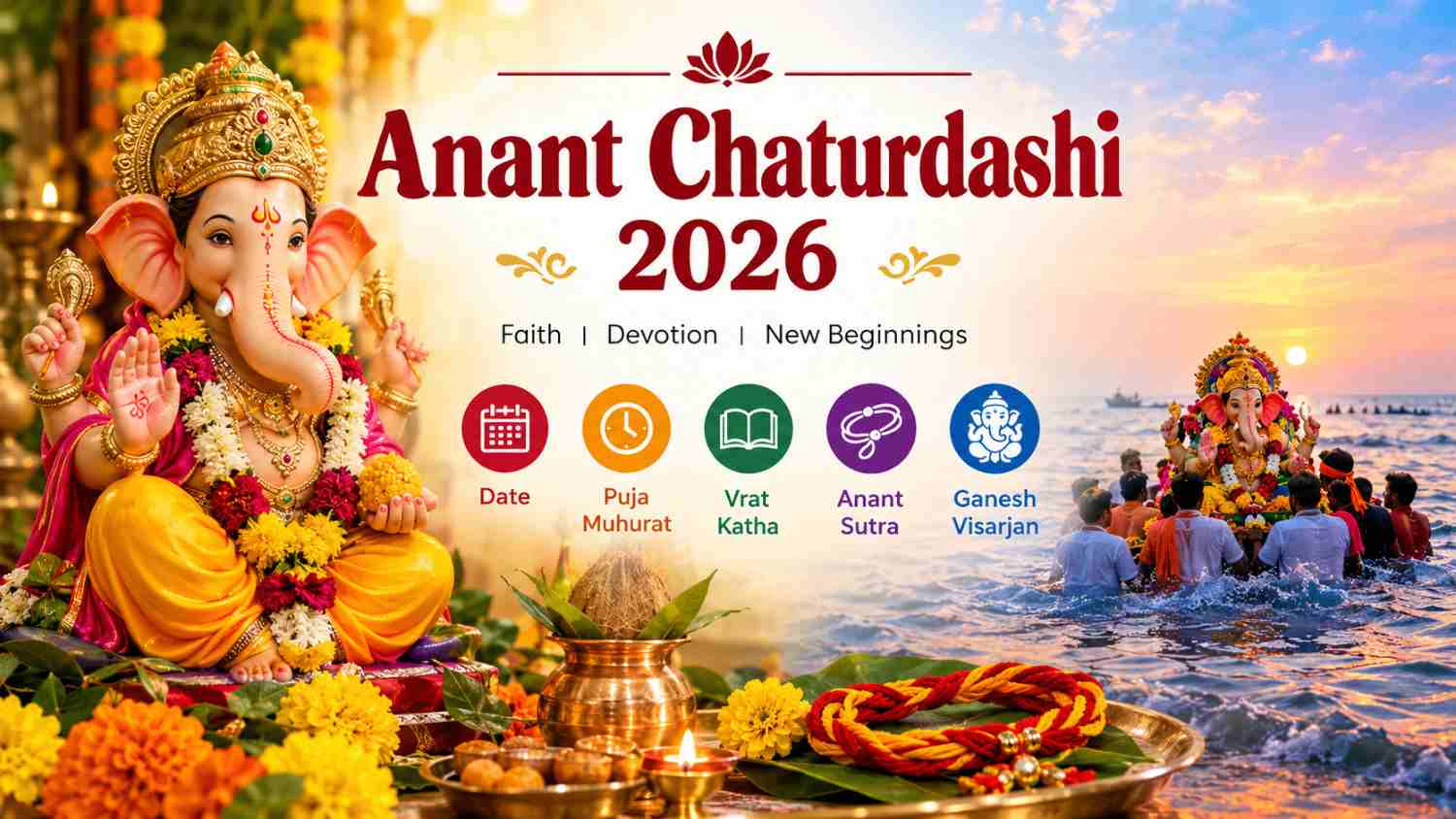
The day has another major significance across India because it marks the traditional conclusion of the 10-day Ganeshotsav, making September 25 the main day for Ganesh Visarjan 2026.
For devotees, Anant Chaturdashi is therefore associated with two important traditions: the worship of Lord Vishnu, the Anant Vrat and Anant Sutra, and the emotional farewell to Lord Ganesha after the Ganesh Chaturthi celebrations.
If you are searching for Anant Chaturdashi 2026 date, puja muhurat, vrat vidhi, vrat katha, Anant Sutra, Ganesh Visarjan date and time, puja samagri, fasting rules and significance, this guide covers the important details in one place.
Anant Chaturdashi 2026 Date
Anant Chaturdashi 2026 will be celebrated on Friday, September 25, 2026.
The Chaturdashi Tithi begins at approximately 11:18 PM on Thursday, September 24, and continues through Friday, September 25. Current Panchang-based calculations place the end of the Tithi at approximately 11:06–11:08 PM on September 25, with the small difference depending on the calculation/source.
Because Chaturdashi is prevailing at sunrise on September 25, the festival is observed on September 25, 2026.
Quick Details
| Festival Detail | 2026 Information |
|---|---|
| Anant Chaturdashi | Friday, September 25, 2026 |
| Hindu Month | Bhadrapada |
| Paksha | Shukla Paksha |
| Tithi | Chaturdashi |
| Tithi Begins | September 24, around 11:18 PM |
| Tithi Ends | September 25, around 11:06–11:08 PM |
| Main Ganesh Visarjan Day | September 25, 2026 |
| Main Deity | Lord Vishnu in Anant form |
| Sacred Thread | Anant Sutra |
| Traditional Knots | 14 |
The same date is also recognized as the principal Ganesh Visarjan 2026 day for the 10-day Ganeshotsav.
Anant Chaturdashi 2026 Puja Muhurat
The Anant Chaturdashi puja period from approximately 6:11 AM to 11:06 PM on September 25, 2026.
This represents the broader auspicious period associated with the day’s worship rather than one requirement that devotees must perform puja continuously throughout the entire period.
The exact sunrise, sunset and auspicious periods can vary slightly depending on the city. Therefore, people searching for Anant Chaturdashi puja muhurat near me should use a Panchang calculated for their own location.
Anant Chaturdashi 2026 Puja Timing
Date: Friday, September 25, 2026
Approximate puja period: 6:11 AM to 11:06 PM
Ganesh Visarjan 2026 Date and Muhurat
The main Ganesh Visarjan 2026 will be performed on:
Friday, September 25, 2026 — Anant Chaturdashi
This is traditionally the concluding day of the 10-day Ganeshotsav.
- Morning: 6:10 AM to 10:42 AM
- Afternoon: 12:12 PM to 1:43 PM
- Evening: 4:43 PM to 6:14 PM
- Night: 9:13 PM to 10:43 PM
What Is Anant Chaturdashi?
Anant Chaturdashi is observed on the fourteenth day of Shukla Paksha in the month of Bhadrapada.
The festival is dedicated to Lord Vishnu in his Anant form. The Sanskrit word Anant means infinite, endless or without limit.
Devotees observe the Anant Chaturdashi vrat and perform Vishnu Puja with the belief that the day represents faith, stability, devotion and divine protection.
One of the most recognizable traditions is the tying of the Anant Sutra, a sacred thread traditionally prepared with 14 knots.
The day also has a major connection with Lord Ganesha because the 10-day Ganeshotsav traditionally concludes with Ganesh Visarjan on Anant Chaturdashi.
Why Is Anant Chaturdashi Important?
Anant Chaturdashi has significance because it combines an important Vishnu worship tradition with the conclusion of one of India’s most popular festivals.
For Vishnu devotees, the day is associated with:
- Anant Vrat
- Lord Vishnu’s Anant form
- Anant Sutra
- Vrat Katha
- Vishnu Puja
- Prayer for family well-being and prosperity
For Ganesh devotees, the same day represents:
- Completion of the 10-day Ganeshotsav
- Final Ganesh Puja
- Uttar Puja
- Ganesh Visarjan
- Farewell to Lord Ganesha
These are related through the calendar but remain distinct religious traditions.
Anant Chaturdashi Vrat Katha
The Anant Chaturdashi Vrat Katha is traditionally associated with Sushila and Kaundinya.
The story explains the importance of faith in Lord Anant and the significance of the Anant Sutra. Different regional traditions preserve slightly different versions of the story, but the central narrative remains connected with Sushila, Kaundinya and their devotion to Lord Anant.
The Story of Sushila and Kaundinya
In ancient times, there lived a Brahmin named Sumant. He was a learned and religious person. His wife was named Diksha, and they had a daughter named Sushila.
Sushila was a devoted and virtuous girl. Unfortunately, her mother died when she was young.
After Diksha’s death, Sumant married another woman. According to the traditional story, his second wife was harsh in nature and did not treat Sushila with affection.
As Sushila grew older, she was married to a learned Brahmin named Kaundinya.
After their marriage, Sushila and Kaundinya left together to begin their married life.
Sushila Sees Women Performing Anant Vrat
While travelling, Sushila saw a group of women performing a special religious ceremony near the river.
Curious about the ritual, she approached them and respectfully asked what they were doing.
The women explained that they were worshipping Lord Anant, the infinite form of Lord Vishnu, on Anant Chaturdashi.
They explained the importance of the Anant Vrat and told Sushila that devotees worship Lord Anant with devotion and then tie a sacred thread known as the Anant Sutra.
The thread traditionally contains 14 knots.
Sushila listened carefully and became interested in observing the vrat herself.
Sushila Performs the Anant Vrat
Sushila followed the instructions given by the women.
She purified herself, participated in the worship of Lord Anant and prayed with devotion.
After completing the ritual, she received the sacred Anant Sutra and tied it around her arm.
She then continued her journey with her husband.
Kaundinya noticed the sacred thread on Sushila’s arm and asked her about it.
Sushila explained that she had observed the Anant Vrat and that the thread represented her devotion to Lord Anant.
Kaundinya Rejects the Anant Sutra
Kaundinya did not understand the religious significance of the thread.
According to the traditional कथा, he questioned whether such a thread could really have any spiritual power.
His pride led him to reject the importance of the Anant Sutra.
He removed the thread from Sushila’s arm and threw it away.
In some versions of the story, Kaundinya throws the thread into a fire.
Sushila was deeply saddened because she had received the thread with faith and devotion.
Difficulties Enter Their Life
After this incident, the story describes a dramatic change in their circumstances.
The prosperity and good fortune that they had enjoyed began to disappear.
Their wealth declined, and they experienced a series of difficulties.
Kaundinya eventually realized that something had gone wrong after he had rejected the Anant Sutra.
He remembered the sacred thread and Sushila’s devotion to Lord Anant.
He began to regret his actions.
Kaundinya Searches for Lord Anant
Kaundinya decided to search for Lord Anant and ask for forgiveness.
He went into the forest and began searching for divine guidance.
During his journey, he encountered various unusual sights and beings.
He asked them whether they knew where he could find Lord Anant, but he could not find the answer he was looking for.
Eventually, Kaundinya became exhausted and discouraged.
He realized that his pride and lack of faith had led him away from the path of devotion.
He sincerely prayed to Lord Anant and asked for forgiveness.
Lord Anant Appears Before Kaundinya
According to the traditional Katha, Lord Vishnu appeared before Kaundinya in his Anant form.
Kaundinya realized his mistake and humbly asked for forgiveness.
He understood that the Anant Sutra was not merely an ordinary thread. It represented devotion, faith and a sacred religious commitment.
Kaundinya promised to observe the Anant Vrat with sincerity.
Lord Anant blessed him and instructed him to follow the vrat with faith and devotion.
Kaundinya Returns Home
After receiving the blessings of Lord Anant, Kaundinya returned home.
He reunited with Sushila and accepted the importance of the Anant Vrat.
Together, they worshipped Lord Anant with devotion and observed the vrat according to tradition.
The story says that prosperity and happiness gradually returned to their household.
Kaundinya had learned an important lesson: faith should not be dismissed simply because its meaning is not immediately understood.
The story also emphasizes humility, repentance and the willingness to correct one’s mistakes.
What Is the Moral of Anant Vrat Katha?
The story of Sushila and Kaundinya carries several traditional lessons.
Faith
Sushila accepts the Anant Vrat with sincere devotion.
Humility
Kaundinya’s initial pride leads him to reject something he does not understand.
Repentance
When he realizes his mistake, he does not continue defending it. He accepts his error.
Devotion
The story emphasizes sincere worship rather than merely performing a ritual mechanically.
Respect for Tradition
The Anant Sutra is presented as a religious symbol of devotion rather than an ordinary piece of thread.
Anant Sutra: Meaning and Significance
The Anant Sutra is one of the central traditions of Anant Chaturdashi.
It is traditionally made using sacred thread and contains 14 knots.
The fourteen knots are commonly associated symbolically with the fourteen Lokas described in Hindu cosmology.
The thread is worshipped during the Anant Puja and then tied according to family or regional tradition.
Many devotees regard it as a symbol of their devotion to Lord Anant and their spiritual commitment.
The precise method of preparing and wearing the thread can differ between communities, so family tradition should be respected.
How to Perform Anant Chaturdashi Puja
A simple traditional Anant Chaturdashi Puja can be performed at home.
Step 1: Clean the Puja Area
Clean the house and prepare a dedicated place for worship.
Place a clean cloth on a wooden platform or chowki.
Step 2: Take a Bath
Take a bath in the morning and wear clean clothes.
Devotees observing the vrat may then take a sankalp.
Step 3: Place Lord Vishnu’s Image
Place an image or idol representing Lord Vishnu’s Anant form.
Step 4: Prepare the Anant Sutra
Place the 14-knot Anant Sutra near the deity.
Step 5: Light the Diya
Light a diya and incense before beginning the main worship.
Step 6: Offer Puja Items
Offer flowers, fruits, sandalwood, akshat and other traditional items.
Tulsi may be offered according to the Vishnu worship tradition followed by the family.
Step 7: Chant Vishnu Mantra
A commonly recited mantra is:
Om Namo Bhagavate Vasudevaya
Devotees may also recite prayers dedicated to Lord Anant.
Step 8: Read Anant Vrat Katha
Read or listen to the complete Sushila-Kaundinya Anant Vrat Katha.
Step 9: Tie the Anant Sutra
After the puja, devotees traditionally tie the Anant Sutra according to their family tradition.
Step 10: Perform Aarti
Complete the worship with aarti and prayer.
Anant Chaturdashi Puja Samagri
Before starting the puja, prepare the basic items.
Anant Chaturdashi Puja Samagri List
- Lord Vishnu idol or picture
- Anant Sutra
- Flowers
- Tulsi leaves according to tradition
- Fruits
- Panchamrit
- Sandalwood
- Kumkum
- Akshat
- Incense sticks
- Diya
- Ghee or oil
- Cotton wick
- Kalash
- Clean cloth
- Prasad
- Water
- Puja thali
- Aarti items
The exact samagri can vary according to regional and family traditions.
Anant Chaturdashi Vrat Vidhi
Devotees observing the Anant Chaturdashi vrat generally begin the day with a bath and a sankalp.
The fasting method varies between families.
Some devotees observe a strict fast, while others follow a phalahar routine or eat one permitted meal.
Common fasting foods may include:
- Fruits
- Milk
- Curd
- Coconut
- Makhana
- Sabudana preparations
- Nuts
- Other foods permitted by the family’s fasting tradition
People with medical or dietary restrictions should not force themselves to follow a strict fast. Religious observance can be followed according to one’s circumstances and family tradition.
Anant Chaturdashi Vrat: Do’s and Don’ts
Do’s
- Take a bath before puja.
- Keep the puja area clean.
- Worship Lord Vishnu with devotion.
- Read or listen to the Anant Vrat Katha.
- Respect the Anant Sutra.
- Follow your family’s fasting tradition.
- Perform aarti after the puja.
- Keep the day peaceful and devotional.
Don’ts
- Do not treat the Anant Sutra as an ordinary decorative thread.
- Avoid unnecessary arguments during the vrat.
- Do not force a strict fast if it is unsuitable for your health.
- Avoid wasting food during the festival.
- Follow local safety rules during Ganesh Visarjan.
- Do not enter unsafe water bodies for idol immersion.
Final Ganesh Puja Before Visarjan
Before taking Lord Ganesha for immersion, devotees traditionally perform Uttar Puja, or the final worship.
The final puja can include:
- Cleaning the worship area.
- Offering flowers.
- Offering Durva grass.
- Offering modak or laddoo.
- Offering fruits.
- Lighting a diya.
- Performing Ganesh Aarti.
- Asking Bappa for forgiveness.
- Thanking Lord Ganesha for visiting the home or pandal.
- Taking the idol respectfully for immersion.
The farewell is generally accompanied by devotional chants such as:
“Ganpati Bappa Morya!”
Many devotees also pray:
“Pudhchya Varshi Lavkar Ya.”
meaning, Come back soon next year.
Why Is Ganesh Visarjan Done?
Ganesh Visarjan represents the conclusion of the period of worship.
The temporary idol is returned to water as part of the traditional ritual of immersion.
At a symbolic level, the ritual is often associated with the cycle of creation, existence and dissolution.
The farewell does not represent the end of devotion to Lord Ganesha. Instead, devotees express gratitude and hope to welcome Bappa again.
The final immersion therefore combines celebration, devotion and an emotional farewell.
Ganesh Visarjan and Anant Chaturdashi: Are They the Same?
They are closely connected but are not exactly the same religious observance.
Anant Chaturdashi is a Hindu festival dedicated to Lord Vishnu’s Anant form and is associated with the Anant Vrat.
Ganesh Visarjan is the immersion of Lord Ganesha’s idol following the Ganeshotsav.
The two occur on the same major festival day in 2026, which is why people often use the terms together.
Environmental Tips for Ganesh Visarjan
Ganesh Visarjan can be celebrated traditionally while also taking care of the environment.
Prefer Natural Clay Idols
When possible, choose idols made from natural clay and traditional materials.
Use Designated Immersion Points
Follow the immersion arrangements made by local authorities.
Avoid Plastic Decorations
Remove plastic and other non-biodegradable materials before immersion.
Do Not Enter Dangerous Water
Devotees should never take unnecessary risks in deep, fast-moving or crowded water bodies.
Consider Home Immersion
For suitable small natural-clay idols, families may follow local guidelines for home immersion.
Public immersion should always follow local rules and safety instructions.
Anant Chaturdashi 2026: City-Specific Timing Matters
Festival timings should not be copied blindly from another city.
For example, the current Delhi-NCR Ganesh Visarjan timings include morning, afternoon, evening and night Choghadiya windows. However, the same periods will not necessarily occur at exactly the same time in Mumbai, Lucknow, Kanpur, Jaipur or other cities.
Therefore, if you are preparing for Ganesh Visarjan 2026 in your city, verify the local Panchang.
The main date remains:
Friday, September 25, 2026.
The exact Choghadiya should be checked according to the location where the immersion will take place.
Anant Chaturdashi 2026 FAQs
When is Anant Chaturdashi in 2026?
Anant Chaturdashi will be observed on Friday, September 25, 2026.
When is Ganesh Visarjan in 2026?
The main 10-day Ganesh Visarjan will take place on Friday, September 25, 2026, on Anant Chaturdashi.
When does Anant Chaturdashi Tithi begin?
The Chaturdashi Tithi begins at approximately 11:18 PM on September 24, 2026.
When does Chaturdashi Tithi end?
The current calculations place the end at approximately 11:06–11:08 PM on September 25, with a small variation between published Panchang calculations.
What is Anant Sutra?
Anant Sutra is a sacred thread associated with Anant Chaturdashi. It traditionally contains 14 knots and is worshipped before being worn.
Who is worshipped on Anant Chaturdashi?
Lord Vishnu is worshipped in his Anant form.
What is the Anant Chaturdashi Vrat Katha?
The traditional vrat katha tells the story of Sushila and Kaundinya and explains the importance of faith in Lord Anant and the Anant Sutra.
Why is Ganesh Visarjan performed on Anant Chaturdashi?
Anant Chaturdashi traditionally marks the conclusion of the 10-day Ganeshotsav, making it the major day for Ganesh Visarjan.
How many knots are there in Anant Sutra?
The traditional Anant Sutra contains 14 knots.
What mantra can be chanted on Anant Chaturdashi?
Devotees commonly chant:
“Om Namo Bhagavate Vasudevaya.”
A prayer dedicated to Lord Anant may also be recited according to family tradition.
Can Anant Chaturdashi and Ganesh Visarjan happen on the same day?
Yes. In 2026, both are observed on Friday, September 25.
Is Anant Chaturdashi a fasting day?
Many devotees observe an Anant Chaturdashi vrat. The exact fasting method differs according to family, regional and personal tradition.
Conclusion
Anant Chaturdashi 2026 will be observed on Friday, September 25, 2026. The day is important both for devotees of Lord Vishnu and for devotees concluding the 10-day Ganeshotsav.
For those observing the Anant Vrat, the festival is associated with Lord Vishnu’s Anant form, the 14-knot Anant Sutra, Vishnu Puja and the traditional Sushila-Kaundinya Vrat Katha.
For Ganesh devotees, the same day marks Ganesh Visarjan, when Lord Ganesha is respectfully bid farewell after days of worship, aarti and celebration.
The Chaturdashi Tithi begins around 11:18 PM on September 24 and ends around 11:06–11:08 PM on September 25, depending on the Panchang calculation. The broader Anant Chaturdashi puja period and Ganesh Visarjan Choghadiya should be checked according to the devotee’s city.
The deeper message of Anant Chaturdashi is one of faith, humility, gratitude and continuity. The story of Sushila and Kaundinya reminds devotees about the value of sincere devotion, while Ganesh Visarjan reminds us that every arrival is eventually followed by a farewell.
As devotees bid farewell to Bappa:
Ganpati Bappa Morya!
Pudhchya Varshi Lavkar Ya!